Castle Pines Car Accident: What High-Income Suburban Claims Require That Other Cases Don’t
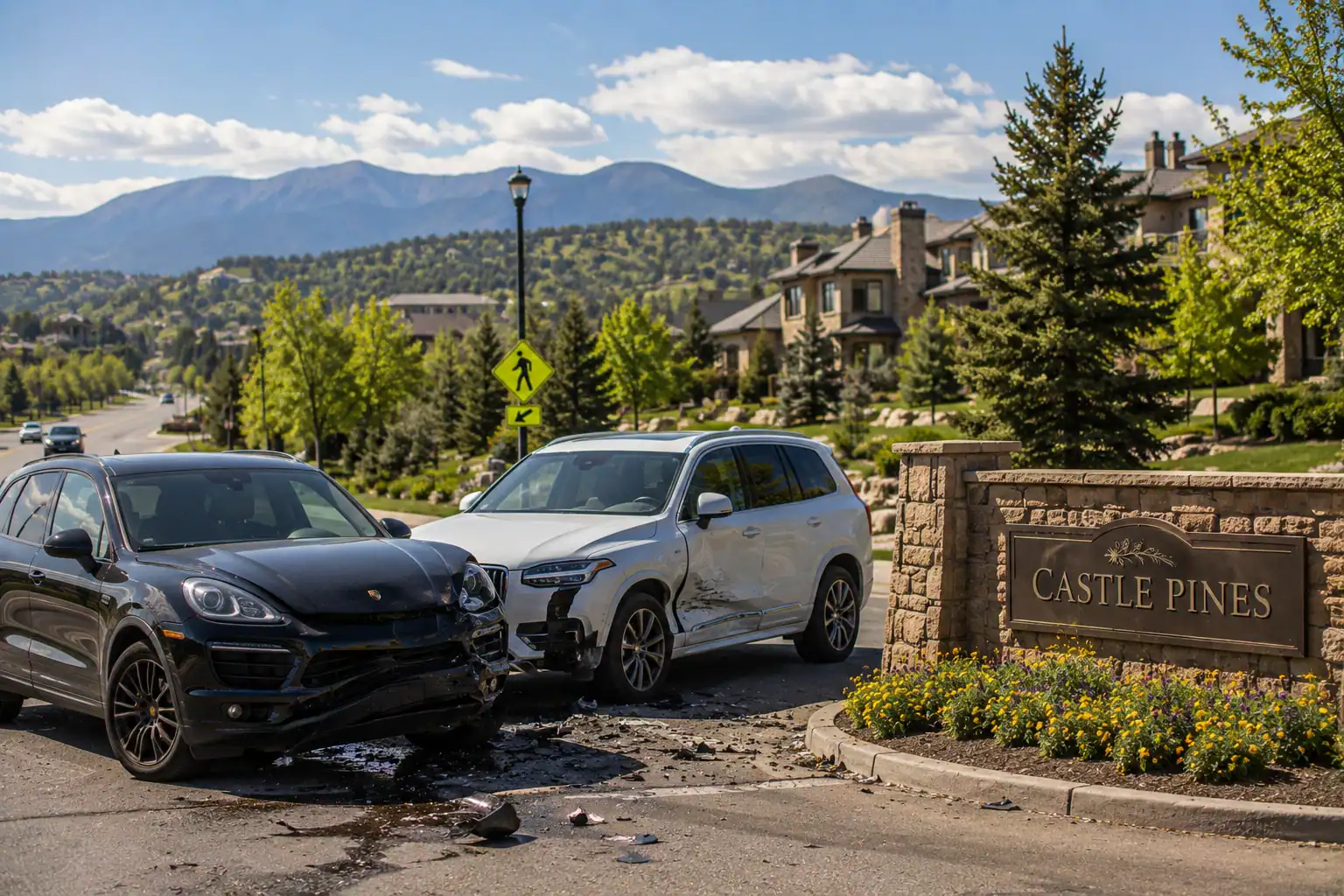
Castle Pines is a small suburb with an outsized financial profile. The drivers who live in Castle Pines, Castle Pines Village, and the surrounding Douglas County developments along the I-25 corridor between Denver and Colorado Springs carry better-than-average insurance, drive vehicles worth more than the regional median, and have professional careers where lost income from a serious accident can run into six figures within months. They are also, in our experience, drivers whose claims insurance carriers underestimate at the start, hoping to close files at a discount before the claimant pushes back with the resources high-income households actually have.
This article is the practical guide for the Castle Pines resident who has just been in a crash and wants to understand what makes their claim different from a typical Front Range case. The fundamentals of Colorado car accident law apply the same in Castle Pines as anywhere else. The strategy of how the claim is built, presented, and resolved is where the differences matter.
If you have been hurt in a Castle Pines accident, call us at 720-928-9178. The conversation is free, there is no obligation, and there is no fee unless we win your case.
Where Castle Pines Crashes Happen Most
The Castle Pines crashes we handle cluster in a few corridors.
The I-25 corridor through Castle Pines and the connection points at Castle Pines Parkway, Happy Canyon Road, and the Castle Rock-side approach all generate consistent crashes, particularly during commute hours and weekend mountain-traffic periods. Highway-speed crashes on this corridor produce the most serious injury cases we see in the area.
The Castle Pines Parkway corridor connecting I-25 to the residential developments produces crashes involving drivers transitioning from interstate speeds to local speeds, drivers unfamiliar with the area accessing the residential and commercial properties, and intersection crashes at the major access points.
The Daniels Park Road and the surface streets through Castle Pines Village produce a different pattern, including crashes involving wildlife (the deer population in the area is substantial), single-vehicle crashes on the curving road network, and crashes in the area around the Castle Pines Golf Club.
The retail and commercial node at Castle Pines Village center, with grocery, dining, and services, generates the parking lot and slow-speed crashes typical of any retail center.
What Makes High-Income Suburban Claims Different
The differences are not about the legal framework. The same Colorado statutes, the same comparative negligence rule, the same insurance regulations apply. The differences are about how the claim is built and what the carrier expects.
Lost wages and lost earning capacity are typically larger and more complex. Castle Pines residents include many high-earning professionals, business owners, and executives. The lost income picture includes base salary, bonuses, deferred compensation, equity vesting, partner draws, and other forms of non-base compensation that average wage calculations miss. Forensic accountants and economists are often needed to present the income picture credibly.
Medical care is typically higher quality and better documented. Castle Pines residents have access to and use top-tier medical care, including specialty consultations, advanced imaging, and aggressive treatment protocols. The medical record is often strong, but carriers sometimes argue the treatment was excessive. Defending the necessity of care requires expert support and treating physician credibility.
The pain and suffering analysis often warrants substantial development. Pain and suffering damages reflect the impact of the injury on daily life. For a high-functioning professional who can no longer engage in the activities that defined their daily life, this category can be substantial. Documenting it requires careful work, including detailed treating physician opinions, vocational expert input, and specific narrative development.
Insurance coverage is typically deeper. Castle Pines households more often carry meaningful liability limits, robust UM/UIM, and umbrella policies. The coverage picture on the at-fault driver’s side often also includes umbrellas. The discovery of all available coverage is essential, and the stacking analysis under Colorado law often produces substantially more available coverage than initial assumptions suggest.
Vehicle and property damage values are higher. Replacement costs for the vehicles common in Castle Pines, including European luxury vehicles and high-end SUVs, are substantial. Diminished value claims on damaged-but-repaired vehicles are also typically larger.
What Carriers Do Differently in High-Income Cases
Insurance carriers handle high-income suburban claims with specific strategies that differ from how they handle average-income claims.
They make early settlement offers more aggressively. The goal is to close the file before the claimant engages experienced counsel and before the lost income picture becomes clear.
They challenge medical necessity more systematically. The carrier expects strong medical care in these cases and prepares to argue that some of it was excessive.
They limit lost income to base wages. Bonus, equity, and other compensation are often resisted unless the claimant’s representation pushes back with proper documentation.
They retain higher-credentialed defense experts. The defense bench in high-stakes cases includes more sophisticated medical experts, vocational experts, and economists.
They prepare for trial earlier. In serious high-income cases, defense counsel is often retained early and the case is positioned for litigation from the start.
These tactics are not inherently bad faith. They are the standard practices of competent defense work. They mean that high-income suburban claimants who do not engage equally competent representation tend to recover materially less than those who do.
How to Build a Strong Castle Pines Claim
The work that produces strong outcomes in Castle Pines cases begins early and extends through every phase.
Engage counsel quickly. The decisions made in the first weeks shape the case.
Document everything from day one. Photographs, witness contacts, the police report, the medical visit notes, the work missed, the activities you can no longer do. This documentation, gathered in real time, is far stronger than reconstruction after the fact.
Follow a thorough treatment plan. Treatment continuity is one of the most important factors in claim credibility. We have written extensively about this in our recent piece on how post-accident medical treatment decisions make or break your claim.
Document the lost income picture comprehensively. Pay stubs, W-2s, K-1s, bonus letters, equity grant agreements, deferred compensation schedules, and any other documentation of compensation. The fuller the documentation, the stronger the lost income claim.
Document the impact on daily life. The activities, the family time, the travel, the recreation, the work, all of it matters and all of it is recoverable in the form of pain and suffering and loss of enjoyment damages.
Consider expert support. In serious cases, life care planners, vocational experts, economists, and treating physician opinion letters all contribute substantially to the value of the claim.
Stay off social media. The same principles that apply to all serious claims apply here. We have written about this throughout our resources, including in our complete guide to car accident claims in Colorado.
What These Cases Are Worth
The value of a serious Castle Pines claim depends on the same factors that drive any Colorado car accident claim, including the severity and permanence of the injury, the strength of liability, the carrier you are dealing with, and the quality of representation. For high-income claimants, the lost income and lost earning capacity components often become the largest single line items in the claim.
We discuss the broader framework in our Colorado car accident settlement guide. The realistic timeline for serious cases runs eighteen months to three years for litigated matters and six to eighteen months for cases that resolve in pre-suit negotiation.
Frequently Asked Questions
Are Castle Pines accident claims handled differently than other Colorado claims?
The legal framework is the same. The strategic and presentation work, particularly around lost income and damages calculation, is often more involved than in average-income claims.
How are bonuses and equity treated in lost wage calculations?
Properly documented bonuses, deferred compensation, equity vesting, and other forms of non-base compensation are all part of the lost income calculation. Forensic accountants and economists are often used to present the picture credibly.
What if I cannot return to my high-paying profession after the accident?
Lost earning capacity covers the difference between what you could have earned and what you can now earn. Vocational experts evaluate the impact of the injury on your specific profession and any retraining alternatives. The numbers in cases involving significant earning capacity loss can be very large.
Should I accept the first offer in a Castle Pines case?
Almost never. The first offer is often substantially below the actual value, particularly because the carrier is testing whether the claimant will push back.
What insurance coverages should I check in a Castle Pines crash?
The at-fault driver’s primary, any umbrella, any commercial coverage if applicable. Your own UM/UIM, MedPay, and any umbrella that may include UM/UIM. Stacking analysis across household policies. We dig into the coverage analysis in our complete guide to Colorado auto insurance.
How long do I have to file a Castle Pines accident claim?
Three years from the date of the accident under CRS 13-80-101. If a government entity is involved, the 182-day notice deadline applies.
What if I am a Castle Pines resident hit while traveling outside Colorado?
Colorado residents hurt outside the state generally have a claim in the state where the accident occurred, governed by that state’s law. The choice of forum and the applicable law require careful analysis. Your own UM/UIM coverage often applies regardless of where the accident occurred.
Sources
Colorado Revised Statutes 13-21-102.5: Limitations on Damages for Noneconomic Loss or Injury, leg.colorado.gov
Colorado Revised Statutes 13-21-111: Comparative Negligence, leg.colorado.gov
Colorado Revised Statutes 13-80-101: Three-Year Limitation for Motor Vehicle Tort Actions, leg.colorado.gov
Colorado Revised Statutes 10-4-609: Uninsured Motorist Coverage, leg.colorado.gov
Colorado Revised Statutes 10-3-1115 and 10-3-1116: Bad Faith Insurance Remedies, leg.colorado.gov
Colorado Department of Transportation, I-25 Corridor and Crash Data, codot.gov
Douglas County, Colorado, Public Safety Resources, douglas.co.us
If you have been hurt in Castle Pines, please call us before signing anything from an insurance carrier. The conversation is free and there is no obligation. We will tell you honestly what we see and what we recommend. Reach Samantha Flanagan and the Flanagan Law team at 720-928-9178. We are a Colorado boutique firm. We answer our own phones. And we do not get paid unless we win your case.