
The Founding-Era Roots of American Personal Injury Law: How 250 Years of Common Law Built Today’s Colorado Rules
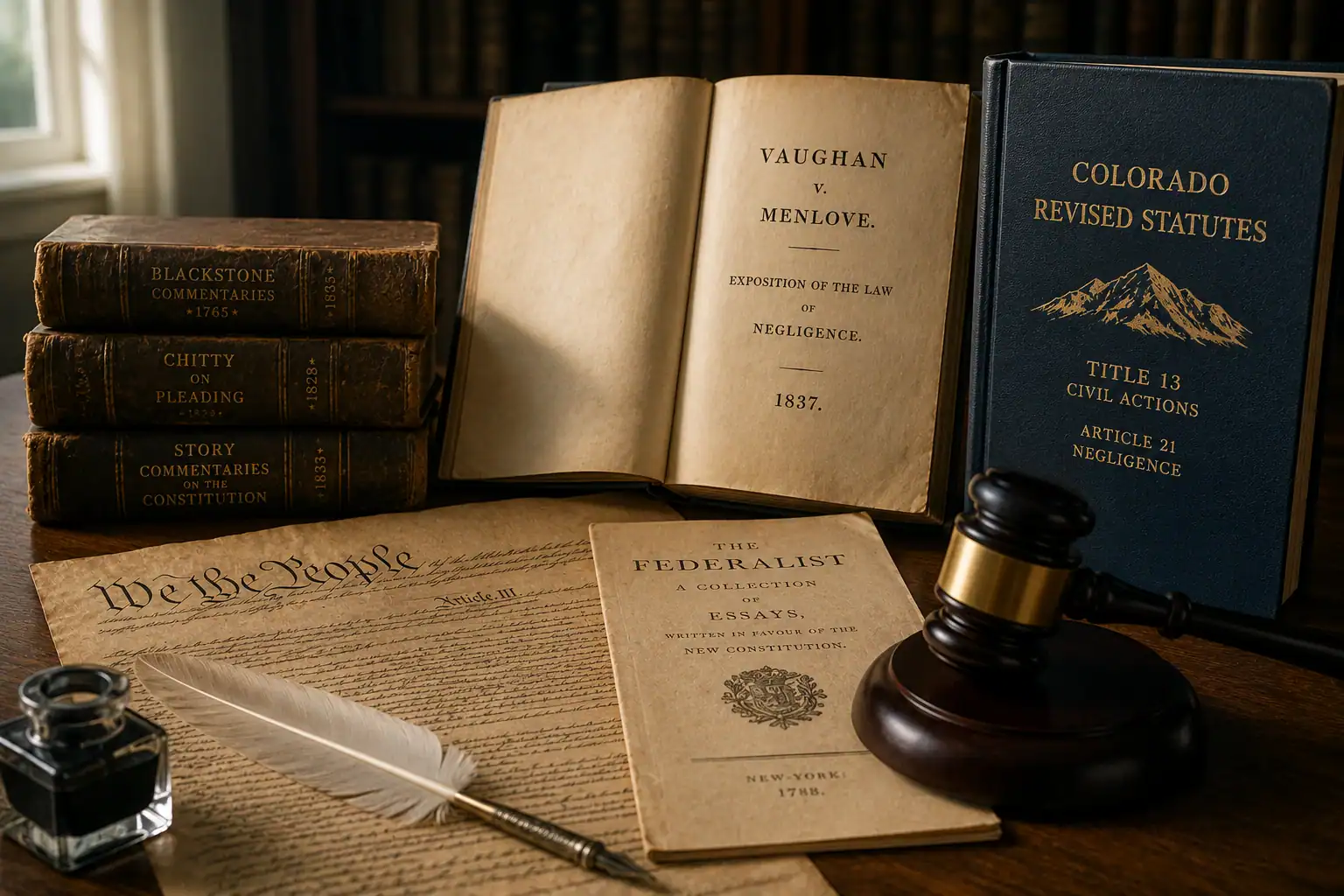
The year of the country’s two hundred and fiftieth birthday is a good year to think about how the legal rules we use every day actually got here. The framework that lets a Colorado driver hurt on I-70 sue the at-fault driver, recover medical expenses and lost wages, prove fault under specific statutory and common-law rules, and have the case decided by a jury of peers, is not a framework that simply existed. It was built. Slowly, over two and a half centuries, by judges, legislators, and lawyers who took the inherited English system and refined it into something distinctly American.
This article is the second in our occasional series for the country’s semiquincentennial. The first piece looked at how American roads went from wagon trails to I-70. This one looks at how American personal injury law itself evolved over the same period. If you are reading because you have a claim, the rules are the rules and the deadlines are real. The phone is 720-928-9178 and the conversation is free.
What We Inherited in 1776
When the United States declared independence, the colonies inherited the English common-law system of tort. The system was already centuries old, having developed through medieval and early modern English courts in response to the kinds of disputes that came before them. Trespass actions for direct physical injury. Case actions for indirect injury through negligence. Assumpsit for breach of agreement.
The rules were rough. The categories were narrow. Recovery was often limited to gross or deliberate wrongs. The American colonies adopted this framework wholesale and applied it for the first several decades of independence.
The framework was adequate for the kinds of disputes it had been designed to handle. Two travelers colliding on a road. A herd of livestock damaging a neighbor’s crop. A workman injured by another workman’s carelessness on a job site. The frequency of these disputes was low enough, and the severity of the resulting harm modest enough, that the rough common-law rules produced acceptable outcomes most of the time.
This stopped being true in the early nineteenth century.
The Industrial Revolution Changed the Math
The arrival of industrial machinery, the railroad, and steam-powered transportation produced injuries on a scale the common law had never encountered. Boiler explosions killed dozens at a time. Train collisions killed entire passenger lists. Industrial workplace injuries were endemic in factories operating under conditions that would horrify modern observers.
The old common-law rules broke down under the volume and severity of these new injuries. The strict requirements of trespass and case actions failed to capture the realities of how harm now occurred. American courts began the long process of building a more flexible, more capable system.
The development took most of the nineteenth century. The doctrines we still use today, all came out of this period of judicial work.
Negligence as a Distinct Cause of Action
The most important development of the nineteenth century was the recognition of negligence as a distinct cause of action, separate from the older trespass and case frameworks. The reasonable person standard, the idea that conduct should be judged by what a reasonable person in similar circumstances would have done, emerged in this period and became the dominant standard for evaluating fault.
Colorado’s modified comparative negligence rule under CRS 13-21-111 is a direct descendant of this development. The reasonable person standard is the underlying basis for assigning percentages of fault among parties to a collision. Without the nineteenth-century work, the rule could not exist.
The Comparative Fault Evolution
The original common-law rule was contributory negligence, which barred recovery entirely if the plaintiff bore any fault for the injury, however small. The rule was harsh and produced outcomes that struck many people as unjust. A pedestrian who stepped slightly off a curb and was struck by a speeding driver could recover nothing.
The reform began with comparative fault. Several states moved to pure comparative fault, which allowed recovery in proportion to fault regardless of the percentage assigned to the plaintiff. Other states, including Colorado, moved to modified comparative fault, which allows recovery only if the plaintiff is less than fifty percent at fault.
The Colorado approach reflects a legislative choice about where to draw the line. The fifty percent threshold balances the harshness of the old contributory negligence rule against the perceived unfairness of allowing recovery to plaintiffs who were primarily responsible for their own injuries.
The Statute of Limitations Framework
The idea that legal claims should have deadlines is ancient. The specific application of statutes of limitations to personal injury claims developed substantially in the nineteenth century, with most American states adopting deadlines that ranged from one to six years depending on the type of claim.
Colorado’s three-year deadline for motor vehicle tort claims under CRS 13-80-101 reflects a deliberate choice to provide a longer window than the two-year deadline that applies to other personal injury claims. The choice acknowledges that motor vehicle claims often involve longer medical recovery and more complex insurance dynamics than other tort claims.
The Eggshell Plaintiff Rule
The rule that the defendant takes the plaintiff as they find them, meaning that a defendant is responsible for the full extent of harm caused even if the plaintiff was unusually vulnerable to harm, developed in American case law during the nineteenth century. The rule reflects a moral judgment that harms are still harms even when the victim was already fragile.
Colorado applies the eggshell plaintiff rule today. It is one of the most important practical rules in any case involving a plaintiff with pre-existing conditions, and we address it regularly in our practice.
Joint and Several Liability and Its Reform
The original common-law rule on multiple defendants was joint and several liability, which allowed a plaintiff to recover the full amount of damages from any defendant who bore some responsibility, with the defendants then sorting out among themselves who actually owed what.
Colorado has substantially modified this rule. Under current Colorado law, defendants are generally liable only for their percentage of fault, with several exceptions. The reform reflects a legislative judgment that allowing full recovery from peripheral defendants produced unfair outcomes.
The Insurance Era
The most fundamental change to American personal injury practice came with the development of liability insurance. The introduction and widespread adoption of auto insurance in the twentieth century changed every aspect of how tort claims actually function in practice. Recovery shifted from chasing personal assets to claiming against insurance policies. The financial accessibility of representation became dramatically broader.
Colorado’s modern auto insurance framework, including the UM/UIM coverage requirements, the bad faith statutes, and the regulatory structure, all reflect a century of refinement of the insurance system.
Civil Justice and the Modern Court
The civil justice system we work in today is the product of all of these developments. The right to a jury trial, the rules of evidence, the procedures for discovery, the appellate review framework, all are the inheritance of two hundred and fifty years of American legal development.
This is not a small thing. The system is imperfect, and the work of representing injured people requires navigating its imperfections daily. But the system that exists in 2026, with all of its limitations, is dramatically more accessible and more just than the system that existed in 1776, in 1826, or even in 1926.
What This Means for Today’s Colorado Accident Victims
A driver hurt today on a Colorado highway exercises rights that trace back through every layer of this development. The right to sue. The right to a jury. The right to a defined deadline that protects against stale claims while preserving access to justice. The right to a fault analysis under a rule designed by Colorado’s legislature. The right to recover from insurance carriers that fail to act in good faith. All of these are products of work done by people we never met.
The work continues. Colorado law evolves through legislative session every year, through appellate decisions, and through the daily work of trial lawyers who shape the law one case at a time. The 2026 framework will be different from the 2056 framework. The injured driver of 2026 is benefiting from the work of generations that came before, and contributing to the work that will benefit generations that follow.
Frequently Asked Questions
How has Colorado personal injury law changed over time?
Substantially. The modern framework reflects nineteenth-century developments in negligence law, twentieth-century developments in insurance, and ongoing legislative refinement specific to Colorado.
Is the right to sue for personal injury constitutional?
The right to a civil jury trial is protected under the Seventh Amendment to the United States Constitution and under Colorado’s own constitution. The right to bring a tort claim is a fundamental part of the American civil justice system.
Why do statutes of limitations exist?
They balance the interest in allowing access to justice against the interest in providing finality and protecting defendants against stale claims where evidence has been lost.
What is the modern justification for comparative fault?
The modern view is that fault rarely lies entirely with one party, and the legal system should reflect that reality by apportioning responsibility rather than treating fault as an all-or-nothing question.
How does the eggshell plaintiff rule actually work?
The defendant is responsible for the full extent of harm caused, even when the plaintiff was unusually vulnerable. A driver who rear-ends a person with a pre-existing spinal condition is responsible for the full worsening of that condition, even if the same impact would have caused only minor injury to a typical plaintiff.
Sources
Colorado Revised Statutes 13-21-111: Comparative Negligence, leg.colorado.gov
Colorado Revised Statutes 13-21-102.5: Limitations on Damages for Noneconomic Loss or Injury, leg.colorado.gov
Colorado Revised Statutes 13-80-101: Three-Year Limitation for Motor Vehicle Tort Actions, leg.colorado.gov
Colorado Revised Statutes 13-21-111.5: Pro Rata Liability of Defendants, leg.colorado.gov
The Constitution of the United States, Seventh Amendment, archives.gov
If you are reading this because you have a recent claim, please call us. Two hundred and fifty years of legal development built the rights you can now exercise, but the rights have deadlines, and waiting damages cases. Reach Samantha Flanagan and the Flanagan Law team at 720-928-9178. We are a Colorado boutique firm. We answer our own phones. And we do not get paid unless we win your case.