Tire Failure Crashes on Colorado Interstates: Why August Is the Worst Month and Who Is Responsible
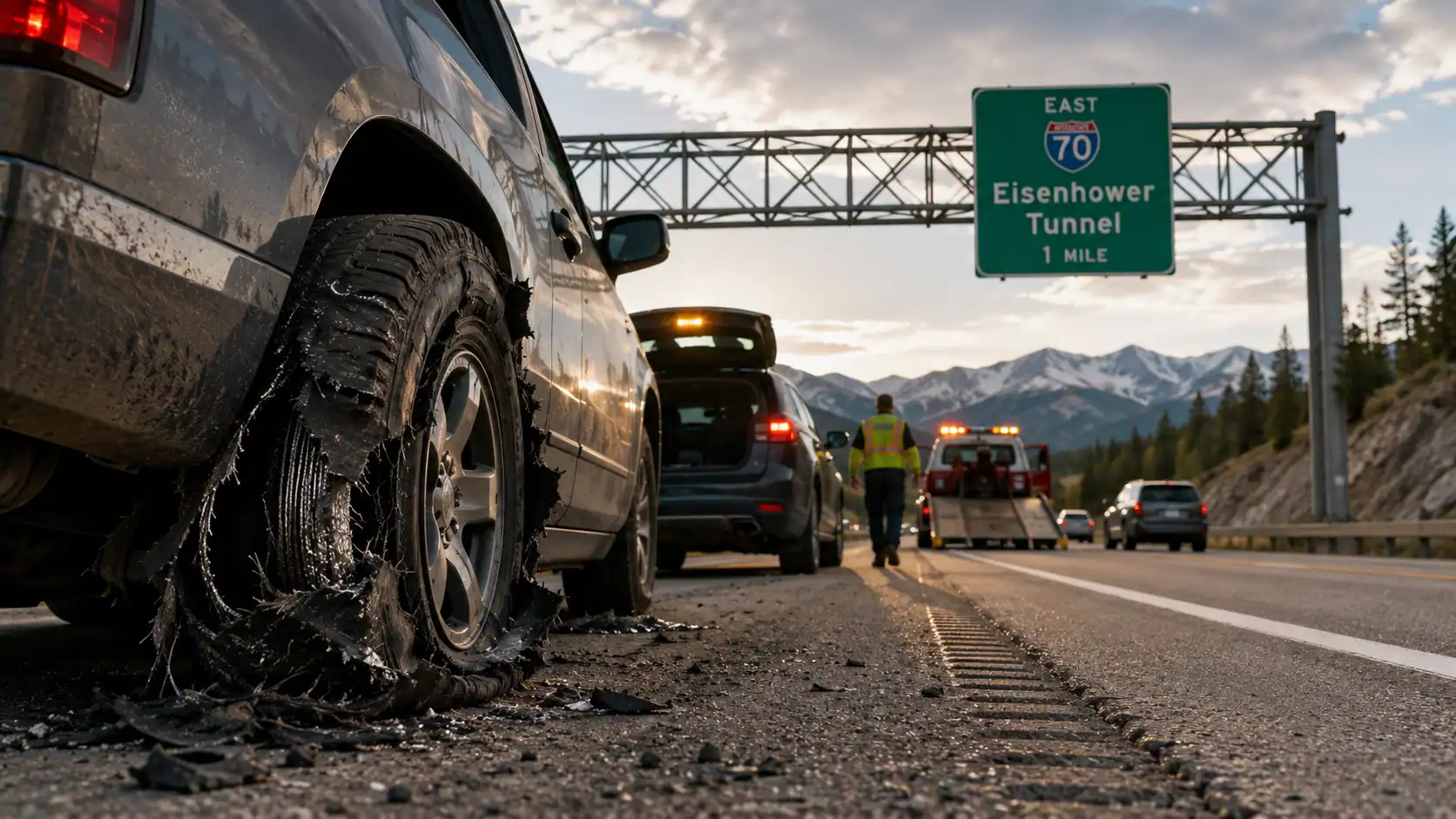
Tire failures cluster in the hottest weeks of the year, and in Colorado that means late July through August. The reason is not mysterious. Heat is what turns a tire that was quietly deteriorating into a tire that comes apart at 75 miles per hour.
The result is a crash type that looks like an accident in the truest sense, an unavoidable mechanical event nobody could have prevented. Colorado law takes a considerably harder line than that.
What August Actually Does to a Tire
Four forces stack on top of each other during a Colorado summer, and each one alone is survivable.
Pavement temperature. Asphalt on an exposed interstate runs far hotter than the air temperature. A 95 degree afternoon on I-25 produces a road surface that is substantially hotter, and the tire absorbs that continuously.
Underinflation. An underinflated tire flexes more through the sidewall, and flexing generates heat internally. This is the most common contributing factor in blowouts and the easiest one to eliminate. Colorado drivers are conditioned to check pressure in November, not in August.
Age and tread depth. Rubber degrades over time regardless of mileage, and Colorado’s elevation, dry air, and intense UV exposure accelerate that. Colorado law sets a minimum legal tread depth, but the legal minimum is a floor, not a safety recommendation, and tires that are legal can still be dangerously worn on a hot grade.
Load and grade. August is when vehicles are loaded heaviest. Camping gear, roof boxes, trailers, four passengers instead of one. Add a sustained climb toward the Eisenhower Tunnel, and a marginal tire is being asked to do the hardest work of its life on the hottest day of its life.
Any one of these is usually fine. All four together on the same afternoon is how tires come apart.
The Crash That Follows Is Rarely the Blowout Itself
A tire failing at highway speed does not typically cause serious injury by itself. What causes the serious injury is what happens in the next four seconds.
A front tire failure pulls the vehicle hard toward the failed side. The instinctive reactions, braking hard and steering sharply against the pull, are both wrong, and both are what most drivers do. The vehicle crosses a lane, or two, and strikes someone. On a rear tire, particularly in a taller vehicle, the loss of stability can develop into a rollover.
There is a second crash pattern that gets overlooked entirely. Tire debris on the roadway causes its own collisions. Large tread sections shed by commercial vehicles, the pieces drivers call road gators, sit in travel lanes on I-70 and I-25 through the summer. Drivers swerve to avoid them and strike another vehicle, or strike the debris and lose control, or stop on a shoulder to inspect damage and get hit there.
Colorado Does Not Excuse the Emergency
Here is where Colorado differs from what most people assume, and from what many other states do.
Historically, a driver facing a genuine unexpected emergency could ask a jury to be instructed that their conduct should be judged against that emergency rather than against calm conditions. The Colorado Supreme Court did away with that instruction in negligence cases, reasoning that it added nothing to the ordinary standard of care and invited juries to excuse conduct that should be evaluated on its own terms.
The practical effect is significant. A driver whose tire fails is still measured against what a reasonably careful driver would have done, and the analysis reaches backward as well as forward. It asks not only how the driver responded, but whether a reasonably careful driver would have been operating on that tire at all.
That is why “my tire blew out” is not an answer in a Colorado claim. It is the beginning of a question.
Who Ends Up Responsible
Several parties can bear responsibility depending on the vehicle and the facts.
The driver. Every driver has a duty to operate a vehicle in reasonably safe condition. Tires that were visibly bald, cracked, badly aged, or persistently underinflated support an argument that the failure was foreseeable and preventable.
The vehicle owner, when different from the driver. Someone who hands over the keys to a vehicle with known tire problems is exposed independently of the driver’s conduct.
Commercial carriers. This is where tire failure claims change character. Motor carriers operate under federal inspection and maintenance requirements, and those requirements generate paperwork. Pre-trip inspection reports, maintenance logs, and repair records exist and can be obtained. A carrier that ran a tractor-trailer on tires its own inspection records flagged is in a materially different position than a private driver with no records at all. Our guide to holding trucking companies accountable covers how those records get pulled, and logbooks and black box data in truck accident cases covers what they reveal.
A recent service provider. If a shop mounted, balanced, repaired, or rotated the tire shortly before the failure, its work becomes part of the investigation.
Preserve the Tire
This is the single most important thing to know about a tire failure crash, and it is the thing people get wrong most often.
The failed tire is the evidence. A qualified examiner can frequently distinguish a run-flat failure caused by chronic underinflation from a road hazard puncture from a tread separation, and each points at a different responsible party. Once the tire is discarded, that analysis is gone permanently.
Practical steps:
- Photograph the tire in place before anything is moved, including the wheel and the surrounding roadway
- Tell the tow operator in writing that all vehicle components including the failed tire must be retained
- Find out where the vehicle is being stored and confirm it will not be released for salvage
- Photograph the remaining tires, since their condition establishes the maintenance pattern
- Locate receipts for tire purchase, rotation, or service
- Do not authorize repairs or disposal until the vehicle has been inspected
Salvage yards move quickly. Vehicles get crushed. If the crash was serious, this deserves attention within days.
Reducing Your Own Risk in August
- Check pressure when the tires are cold, before driving, not at a station after twenty miles
- Set pressure to the figure on the door jamb placard, not the number molded into the tire sidewall
- Add pressure when the vehicle is loaded for a trip, since the placard usually lists a heavier load figure
- Check the date code on tires older than six years regardless of tread remaining
- Inspect sidewalls for cracking, which Colorado’s dry climate and elevation accelerate
- If a tire fails while driving, ease off the throttle, hold the wheel firmly, avoid hard braking, and let the vehicle slow before steering toward the shoulder
Frequently Asked Questions
Why do tire blowouts increase in August?
Heat is the accelerant. Pavement on an exposed interstate runs well above air temperature in August, and a tire that is underinflated, aged, or worn builds internal heat faster than it can shed it. Add heavy summer vehicle loads and sustained mountain grades, and conditions that a tire survived in spring become the conditions that destroy it.
Can I recover damages if another driver’s tire blew out and caused my crash?
Often yes. A tire failure does not automatically excuse the driver under Colorado law, and liability can rest on whether a reasonably careful driver would have been operating on that tire and how the driver responded once it failed. Responsibility may also extend to a vehicle owner, a commercial carrier, or a shop that recently serviced the tire.
Does Colorado recognize the sudden emergency defense?
The Colorado Supreme Court eliminated the sudden emergency jury instruction in negligence cases, holding that it added nothing to the ordinary reasonable care standard and risked excusing conduct that should be judged on its own facts. A driver facing a tire failure is still measured against what a reasonably careful driver would have done, both before and during the emergency.
What is the minimum legal tire tread depth in Colorado?
Colorado sets a minimum tread depth for ordinary driving, with a higher requirement that applies when the traction law is in effect during winter conditions. The legal minimum is a floor rather than a safety standard, and tires that satisfy it can still perform poorly under heat, load, and mountain grades. Tread that is legal is not the same as tread that is safe.
Should I keep the tire after a blowout accident?
Yes, and this is urgent. A qualified examiner can often determine whether a tire failed from chronic underinflation, a road hazard, or tread separation, and each answer points to a different responsible party. Once the tire is discarded or the vehicle is salvaged, that analysis is permanently unavailable.
Who is liable when tire debris on the highway causes a crash?
It depends on whether the source of the debris can be identified and whether that party’s maintenance was inadequate. Commercial carriers generate inspection and maintenance records that can establish a failure to maintain, which is why identifying the vehicle that shed the debris matters. When the source is unknown, the analysis often shifts to how following drivers reacted and whether they were maintaining a safe distance and speed.
Talk to Flanagan Law
Flanagan Law is a boutique Colorado firm handling vehicle accident cases across the Denver metro and Front Range. If a tire failure crash injured you or someone in your family, call 720-928-9178 before the vehicle leaves the storage lot. Someone answers 24 hours a day.
This article is general information about Colorado injury claims and is not legal advice for your particular situation.