Colorado’s Traction Law Codes Explained: Code 15 and Code 16 and Crash Liability on I-70
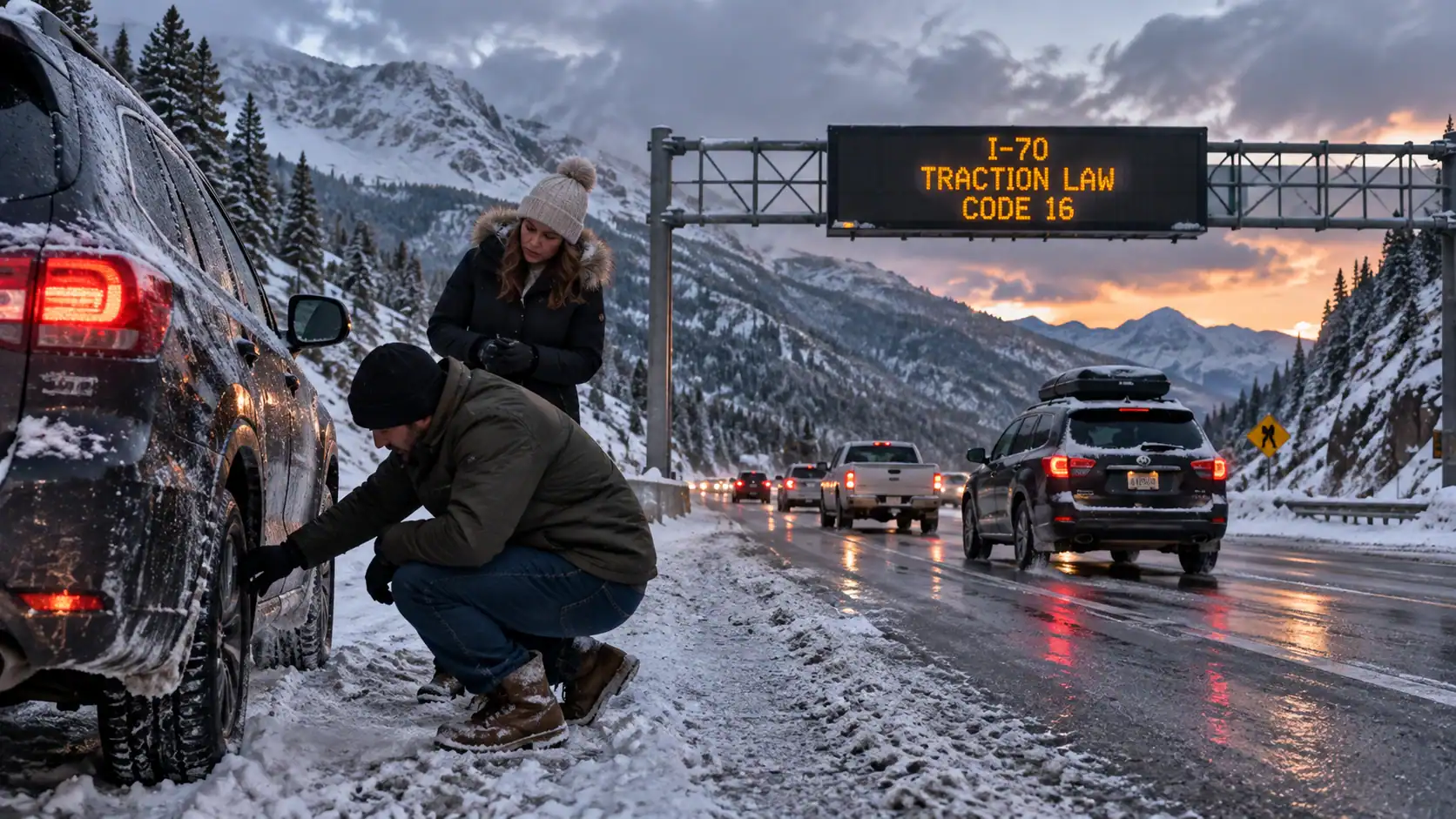
When the overhead signs on I-70 flash “Code 15” or “Code 16,” they aren’t suggestions. They are active Colorado traffic laws with fines attached, and they matter after a crash too. A driver who spins out on bald tires during an active Traction Law has broken a safety law, and that fact can shape who pays when their car blocks the road or slides into yours.
What is Colorado’s Traction Law?
Colorado’s Traction Law is a set of equipment rules that require vehicles on state highways to have adequate tires or traction devices for snowy and icy conditions. CDOT has authority under C.R.S. 42-4-106 to restrict highway travel to properly equipped vehicles. On the I-70 mountain corridor between Dotsero and Morrison, the Traction Law is in effect every year from September 1 through May 31, whether or not it is snowing that day. On every other state highway, CDOT activates it when weather calls for it.
What does Code 15 require?
Code 15 is the Traction Law, and it requires every passenger vehicle to have at least one of these: a four-wheel or all-wheel drive vehicle with tires that have at least 3/16 inch of tread; tires with the mud and snow (M+S) designation and at least 3/16 inch of tread; winter tires with the mountain snowflake symbol and at least 3/16 inch of tread; or chains or an alternative traction device such as an AutoSock. The 3/16 inch minimum is stricter than the 2/16 inch that applies on dry roads, so tires that are legal in August may not be legal on Vail Pass in October.
What does Code 16 require?
Code 16 is the Passenger Vehicle Chain Law, and it requires every vehicle on the road to have chains or an approved alternative traction device installed. Four-wheel drive alone does not satisfy Code 16. CDOT uses it during severe storms as the last step before closing the highway entirely, which tells you how dangerous conditions are when those signs light up.
What are the fines for violating the Traction Law?
A passenger vehicle that isn’t properly equipped during an active Traction Law or Chain Law faces a fine of about $132 with surcharges. If the driver’s lack of equipment causes a lane of traffic to close, the fine jumps to about $656. Commercial vehicles have separate chain requirements and heavier penalties.
Who is at fault when an ill-equipped car causes an I-70 crash?
A driver who violates the Traction Law and then causes a crash is usually in a weak position on fault. Colorado courts can treat the violation of a safety statute as evidence of negligence, and in some cases as negligence per se, meaning the violation itself establishes the breach of duty. If a car on worn all-season tires spins across lanes on Floyd Hill and you can’t avoid it, the lack of required equipment becomes a central fact in your claim against that driver’s insurer.
The same rule can cut the other way. If you were the one on worn tires, the other driver’s insurer will argue that your equipment contributed to the crash. Under Colorado’s comparative negligence rule, your recovery is reduced by your share of fault, and you recover nothing if you are 50 percent or more at fault. Checking your tread before a mountain trip protects your safety and your claim.
What about chain reaction crashes when a spinout blocks the road?
When one ill-equipped vehicle spins out and blocks a lane, the crashes that follow can involve several drivers who share fault in different amounts. The driver who spun out may be responsible for creating the hazard, while drivers who followed too closely or drove too fast for conditions may be responsible for how badly it went. Sorting out multi-vehicle fault requires evidence gathered quickly: dashcam footage, photos of tires and road conditions, CSP crash reports, and witness statements. Our complete guide to car accident claims in Colorado explains how those claims move forward.
Do rental cars and out-of-state vehicles have to follow the Traction Law?
Yes. The Traction Law applies to every vehicle on the road, including rentals and cars registered in other states. Many rental cars come with all-season tires, and many visiting drivers have never driven on packed snow. Before heading up I-70, check the tire sidewall for the M+S or mountain snowflake marking and test the tread depth. Holding a quarter upside down in the tread is a quick test: if the tread doesn’t reach the top of Washington’s head, the tire likely falls short of 3/16 inch.
How does your own insurance come into play?
Your policy matters most when the at-fault driver is uninsured, underinsured, or hard to identify after a multi-car pileup. Uninsured and underinsured motorist coverage can pay for your injuries when the other driver’s coverage can’t, and collision coverage pays to repair your car regardless of fault. Our complete guide to Colorado auto insurance after an accident covers each type in plain English. Before any mountain trip, check current restrictions at COtrip.org.
Frequently Asked Questions
When is the Traction Law in effect on I-70?
The Traction Law is in effect on I-70 between Dotsero and Morrison from September 1 through May 31 every year. During that period, vehicles must be properly equipped whether or not it is snowing. On other state highways, CDOT activates the Traction Law when winter weather makes it necessary.
Is four-wheel drive enough to comply with Colorado’s Traction Law?
Four-wheel or all-wheel drive satisfies Code 15 only if the tires have at least 3/16 inch of tread. It does not satisfy Code 16, the Passenger Vehicle Chain Law, which requires chains or an approved alternative traction device on every vehicle regardless of drivetrain.
What is the difference between Code 15 and Code 16?
Code 15 is the Traction Law, which requires adequate tires, four-wheel or all-wheel drive with good tread, or chains. Code 16 is the Passenger Vehicle Chain Law, which requires chains or an alternative traction device on every vehicle. Code 16 is the final step CDOT takes before closing the highway.
Can a Traction Law violation be used against the other driver in my injury claim?
Yes. A driver who violated the Traction Law and then caused a crash broke a law designed to prevent exactly that kind of crash. Colorado courts can treat that violation as evidence of negligence, which strengthens your claim against the driver’s insurance company.
Can my own worn tires reduce my injury settlement?
They can. If you were driving without required equipment, the other driver’s insurer will argue that your tires contributed to the crash. Under Colorado’s comparative negligence rule, your recovery is reduced by your percentage of fault, and you recover nothing at 50 percent or more.
What should I do after a crash on I-70 in winter conditions?
Move to safety if you can, call 911, and photograph every vehicle involved, including tires, along with road conditions and any overhead signs showing an active code. Get names of witnesses, request the CSP crash report number, and see a doctor promptly. Then call Flanagan Law at 720-928-9178 for a free consultation.
If you were hurt in a winter crash on I-70 or any Colorado mountain highway, call Flanagan Law at 720-928-9178 for a free consultation.