Daylight Saving Ends: The Darker Drive Home and the Evening Crash Window
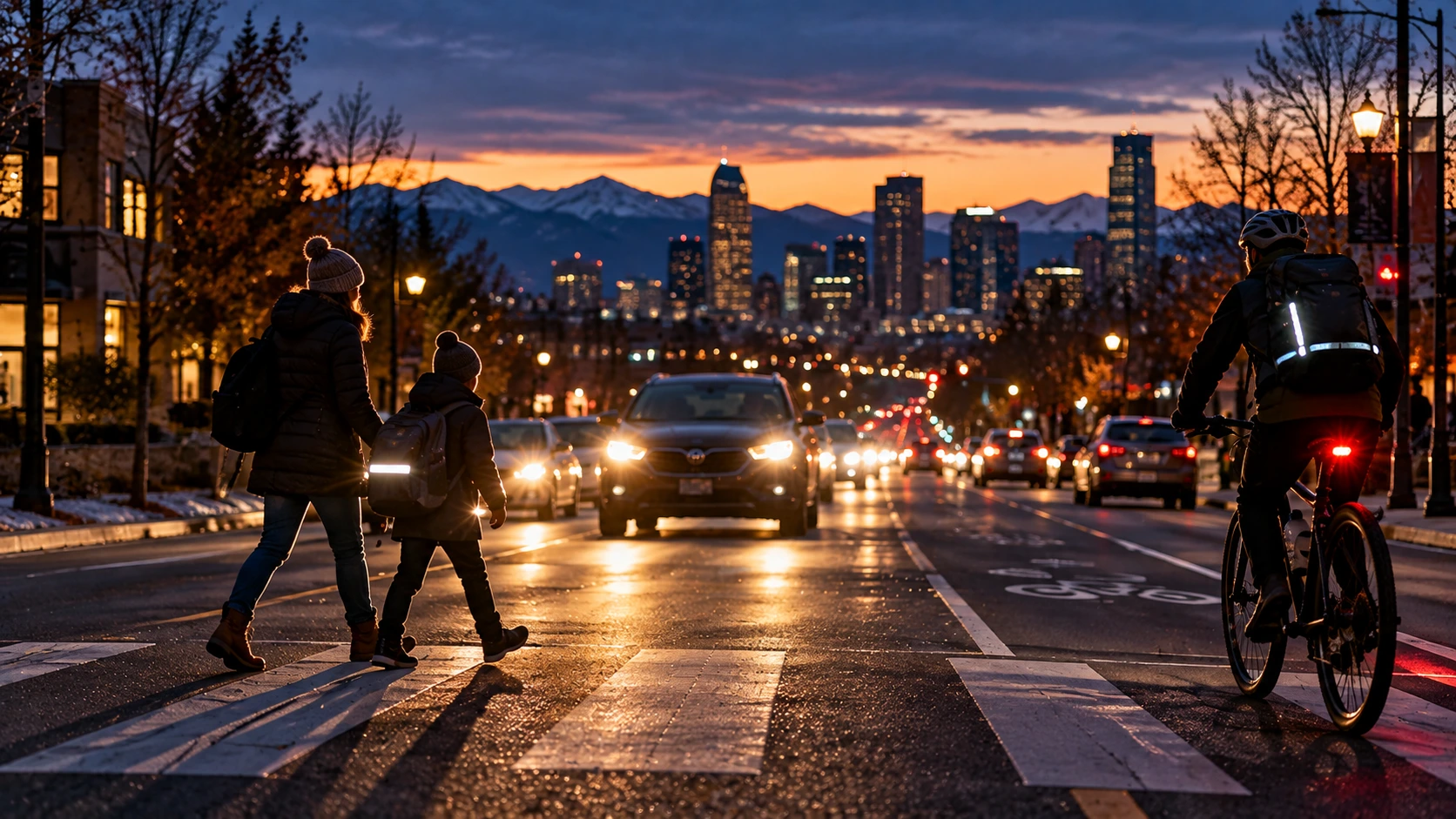
At 2 a.m. this Sunday, November 1, clocks in Colorado fall back one hour. The extra hour of sleep is the easy part. The hard part comes Monday evening, when the commute home that happened in daylight last week suddenly happens at dusk and in the dark. The sun sets around 4:50 p.m. in the Denver metro in early November, which puts the heaviest traffic of the day into the poorest light. Drivers, pedestrians, and cyclists all have to adjust at once, and in the first weeks they often don’t.
Why do crashes rise after daylight saving time ends?
Crashes rise after the time change because the evening rush hour moves into darkness overnight while traffic volume stays the same. Drivers who have been seeing pedestrians and cyclists clearly at 5:30 p.m. all summer now face the same crowds in low light. Eyes take time to adjust to dusk, and older drivers in particular lose contrast sensitivity in the dark. The result is a predictable window in the first weeks of November when evening pedestrian and vehicle crashes climb.
Why are pedestrians most at risk in the evening window?
Pedestrians are most at risk because they are the hardest road users to see in the dark, and many don’t realize how invisible they are. People walking home from transit stops, schools, and jobs wear the same dark coats they wore in daylight. A driver’s low beams may not reveal a pedestrian in dark clothing until it’s too late to stop at normal city speeds. Under C.R.S. 42-4-807, drivers must exercise due care to avoid hitting pedestrians, and that duty doesn’t shrink when the sun goes down. Our article on Denver’s winter pedestrian dangers covers how those claims work.
Is darkness an excuse for hitting someone?
Darkness is not an excuse. Colorado’s basic speed law requires drivers to travel at a speed that is reasonable and prudent for actual conditions, and reduced visibility is a condition. A driver who travels at the posted limit on a dark street and can’t stop in the distance their headlights reveal is driving too fast for conditions. Insurers sometimes argue that a pedestrian or cyclist “came out of nowhere,” but the law expects drivers to adjust to what they can and can’t see.
What does Colorado law require for headlights?
Colorado law requires headlights from sunset to sunrise and any other time visibility is reduced so that people and vehicles can’t be clearly seen at a distance of 1,000 feet. In the first weeks after the time change, many drivers leave work in what feels like daylight and forget their lights as dusk falls. Some newer vehicles have daytime running lights that keep the dash lit while the taillights stay off. A driver without proper lights who causes a crash may be found negligent for that reason alone.
Do cyclists and pedestrians share responsibility in the dark?
They can. Colorado requires cyclists riding at night to use a white front light and a red rear reflector or light, and pedestrians are expected to use reasonable care for their own safety. If an injured cyclist had no lights, or a pedestrian crossed mid-block in dark clothing, an insurer will argue they share the fault. Under Colorado’s comparative negligence rule, any share of fault reduces recovery, and 50 percent or more bars it. Our article on a cyclist’s guide to Colorado’s right-of-way laws explains the rules riders must follow.
How does sun glare fit into the evening commute?
In the weeks around the time change, westbound drivers in the late afternoon face a low sun directly ahead, and glare can blind a driver for several seconds. Glare is not a defense to a crash. Drivers are expected to slow down, use visors and sunglasses, and leave more room when they can’t see clearly. A driver who keeps going at full speed into blinding glare and hits a stopped car or a pedestrian has not used reasonable care.
Does fatigue play a role after the time change?
Fatigue can play a role. Shifting the body clock by an hour disrupts sleep for some people for several days, and darkness arriving earlier makes many drivers feel tired sooner in the evening. Drowsy driving slows reaction time much like impairment does. A driver who causes a crash while nodding off is responsible for it, and evidence such as long work shifts or lane drifting can help show what happened.
How can you stay safer on the darker drive home?
Drivers should turn on headlights before dusk, slow down on neighborhood streets and near transit stops, clean the windshield inside and out to cut glare, and watch crosswalks and bus stops closely. Pedestrians should cross at lit intersections and wear something bright or reflective. Cyclists should use a bright front light and a red rear light, even on short rides. Everyone should assume they are harder to see than they think.
Frequently Asked Questions
When does daylight saving time end in 2026?
Daylight saving time ends at 2 a.m. on Sunday, November 1, 2026, when clocks fall back one hour. In the Denver area, sunset moves to roughly 4:50 p.m. in early November, which puts the evening commute in dusk and darkness.
Are crashes more common after the clocks fall back?
Yes, evening crashes, especially those involving pedestrians, tend to increase in the weeks after daylight saving time ends. Traffic stays heavy while light disappears earlier, and drivers, walkers, and cyclists all need time to adjust to the darker commute.
Is a driver at fault for hitting a pedestrian in the dark?
Often, yes. Colorado drivers must exercise due care to avoid pedestrians and drive at a speed reasonable for visibility. A pedestrian’s dark clothing or mid-block crossing may reduce recovery under comparative negligence, but darkness alone doesn’t excuse a driver who couldn’t stop in time.
When are headlights required in Colorado?
Colorado requires headlights from sunset to sunrise and whenever visibility is reduced so that people and vehicles can’t be clearly seen at 1,000 feet. Driving at dusk without lights can be evidence of negligence if a crash happens.
Can sun glare be used as a defense after a crash?
Sun glare rarely works as a defense. Drivers are expected to slow down and adjust when glare limits their vision. Continuing at normal speed while unable to see is generally treated as a failure to use reasonable care.
What should I do if I’m hit while walking or biking after dark?
Call 911, get medical care, and gather the driver’s information and witness names. Photograph the lighting, your clothing, and any lights or reflectors you were using, and look for nearby cameras. Then call Flanagan Law at 720-928-9178 for a free consultation.
If you were hurt in a crash on the darker evening commute, call Flanagan Law at 720-928-9178 for a free consultation.