Rear-End Collision on I-25 in Denver: What Backed-Up Traffic Claims Require
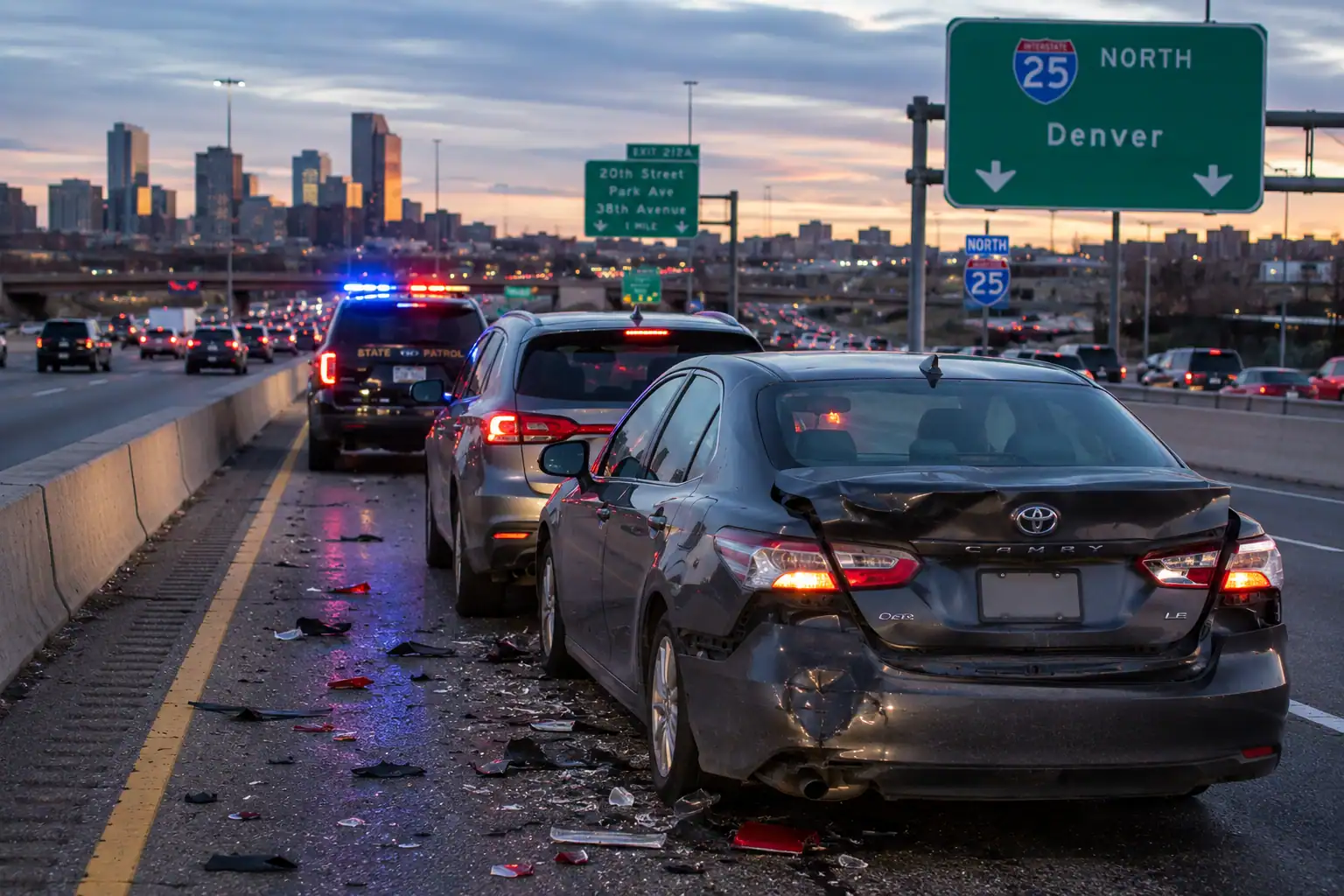
I-25 through Denver is the busiest stretch of highway in Colorado. The corridor carries hundreds of thousands of vehicles daily, and during peak hours the traffic slows to a crawl repeatedly between Sixth Avenue and 84th Avenue. The slowdowns produce rear-end crashes at a volume that nothing else on the Front Range matches, and we handle these cases regularly.
This article is for the driver who has just been rear-ended on I-25 and is trying to figure out what to do next. The dynamics of backed-up traffic crashes are specific enough that they warrant their own discussion, separate from the broader rear-end collision framework we have addressed elsewhere.
If you have been rear-ended on I-25, call us at 720-928-9178. The conversation is free, there is no obligation, and there is no fee unless we win your case.
Why I-25 Produces So Many Rear-End Crashes
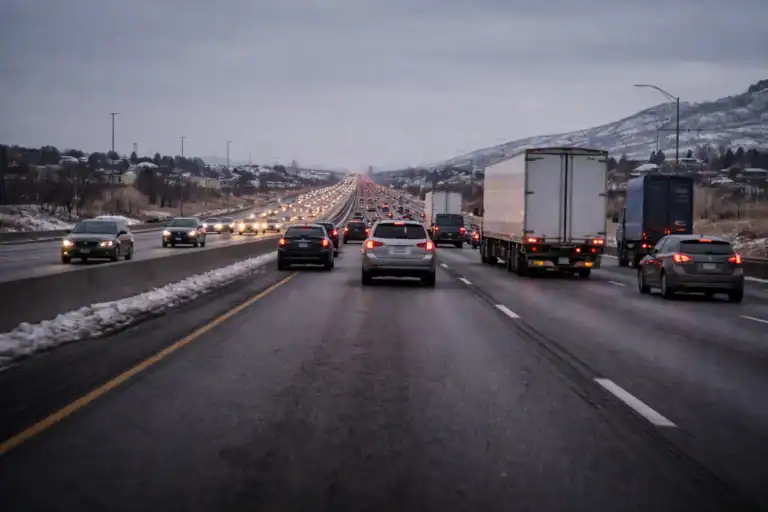
The traffic pattern on I-25 through Denver creates the conditions for chronic rear-end crashes. The corridor carries volume that exceeds its capacity during peak hours. The result is repeated wave-like slowdowns where free-flow speeds drop to stop-and-go and then back up to free-flow and then down again.
A driver maintaining seventy miles per hour with following distance appropriate for that speed needs significantly more distance to stop than a driver realizes when they first see brake lights ahead. The reaction time, the perception time, the braking distance, all of them add up to a stopping requirement that exceeds what most drivers actually maintain. When traffic compresses unexpectedly, the rear driver who was maintaining marginal following distance has no margin and rear-ends the vehicle ahead.
This pattern repeats hundreds of times per day on I-25 during peak hours.
The Specific Stretches Where Crashes Cluster
Some I-25 stretches see particular concentrations of rear-end crashes.
The section from Sixth Avenue through downtown, including the I-25 and I-70 interchange, is one of the busiest and most crash-prone stretches in the state. The lane configurations, the merging traffic, and the proximity to downtown all contribute to the volume.
The stretch from Lincoln to Mineral, through the south metro, sees consistent crash volume during the morning northbound commute and the evening southbound commute.
The stretch from 58th Avenue to 84th Avenue, through the north metro, produces crashes related to the I-25 and I-76 interchange and the chronic congestion at the 58th and 70th exits.
The interchange at I-225 sees crashes related to the lane drops and the speed transitions.
The interchange at C-470 produces crashes at the merge points where southbound I-25 traffic joins westbound C-470 traffic.
How Fault Is Decided in a Backed-Up Traffic Rear-End
The general rule that the rear driver is at fault applies. The rear driver had the duty to maintain safe following distance and to anticipate the conditions ahead. Failure to do so produces the crash.
The exceptions are narrow. A driver who brake-checked, who stopped suddenly with no provocation, or whose vehicle was inoperable and improperly stopped in the travel lane may bear some share of fault. In a typical I-25 backed-up traffic crash, the rear driver is at or near 100 percent fault.
Multi-vehicle pileups during slowdowns are different. The fault analysis in a chain-reaction crash on I-25 follows the dynamics we discussed in how Colorado’s modified comparative negligence rule affects multi-vehicle pileups on mountain roads. The driver who started the chain bears the largest share. Drivers who joined the pileup share smaller portions.
The Injury Patterns
Rear-end crashes at I-25 speeds, even when the speeds at the moment of impact are reduced by the slowdown, produce real injuries. Whiplash. Herniated and bulging discs. Concussion. Lower back injuries from seat belt loading. Knee and shoulder injuries from bracing against the impact.
The carrier will argue the property damage shows the impact was minor. The medical literature, as we have discussed in the science of whiplash and why symptoms appear days after a collision, supports the connection between low-impact rear-end crashes and significant injury.
The cases that recover well are the cases where the medical documentation is strong, the treating physician supports the injury connection clearly, and the claim is presented professionally.
The Insurance Picture
Standard Colorado framework applies. The at-fault driver’s liability coverage is the primary source. Your own UM/UIM applies when their coverage is exhausted. Your MedPay pays regardless of fault. Any umbrella coverage you carry may provide additional UM/UIM benefits.
The frequency of state-minimum coverage among I-25 drivers is high enough that meaningful UM/UIM coverage on your own policy often becomes the largest source of recovery in a serious case.
What to Do After an I-25 Rear-End
Move to the shoulder if you can do so safely. Remaining stopped in the I-25 travel lane after a crash is dangerous. Additional vehicles may strike the scene.
Call 911. Colorado State Patrol responds to I-25 crashes.
Document the scene. Photographs of both vehicles, the lane positions, the road conditions, the time and the weather.
Seek medical attention. The medical record matters from the first day.
Notify your own carrier.
Do not give recorded statements to the at-fault driver’s carrier.
Engage counsel if the injuries are meaningful.
Frequently Asked Questions
How long do I have to file an I-25 rear-end claim?
Three years from the date of the accident under CRS 13-80-101.
What if I cannot remember exactly how the crash happened?
The reconstruction work, EDR data, and witness statements typically produce the picture even when individual memories are incomplete.
Is the rear driver always at fault in a backed-up traffic rear-end?
Almost always. The exceptions are narrow.
What if my injuries did not appear until days after the crash?
Delayed-onset injuries are common and fully compensable.
What if the at-fault driver was driving a commercial vehicle?
Commercial coverage typically provides substantially more liability protection. Federal regulations may apply.
Should I accept the first offer?
Almost never.
Sources
Colorado Revised Statutes 13-21-111: Comparative Negligence, leg.colorado.gov
Colorado Revised Statutes 13-80-101: Three-Year Limitation for Motor Vehicle Tort Actions, leg.colorado.gov
Colorado Revised Statutes 10-4-609: Uninsured Motorist Coverage, leg.colorado.gov
Colorado Department of Transportation, I-25 Corridor and Crash Data, codot.gov
National Highway Traffic Safety Administration, Rear-End Collision Resources, nhtsa.gov
If you have been rear-ended on I-25 in Denver, please call us. The conversation is free and there is no obligation. Reach Samantha Flanagan and the Flanagan Law team at 720-928-9178. We are a Colorado boutique firm. We answer our own phones. And we do not get paid unless we win your case.