What 250 Years of American Liberty Means for the Right to a Civil Jury Trial in Colorado
This week leads up to the country’s 250th birthday on Saturday. From today through Friday, we will publish a short reflection each day on a different aspect of the American legal tradition and what it means for the work we do. Then on Saturday, July 4, we will publish a letter of thanks to the Colorado community we serve.
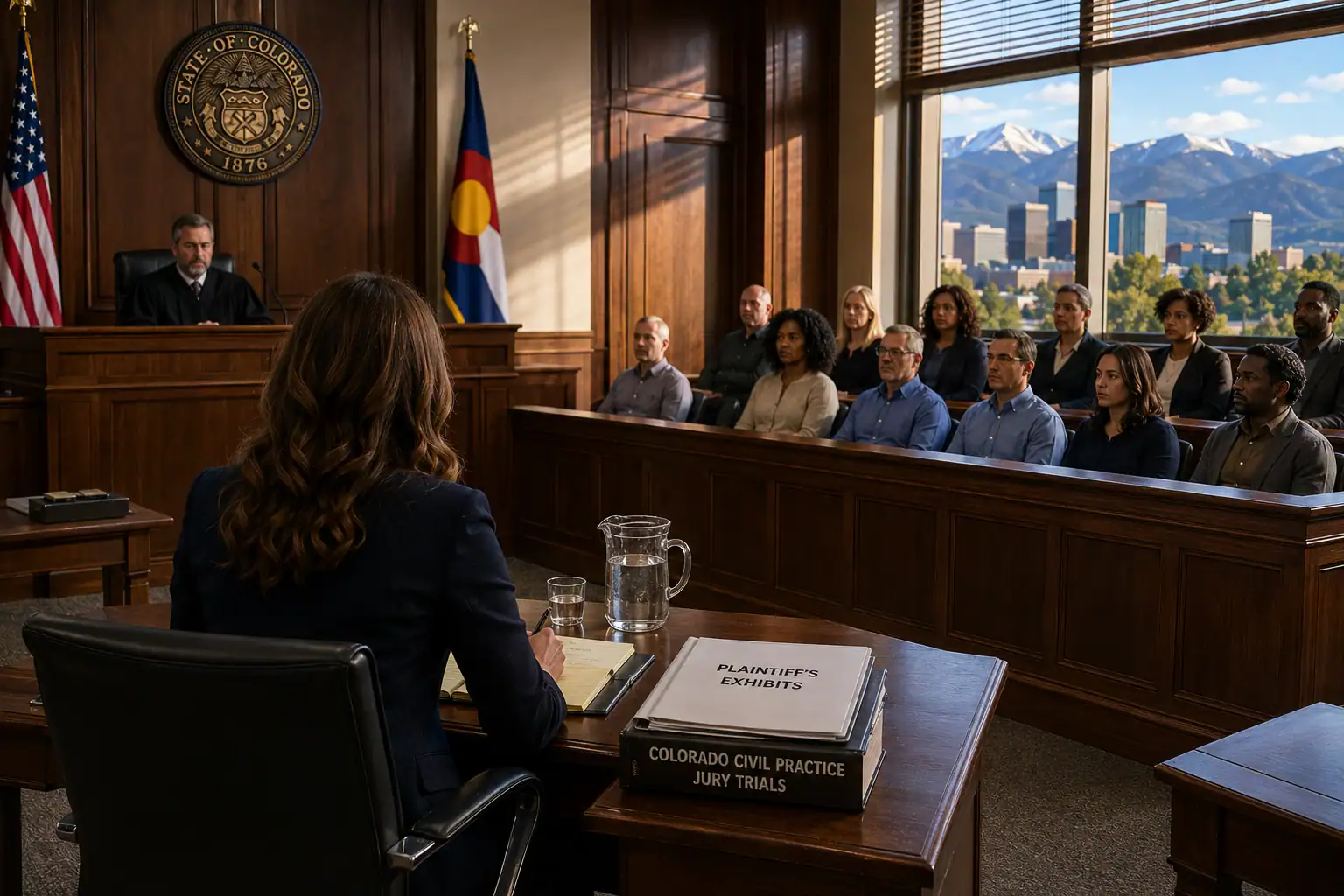
Today’s piece is on the right to a civil jury trial. It is one of the most distinctive and consequential features of the American legal system, and it is the right that shapes every Colorado car accident case more than any other.
If you are reading because you have a claim, please call us at 720-928-9178. The conversation is free, there is no obligation, and there is no fee unless we win your case. If you are reading because the history interests you, read on.
What the Right to a Civil Jury Actually Is
The Seventh Amendment to the United States Constitution guarantees the right to a jury trial in civil cases where the amount in controversy exceeds twenty dollars. The amendment was ratified in 1791 as part of the Bill of Rights. It reflects a colonial-era distrust of judges sitting alone and a belief that ordinary citizens should decide questions of fact in civil disputes.
The Colorado Constitution provides similar protection in state cases. Colorado Rule of Civil Procedure 38 governs the procedural mechanics of demanding and conducting a civil jury trial.
The principle is straightforward. In a civil case where the amount in controversy is meaningful, the parties have the right to demand that a jury of citizens, not a judge sitting alone, decide the questions of fact. The judge instructs the jury on the law. The jury applies the law to the facts and renders a verdict.
Why This Matters for Every Colorado Car Accident Case
Most Colorado car accident cases settle without a trial. The settlement rate exceeds ninety percent in most years. But the existence of the jury option shapes every settlement negotiation, and the shadow of the jury verdict is the single most important factor in the insurance carrier’s evaluation of any case.
When a carrier evaluates a car accident claim, they ask a specific question. What would a jury award if this case went to trial? The answer depends on the facts, the law, the strength of the evidence, the credibility of the witnesses, the venue, and many other factors. The carrier’s settlement offer is, in essence, a discount on the jury verdict they project, adjusted for the cost and uncertainty of litigation.
The skill and willingness of the plaintiff’s lawyer to take the case to trial directly affects this evaluation. A lawyer with a strong trial record, who is known to actually try cases when carriers refuse to pay fairly, generates better settlements than a lawyer who is known to settle every case at any price.
This is one of the reasons representation matters in Colorado car accident cases. The carrier knows who actually tries cases. They price their offers accordingly.
The Specific Colorado Jury Practice
Colorado civil jury trials follow a specific procedural framework.
Jury size is six jurors for civil cases in district court, though parties can stipulate to larger numbers. The verdict requires unanimity unless the parties stipulate to a lesser number.
Jury selection involves voir dire, the questioning of potential jurors by the parties’ lawyers and by the judge, to identify jurors who can decide the case fairly. Challenges for cause remove jurors who cannot be fair. Peremptory challenges allow each party to remove a limited number of jurors without stating cause.
The trial itself follows the standard structure. Opening statements. Plaintiff’s evidence. Defendant’s evidence. Plaintiff’s rebuttal if any. Closing arguments. Jury instructions from the judge. Deliberation. Verdict.
The verdict in a Colorado car accident case typically requires the jury to make several findings. Liability and the percentage of fault assigned to each party. Damages in each applicable category. The jury’s findings on these questions are then translated into a judgment by the court.
The Verdicts That Shape Settlement Markets
A handful of high-profile jury verdicts in Colorado personal injury cases each year have outsized effects on settlement markets. When a Colorado jury returns a substantial verdict in a serious injury case, every insurance carrier evaluating similar cases adjusts their reserves and their offer parameters accordingly.
This is why the willingness of plaintiff’s lawyers to take strong cases to trial matters beyond the specific cases that go to verdict. The trials that happen establish the boundaries that shape the settlements that happen.
We do not file lawsuits or take cases to trial unnecessarily. We do not escalate cases that should settle. But when a case calls for it, we are ready, and the carriers we deal with know that.
What the Founders Got Right
The Founders of the country, drafting the Constitution and the Bill of Rights in the late eighteenth century, could not have imagined modern vehicle accidents. The technology, the road network, the insurance industry, the medical landscape, all of it would have been incomprehensible to them.
What they did imagine, and what they got right, was that ordinary citizens should have the power to decide civil disputes. The judge, however learned, however principled, has institutional pressures and limited perspective. The jury of twelve, or in Colorado civil practice six, brings the perspective of ordinary citizens to the question of what justice requires.
Two hundred and fifty years later, in a country that has changed almost beyond recognition since 1776, the civil jury still functions. The Colorado driver hurt on US-36 today has the same right to a jury of citizens that the founders wrote into the Constitution. The right is exercised through skilled lawyering, through preparation, and through the willingness to put the case in front of the citizens of the community where the crash occurred.
This is one of the things the country got right. Among the many things it has gotten wrong over 250 years, the civil jury remains a substantial contribution.
Frequently Asked Questions
Do I have the right to a jury trial in my Colorado car accident case?
Yes, in any case where the amount in controversy exceeds the threshold and either party demands a jury trial in the proper procedural manner.
How many jurors decide a Colorado civil case?
Six jurors in district court, unless the parties stipulate to a larger number.
Will my case actually go to trial?
Probably not. Most cases settle. But the existence of the jury option shapes the settlement.
What is voir dire?
The process of questioning potential jurors before trial to identify those who can decide the case fairly. The questioning is conducted by the lawyers and by the judge.
How long does a Colorado car accident jury trial take?
Most car accident jury trials run three to five days, though complex cases can take substantially longer.
Sources
The Constitution of the United States, Seventh Amendment, archives.gov
The Colorado Constitution, Article II Section 23 and related provisions, leg.colorado.gov
Colorado Rules of Civil Procedure, Rule 38: Jury Trial of Right, coloradosupremecourt.com
Colorado Revised Statutes 13-80-101: Three-Year Limitation for Motor Vehicle Tort Actions, leg.colorado.gov
Tomorrow we publish on the Seventh Amendment and what it specifically protects. Friday’s piece reflects on the broader American tradition of a free country needing a strong civil justice system. Saturday is the letter of thanks. Until then, please call us if you need us. Reach Samantha Flanagan and the Flanagan Law team at 720-928-9178. We are a Colorado boutique firm. We answer our own phones. And we do not get paid unless we win your case.