The Science Behind Late-Onset TBI Symptoms: What Colorado Victims Often Miss in the First Week
Traumatic brain injury is the most underdiagnosed serious injury we see in Colorado vehicle crashes. The reason is not that doctors miss it on purpose. The reason is that TBI often does not present its full symptom picture immediately. A crash victim walks away from the scene feeling rattled but functional. The emergency room evaluation, often focused on visible trauma and obvious neurological deficits, comes back unremarkable. The victim goes home, sleeps, wakes up, and over the next several days realizes that something is not right. The headaches that will not go away. The trouble concentrating at work. The strange irritability. The sleep that is not restorative. By the time the picture becomes clear, the victim has often missed the medical visits that would have documented the injury from the start.
This article walks through the medical literature on late-onset TBI symptoms, explains why the delayed picture is the rule rather than the exception, and addresses what Colorado victims should do to protect both their health and their claims. We have written about the broader TBI category in the lifelong costs of traumatic brain injury for Colorado families and how neuropsychological experts prove the true value of a TBI claim. This piece focuses on the early-symptom window specifically.
If you have been in a crash and are experiencing any symptoms that concern you, call us at 720-928-9178. The conversation is free, there is no obligation, and we will help you think through whether further evaluation is warranted.
Why TBI Symptoms Are Often Delayed
The mechanism of traumatic brain injury in a vehicle crash usually does not involve direct impact to the skull. The brain is suspended in cerebrospinal fluid inside the skull. When the vehicle decelerates violently, the brain decelerates with it, and the brain tissue strikes the inside of the skull and twists against the brain stem. The shearing forces produce diffuse axonal injury, the disruption of the connections between brain cells, which is the most common type of TBI in vehicle crashes.
The damage at the cellular level often does not produce immediate observable symptoms. The brain has remarkable capacity to compensate for injury in the short term. The compensation depletes over hours and days as the injured tissue swells, as the brain’s metabolic demands exceed its supply, and as the cascade of secondary injury processes unfolds.
The result is a symptom picture that often does not become clear until days or weeks after the crash, exactly when the victim is past the point where they think to connect the symptoms to the accident.
The Symptoms to Watch For
The symptoms of TBI in the days following a Colorado vehicle crash include the following.
Headaches that persist or worsen. Particularly headaches that respond poorly to standard over-the-counter pain medication. Persistent post-traumatic headache is one of the most common TBI symptoms and one of the most overlooked.
Difficulty concentrating. The inability to maintain focus on tasks that were easy before the crash. Trouble reading. Trouble following conversations. Trouble at work.
Memory problems. Difficulty remembering recent events, conversations, or instructions. Sometimes difficulty with longer-term memory as well.
Sleep disturbance. Difficulty falling asleep, staying asleep, or waking up rested. Sleep architecture is disrupted by TBI in ways that produce non-restorative sleep even when total sleep time looks normal.
Mood changes. Irritability, anxiety, depression, emotional lability. Family members often notice these changes before the victim does.
Sensory sensitivity. Particularly to light and sound. Bright lights become painful. Normal sound levels feel overwhelming.
Dizziness and balance problems. The vestibular system is frequently affected by TBI. Balance, spatial orientation, and motion sensitivity can all be disrupted.
Fatigue beyond what the situation seems to warrant. Cognitive fatigue, where mental effort produces exhaustion much faster than normal, is a hallmark TBI symptom.
Vision changes. Blurred vision, difficulty tracking, problems with depth perception, or sensitivity to motion.
Tinnitus. Ringing or buzzing in the ears, sometimes persistent.
The presence of one or two of these symptoms in isolation does not necessarily mean TBI. The presence of several of them in combination, particularly when they developed in the days after a crash, warrants medical evaluation.
Why Standard Emergency Room Evaluation Often Misses TBI
The standard emergency room evaluation after a crash typically includes a brief neurological examination, a CT scan if indicated, and a discharge with instructions to seek follow-up care if symptoms develop.
The CT scan is good at detecting bleeding, fractures, and gross structural damage. It is not good at detecting diffuse axonal injury, which is the most common type of TBI in vehicle crashes. A normal CT scan does not rule out TBI.
The brief neurological examination is similarly limited. The victim can follow commands, can answer questions, can move all extremities. The examination does not detect the subtle cognitive and behavioral changes that characterize mild TBI.
The discharge with instructions to follow up assumes the victim will recognize the symptoms when they appear and will seek evaluation promptly. The reality is that many victims do not recognize the symptoms, do not connect them to the crash, or assume the symptoms will resolve on their own.
The result is a substantial underdiagnosis of TBI in the days after Colorado vehicle crashes.
What Proper TBI Evaluation Looks Like
When TBI is suspected, the appropriate evaluation involves several components.
A detailed neurological history and examination by a physician familiar with TBI. The neurologist or specialized primary care physician asks specific questions about the symptoms, the mechanism of injury, and the trajectory of symptoms since the crash.
Neuropsychological testing. Standardized testing of cognitive function, including attention, memory, processing speed, and executive function, provides objective documentation of cognitive deficits that are otherwise difficult to quantify.
Advanced imaging when indicated. MRI is more sensitive than CT for detecting subtle brain injury. Diffusion tensor imaging and other advanced MRI techniques can detect diffuse axonal injury that standard MRI misses.
Vestibular and visual evaluation. The vestibular and visual systems are commonly affected by TBI and warrant their own specialized evaluations.
Vocational and functional assessment. The impact of the injury on the victim’s ability to work and to perform daily activities is evaluated by specialists in that field.
The full TBI workup is expensive and time-consuming. It is also essential for any TBI case that warrants meaningful compensation. We have addressed the critical role of life care planners in TBI cases and how vocational experts help prove lost earning potential after a TBI in our broader TBI resources.
What to Do If You Suspect TBI After a Crash
Seek evaluation. Do not wait for the symptoms to resolve on their own. The medical record created in the days and weeks after a crash is essential for documenting the injury.
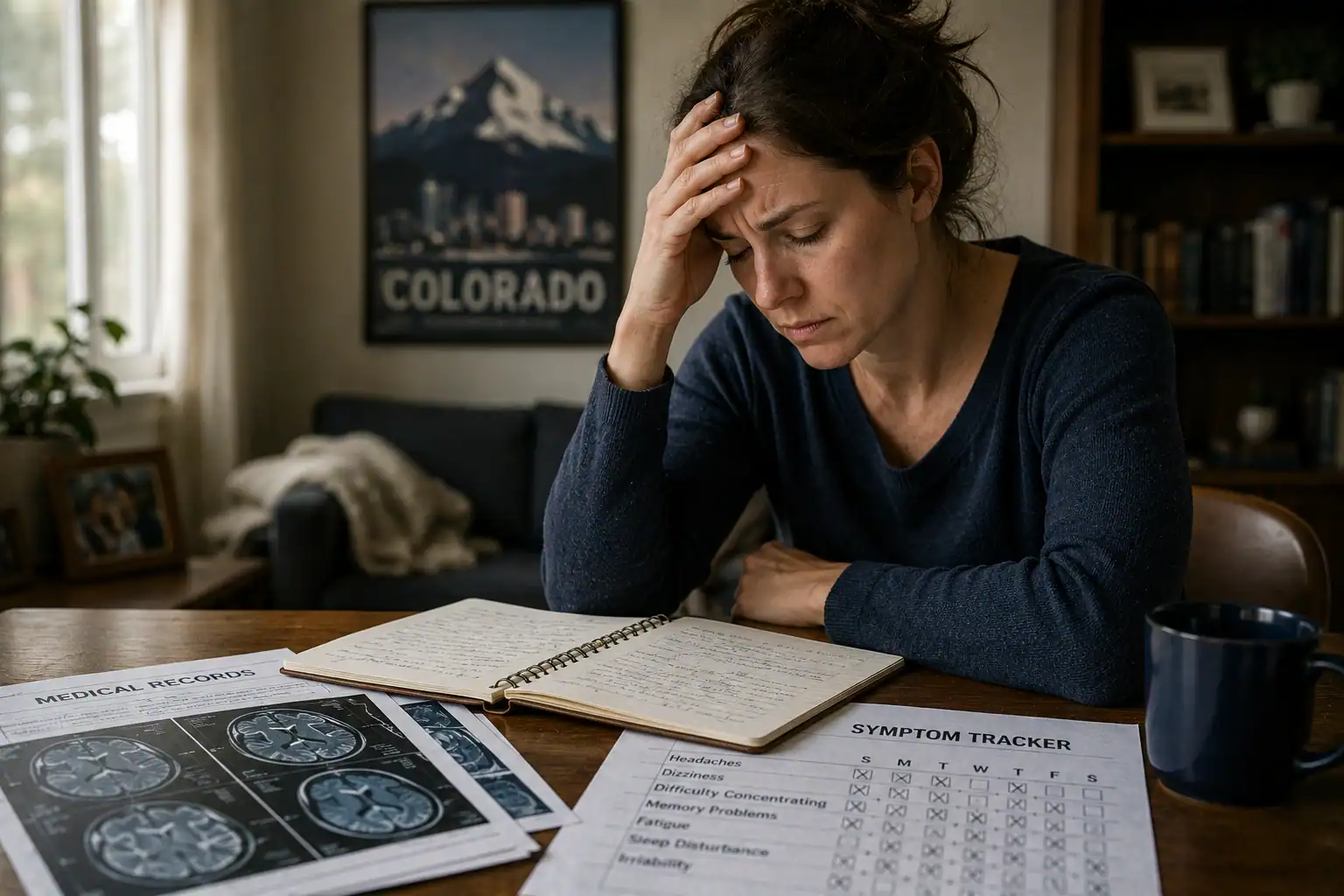
Document the symptoms. Keep a daily journal of symptoms, their severity, and how they affect your daily life. The journal becomes valuable evidence in the case.
Tell your medical providers about every symptom. Do not minimize. Do not assume the provider will ask the right questions. Volunteer the information about cognitive symptoms, mood changes, sleep disturbance, and sensory sensitivity.
Follow up with specialists. Neurologists, neuropsychologists, vestibular specialists, and vision specialists all play roles in proper TBI evaluation. Follow through on referrals.
Engage counsel if the injury appears serious. TBI cases benefit substantially from early counsel involvement because the medical work-up needs to be coordinated and the evidence needs to be preserved.
Do not give recorded statements to insurance carriers. The carrier’s adjuster will use anything you say against the case.
Frequently Asked Questions
How long after a crash can TBI symptoms appear?
Symptoms can develop hours to weeks after a crash. The most common pattern is symptoms that emerge in the first three to seven days and continue to develop over the following weeks.
Can I have TBI without losing consciousness?
Yes. Loss of consciousness is not required for TBI. Many TBI cases in vehicle crashes involve no loss of consciousness at all.
Does a normal CT scan rule out TBI?
No. CT is insensitive to diffuse axonal injury, which is the most common type of TBI in vehicle crashes. A normal CT does not rule out the injury.
How long does TBI take to heal?
The trajectory varies widely. Many mild TBIs resolve within weeks to months. Some produce permanent deficits. The trajectory depends on the severity of the injury, the quality of treatment, and individual factors.
Should I tell my medical providers I am in a car accident case?
Yes. The providers need to know the mechanism of injury to evaluate and document properly.
How are TBI cases valued in Colorado?
The value depends on the severity and permanence of the injury, the impact on the victim’s life, and the quality of the documentation. Serious TBI cases can produce settlement values in the hundreds of thousands or millions of dollars when properly documented. We address valuation in our Colorado car accident settlement guide.
How long do I have to file a TBI claim?
Three years from the date of the accident under CRS 13-80-101 for personal injury claims arising from a motor vehicle.
Sources
Centers for Disease Control and Prevention, Traumatic Brain Injury Resources, cdc.gov
National Institutes of Health, National Library of Medicine, Traumatic Brain Injury Literature, nih.gov
National Institute of Neurological Disorders and Stroke, Traumatic Brain Injury Information, ninds.nih.gov
Colorado Revised Statutes 13-80-101: Three-Year Limitation for Motor Vehicle Tort Actions, leg.colorado.gov
Colorado Brain Injury Program, colorado.gov
If you suspect you may have sustained a traumatic brain injury in a Colorado crash, please call us. The conversation is free, there is no obligation, and we will help you think through whether further evaluation is warranted. Reach Samantha Flanagan and the Flanagan Law team at 720-928-9178. We are a Colorado boutique firm. We answer our own phones. And we do not get paid unless we win your case.