
Rollover Accidents in Colorado: Why These Claims Are More Valuable Than Most People Realize
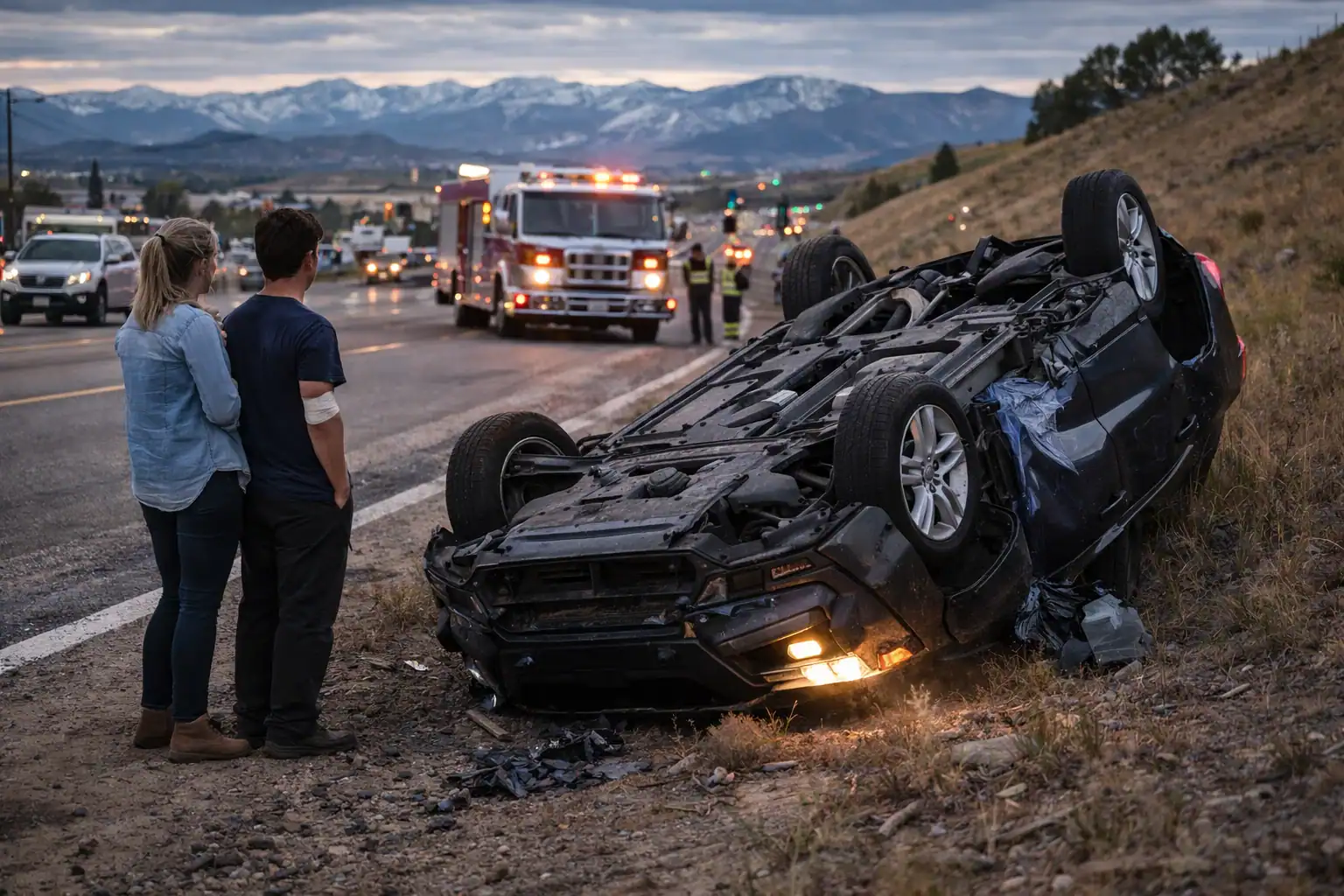
Rollover accidents produce some of the most serious injuries on Colorado roads. Here is what makes these claims different and what Colorado law gives victims.
A rollover is not like other car accidents. Most crashes involve two vehicles moving along roughly the same plane, with impact forces that are significant but directionally predictable. A rollover subjects the vehicle and everyone inside it to forces that cycle through multiple planes of movement, often repeatedly. Roof crush, ejection, and the structural failure of vehicle components that were never designed to absorb impact from above are the injury mechanisms that make rollovers among the most catastrophic crashes on Colorado roads.
In our practice, rollover accident claims consistently involve more serious injuries, more complex liability questions, and more insurance coverage disputes than almost any other accident type. They are also more valuable, when pursued correctly, than most people realize at the time of the accident. This article explains why.
How Rollovers Happen on Colorado Roads
The physics of a rollover require either a tripping mechanism, something that catches a wheel and initiates the rotation, or a combination of high center of gravity and lateral force sufficient to tip the vehicle without a trip. Tripped rollovers are the more common type and account for the majority of rollover crashes in Colorado.
Tripping mechanisms on Colorado roads include curbs, guardrails, soft shoulders, and road edge drop-offs where pavement has eroded away from the shoulder. A driver who runs slightly off the road edge and encounters a significant drop-off between the pavement and the shoulder has almost no ability to recover without initiating a rollover sequence. This road edge condition is both a common road maintenance failure and a significant government liability issue on Colorado highways.
High-center-of-gravity vehicles, including SUVs, pickup trucks, and vans, are disproportionately represented in rollover statistics. NHTSA data shows that SUVs and pickup trucks account for the majority of rollover fatalities nationally. On Colorado mountain roads, where abrupt steering inputs to avoid obstacles or navigate tight curves are more common, this center-of-gravity vulnerability is amplified.
Speed is the other dominant factor. The energy available for a rollover sequence increases with the square of vehicle speed, which means a rollover at 65 miles per hour involves roughly four times the kinetic energy of one at 35 miles per hour. Rollovers on Colorado interstate and state highway corridors, where speeds are high and tripping hazards exist at road edges, produce injuries that reflect this energy differential.
Why Rollover Injuries Are So Serious
The injury patterns in rollover crashes differ fundamentally from those in standard front or side impact collisions. Roof crush, which occurs when the vehicle’s roof contacts the ground during the roll sequence, can produce catastrophic spinal cord injuries, traumatic brain injuries, and facial trauma even when occupants are belted. The Federal Motor Vehicle Safety Standard 216 governs roof crush resistance for passenger vehicles, and failures of this standard in rollover crashes have been the subject of significant product liability litigation nationally.
Ejection is the other dominant rollover injury mechanism. Partial or complete ejection from the vehicle during a rollover dramatically increases the probability of fatal or catastrophic injury. NHTSA data shows that ejected occupants are significantly more likely to be killed than those who remain in the vehicle. Seatbelt non-use is the primary ejection risk factor, but seatbelt system failures have also been documented in rollover crash analysis.
Traumatic brain injury is common in rollover crashes even among belted, non-ejected occupants. The rotational forces of a multi-quarter roll subject the brain to the angular acceleration that produces diffuse axonal injury, a form of TBI that is particularly difficult to diagnose acutely and whose full extent often emerges over weeks or months following the crash.
The Multiple Liability Layers in a Colorado Rollover Case
What makes rollover claims more valuable and more complex than standard two-car accidents is the potential for liability to exist at multiple levels simultaneously.
The at-fault driver, if another vehicle initiated the rollover sequence through negligence, is the most visible defendant. But in rollover cases, additional defendants frequently emerge through investigation.
Road condition liability arises when a road edge drop-off, soft shoulder, or missing guardrail contributed to the trip mechanism. Government liability claims for these conditions require the 182-day notice of claim under CRS 24-10-109 but can add a significant source of compensation beyond the at-fault driver’s policy.
Vehicle manufacturer liability arises when roof crush, seatbelt failure, or a defective stability control system contributed to the severity of the crash. These are product liability claims governed by Colorado’s product liability statutes and the federal safety standards that govern vehicle design. Rollover cases with roof crush or ejection injuries warrant early evaluation by an attorney with product liability experience.
Tire manufacturer liability arises in cases where a tire failure, particularly a tread separation at speed, initiated the rollover sequence. Tread separation rollovers on highway speeds have been the subject of major product liability litigation and remain a viable claim category when the tire failure can be established through physical evidence.
Call us at 720-928-9178 if you or someone you love was hurt in a Colorado rollover accident. These cases move fast and require early expert involvement. The consultation is free and there is no fee unless we win.
Evidence Preservation in Rollover Cases
The physical evidence of a rollover crash is uniquely important and uniquely perishable. The vehicle itself is the primary evidence source: roof deformation, seatbelt condition, airbag deployment patterns, and electronic data recorder data all tell the story of the crash sequence and the injury mechanisms. This evidence must be preserved before the vehicle is repaired, scrapped, or released to an insurance company for disposal.
Your attorney can send a vehicle preservation demand immediately to the insurer, the tow yard, and any other entity that has custody of the vehicle. This demand establishes a legal obligation to preserve the vehicle and creates potential spoliation consequences if the evidence is destroyed after notice.
EDR data, the black box equivalent in passenger vehicles, records vehicle speed, throttle position, brake application, steering angle, and stability control activation in the seconds before and during a crash. This data is downloadable by a qualified accident reconstructionist and is frequently decisive in rollover case analysis.
Frequently Asked Questions
What makes a rollover accident claim more valuable than a standard crash?
The severity of injuries, the potential for multiple defendants including the at-fault driver, road maintenance agencies, and vehicle manufacturers, and the availability of substantial insurance coverage across those defendants all contribute to higher claim values. Rollover cases also tend to involve catastrophic injury categories, including TBI and spinal cord injury, that carry large future damage components.
Can I sue the government if a road edge drop-off caused my rollover?
Potentially yes. Road edge drop-offs that create a tripping hazard may constitute a dangerous condition of a public highway under CRS 24-10-106(1)(d), waiving government immunity if the agency had prior notice. The 182-day notice requirement under CRS 24-10-109 applies. Early action is critical.
What if my vehicle’s roof crushed significantly during the rollover?
Significant roof crush may indicate that the vehicle failed to meet Federal Motor Vehicle Safety Standard 216 for roof crush resistance. This is a product liability claim against the vehicle manufacturer. An attorney with product liability and rollover experience can evaluate whether the roof’s performance fell below the required standard.
What is EDR data and how does it help a rollover case?
Event Data Recorder data captures vehicle dynamics in the seconds before and during a crash, including speed, braking, steering input, and stability control activation. This data is downloaded by a qualified accident reconstructionist and can establish the crash sequence, the vehicle’s behavior, and what actions were taken or not taken by the driver.
What if I wasnt wearing a seatbelt during the rollover?
Seatbelt non-use may be raised by the defense as a contributing factor to your injuries, particularly in ejection cases. Colorado’s comparative negligence rules under CRS 13-21-111 allow this as a factor in fault apportionment. However, seatbelt non-use does not eliminate your right to recover. It may reduce your damages by your assigned percentage of fault.
How long do I have to file a rollover accident claim in Colorado?
Three years from the date of injury for standard negligence claims under CRS 13-80-101. If a government entity is involved, the 182-day notice under CRS 24-10-109 applies first. Product liability claims against vehicle manufacturers are also subject to the three-year statute. Preserve the vehicle and contact an attorney immediately.
What if the rollover happened because another driver forced me off the road?
This is a standard negligence claim against the at-fault driver. If the driver fled, it becomes a hit-and-run claim handled through your own uninsured motorist coverage under CRS 10-4-609. If road conditions contributed to the severity of the rollover after you were forced off the road, both the driver and the road maintenance agency may share liability.
Sources
Colorado Governmental Immunity Act, CRS 24-10-101 et seq. Dangerous Road Condition Immunity Waiver, CRS 24-10-106(1)(d) Government Notice of Claim Requirement, CRS 24-10-109 Colorado Comparative Negligence Statute, CRS 13-21-111 Personal Injury Statute of Limitations, CRS 13-80-101 Uninsured and Underinsured Motorist Coverage, CRS 10-4-609 Federal Motor Vehicle Safety Standard 216, Roof Crush Resistance: https://www.nhtsa.gov National Highway Traffic Safety Administration, Rollover Crash Data: https://www.nhtsa.gov Colorado Department of Transportation, Highway Safety Data: https://www.codot.gov
If you or someone in your family was hurt in a Colorado rollover accident, call Samantha Flanagan at 720-928-9178. The consultation is free and confidential, and we dont charge a fee unless we win. Your recovery comes first.