Longmont Car Accident on the Diagonal Highway: A Local Guide to Your Rights on US-119
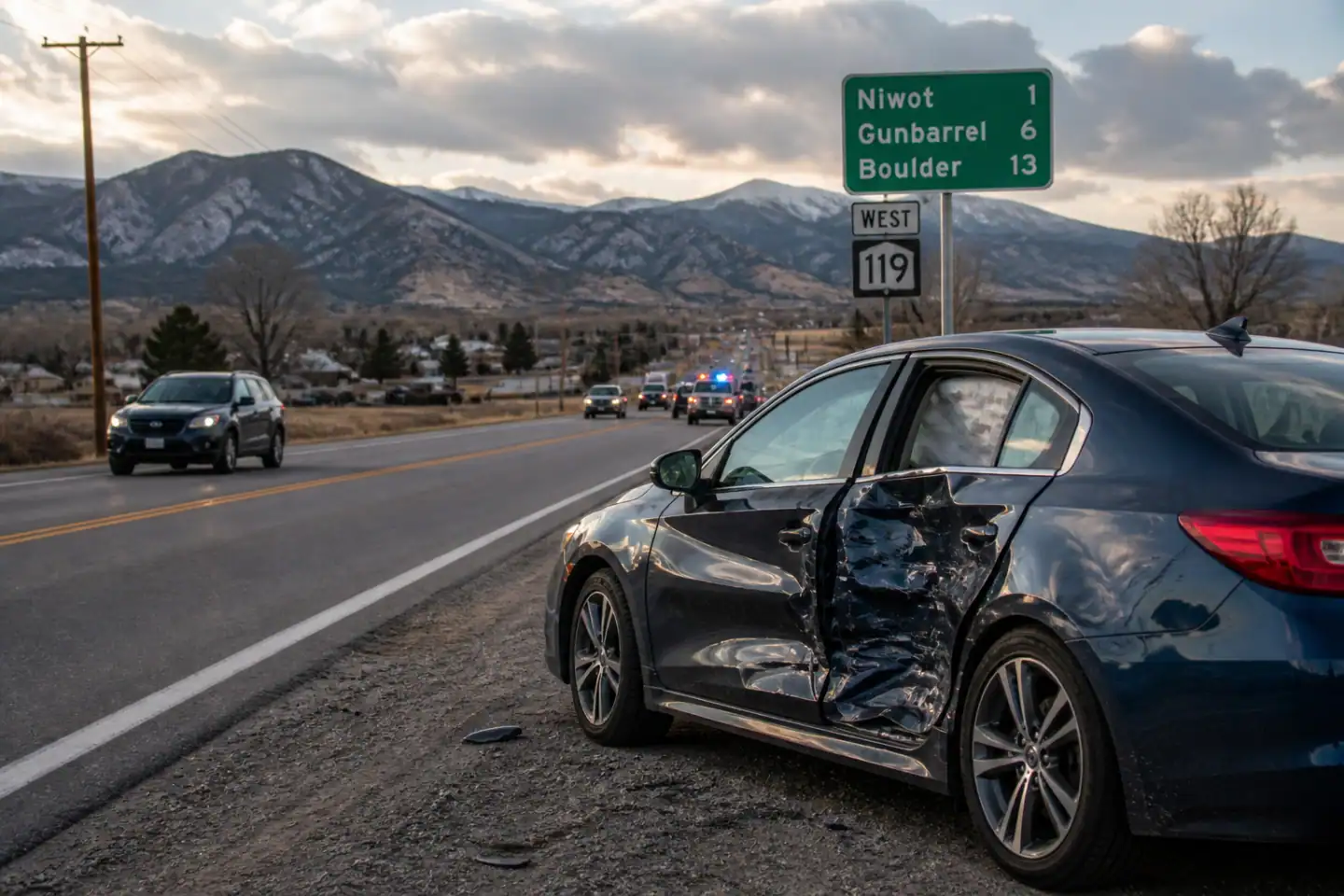
The Diagonal Highway is one of the most familiar drives in Boulder County and one of the most dangerous. US-119 runs from Longmont to Boulder at high speed, with cross traffic, bicycle traffic in the shoulder lanes, fluctuating speed limits as the highway transitions through Niwot and Gunbarrel, and intersection points that produce serious crashes year after year. If you have lived in Longmont for any length of time, you know somebody who has been in a Diagonal accident. If you have driven the Diagonal during morning or evening rush, you have seen close calls that almost became them.
This article is for the Longmont resident or commuter who has just been in a crash on the Diagonal and is trying to figure out what to do next. We handle Diagonal Highway crashes regularly, and we wrote this guide to share the things we wish every Longmont resident knew about their rights, the corridor’s hazards, and the insurance picture that follows a US-119 collision.
If you have been hurt on the Diagonal Highway, call us at 720-928-9178. The conversation is free, there is no obligation, and there is no fee unless we win your case.
Why the Diagonal Highway Is a High-Crash Corridor
The Diagonal is not a typical Colorado state highway. It is a high-speed corridor running at expressway speeds with at-grade intersections rather than full interchanges, which means cross-traffic conflicts at speeds where there is no margin for error. The highway also serves as a primary commuter route between Longmont and Boulder, generating concentrated traffic during rush hours that the corridor’s design was not built to handle at modern volumes.
The most consistent crash patterns we see on the Diagonal involve rear-end collisions at speed during slowdowns, T-bone crashes at the major intersections, single-vehicle run-off-road incidents on the curves near Niwot, and crashes involving cyclists in the shoulder lanes during peak cycling hours.
The Niwot intersections are a particular concern. The transition from open expressway speeds to intersection speeds, the offset access points, and the volume of agricultural and commercial traffic crossing the highway combine to create a setting where momentary inattention is enough to cause a catastrophic collision. The Boulder County and CDOT data on US-119 reflects this, and we see the human cost of it in our practice every year.
What to Do Immediately After a Diagonal Highway Crash
If you can move safely, do so. The Diagonal carries enough traffic at enough speed that a stopped vehicle in the travel lane is at high risk of being struck again. Move to the shoulder if your vehicle is operable and it is safe to do so.
Call 911. State troopers and Boulder County Sheriff deputies cover the corridor and respond to crashes here. Get an officer to the scene if possible. The official report becomes part of the evidence.
Document the scene. Photographs of the vehicles, the road, the weather, the lane positions, and any visible injuries. The Diagonal’s curves and intersections matter to the liability analysis, and photographs that capture the geometry of the scene are valuable later.
Seek medical attention immediately, even if you feel fine. Diagonal crashes occur at speeds where serious injury is possible even when the vehicle damage looks survivable. Brain injury, spinal injury, and internal trauma all present with delayed symptoms. Get evaluated.
Do not give a recorded statement to the other driver’s insurance company. Their adjuster will call, often within 24 hours, and try to get you to describe the crash on a recorded line before you have had time to process what happened. You are not obligated to do so.
Notify your own insurance carrier. Even if you intend to pursue the at-fault driver, you have contractual reporting obligations under your own policy.
The Insurance Picture After a US-119 Crash
The insurance dynamics on a Diagonal crash are like any other Colorado highway crash, with a few corridor-specific complications worth knowing.
If the at-fault driver carries only the Colorado state minimum liability coverage of 25/50/15, their coverage is almost certainly inadequate for any serious Diagonal-speed crash. A single emergency room visit after a high-speed collision routinely exceeds 25,000 dollars before treatment beyond the initial evaluation, and surgery for a herniated disc, a fracture, or a brain bleed can run into six figures on its own. The gap between what the at-fault driver carries and what your medical bills will be is the gap that destroys financial lives, and it is filled by your own UM/UIM coverage if you carry meaningful limits.
Diagonal crashes also frequently involve commercial vehicles, agricultural vehicles, and out-of-state drivers. Each of these complicates the coverage picture in ways that are worth a separate conversation. Commercial vehicles typically carry higher liability limits but introduce employer liability and federal regulatory issues. Out-of-state drivers complicate service of process. Our analysis of why commercial vehicle accident claims work differently covers the commercial layer in more detail.
How Fault Is Assigned in a Diagonal Highway Crash
Colorado is a modified comparative negligence state under CRS 13-21-111. Every party who contributed to the collision is assigned a percentage of fault, and your recovery is reduced by your percentage. If you are 50 percent or more at fault, you recover nothing.
In Diagonal crashes, the fault analysis often turns on speed, lane position, and whether anyone violated a traffic control device at one of the highway’s intersections. Cross-traffic crashes at the Niwot or Gunbarrel intersections often turn on which driver had the green or whether either driver entered the intersection on yellow. Rear-end crashes during slowdowns turn on following distance, brake timing, and whether either driver was distracted. Single-vehicle crashes on the curves often turn on speed for conditions, weather, and whether road defects or visibility played a role.
Fault is rarely as simple as the carrier’s first letter suggests. Independent investigation, witness statements, and crash reconstruction can change the picture substantially in cases where the facts are contested.
Cyclists on the Diagonal
The Diagonal is a primary route for serious road cyclists riding between Longmont and Boulder. The shoulder lanes are used heavily during peak cycling hours, and cyclist-vehicle conflicts on the corridor produce some of the most serious injury cases we handle.
Colorado law gives cyclists the right to use the road, and the three-foot passing law under CRS 42-4-1003 requires drivers to give cyclists at least three feet of clearance when passing. Drivers who fail to do so and cause a crash are at fault for the collision. Cyclists struck on the Diagonal frequently suffer catastrophic injuries because the speed differential is enormous, and these claims warrant aggressive representation.
What to Expect in the Months After a Diagonal Crash
A serious Diagonal Highway crash sets in motion a process that typically takes six to eighteen months from the date of the accident to a settlement, and longer if litigation becomes necessary. The medical treatment, the insurance investigation, the demand letter, the negotiation, and the lien resolution all proceed on their own timelines.
What we tell our Longmont clients in their first conversation with us is the same thing we tell every client. Focus on getting better. Follow your treatment plan. Stay off social media. Do not give recorded statements to the other driver’s carrier. Let us handle the rest.
Considering calling? Most callers tell us they wish they had called sooner. Speaking with us costs you nothing. There is no obligation, no pressure, no recording, and no fee unless we win your case. Call 720-928-9178 and tell us what happened. We will tell you what we think, honestly.
Frequently Asked Questions
Is the Diagonal Highway US-119 a state highway or interstate?
US-119, known locally as the Diagonal Highway, is a US route. It is maintained by the Colorado Department of Transportation. It is not an interstate highway and not a fully access-controlled expressway, which is one of the reasons crashes at its at-grade intersections are so consistent.
How long do I have to file a claim for a Diagonal Highway crash?
Three years from the date of the accident under CRS 13-80-101 for personal injury claims arising from a motor vehicle. If a governmental entity is involved, the notice deadline is 182 days. Different deadlines apply to wrongful death and other circumstances.
What if I was hit by an out-of-state driver on the Diagonal?
Out-of-state drivers do not change your right to bring a claim in Colorado. Colorado courts have jurisdiction over accidents that occur on Colorado roads. The practical complications are usually about service of process and locating the driver.
What if my injuries did not appear until days after the crash?
Delayed-onset injuries are common, particularly for whiplash, soft tissue injuries, and traumatic brain injuries. Adrenaline and stress can mask injury for hours or days. As long as you seek treatment promptly once symptoms appear, the delayed onset does not defeat the claim.
Should I accept the first settlement offer from the other driver’s insurance?
Almost never. The first offer in a serious Diagonal Highway case is almost always far below what the case is worth. The carrier knows you have not yet seen the full medical picture and is hoping to close the file at a discount.
What if my own insurance carrier is delaying my UM/UIM claim?
Colorado has strong bad faith insurance protections under CRS 10-3-1115 and 10-3-1116. Carriers that unreasonably delay or deny benefits face statutory damages including double the covered benefit and attorneys fees. If your own carrier is treating you unfairly, call us.
Are punitive damages available in Diagonal Highway crashes?
In cases involving DUI, hit-and-run, or other willful and wanton conduct, yes, under CRS 13-21-102. Punitive damages meaningfully increase settlement value because the carrier prices them as additional risk.
Sources
Colorado Revised Statutes 13-21-111: Comparative Negligence, leg.colorado.gov
Colorado Revised Statutes 13-21-102: Exemplary Damages, leg.colorado.gov
Colorado Revised Statutes 13-80-101: Three-Year Limitation for Motor Vehicle Tort Actions, leg.colorado.gov
Colorado Revised Statutes 10-4-609: Uninsured Motorist Coverage, leg.colorado.gov
Colorado Revised Statutes 42-4-1003: Overtaking and Passing Cyclists, leg.colorado.gov
Colorado Department of Transportation, US-119 Corridor and Crash Data, codot.gov
If you were hurt on the Diagonal Highway, please call us. The conversation is free and there is no obligation. We will tell you honestly what we see, what we think the realistic range looks like, and whether we think you need a lawyer at all. The clients who recover the most are usually the ones who called early. Reach Samantha Flanagan and the Flanagan Law team at 720-928-9178. We are a Colorado boutique firm. We answer our own phones. And we do not get paid unless we win your case.