Loveland or Greeley Accident on US-34: Northern Colorado’s Most Dangerous Highway Explained
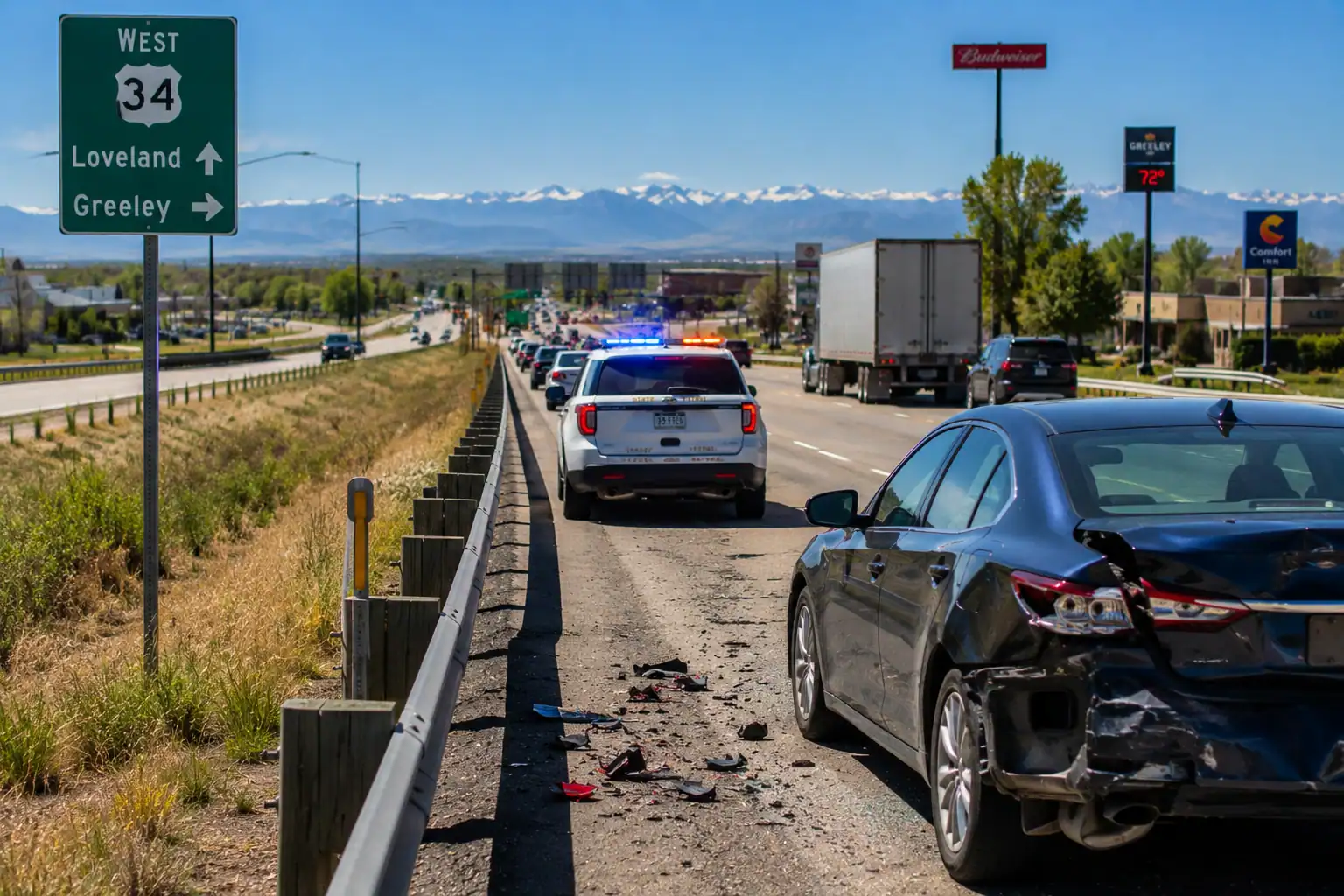
US-34 is the highway that connects northern Colorado together, running from Estes Park through Loveland and Greeley and out into eastern Colorado. The stretch between Loveland and Greeley, in particular, sees a volume of traffic that the highway’s design was not built to handle, and the result is a corridor that consistently appears in CDOT crash data as one of the most dangerous in the region. We see it in our practice. We handle US-34 crashes regularly, and the patterns repeat year after year.
This article is for the Loveland or Greeley resident, or anyone using US-34 as a daily corridor, who has just been in a crash and wants to understand the highway, the typical liability picture, and what to do next. We have written about Loveland accidents previously in our coverage of Loveland rear-end collision injury claims and Loveland truck accident claims, and this piece focuses on the corridor itself.
If you have been hurt on US-34, call us at 720-928-9178. The conversation is free, there is no obligation, and there is no fee unless we win your case.
Why US-34 Is Northern Colorado’s Most Dangerous Highway
US-34 carries a mix of traffic that produces conditions for serious crashes. Local commuters, agricultural traffic, commercial trucks, mountain-bound visitors, and through-traffic all share the road. The speed transitions between the open stretches outside the cities and the dense intersections within them are sharp. The intersections themselves, particularly along the Greeley side and the eastern stretches, are at-grade and produce cross-traffic conflicts at speeds where there is no margin.
The corridor’s design has not kept up with the population growth in Loveland, Greeley, and the surrounding Weld and Larimer County communities. The highway was designed as a regional connector for a population a fraction of what it serves today. The result is congestion at peak hours, speed-differential crashes when commute traffic backs up against agricultural traffic, and the chronic intersection conflicts that come with mixing local and through-traffic at scale.
The crash patterns we see most often involve rear-end crashes during slowdowns at speed, T-bone crashes at the major intersections, single-vehicle crashes along the curving sections east of Loveland, and crashes involving commercial trucks at the truck-heavy stretches.
The Loveland Side Crash Patterns
The Loveland portion of US-34, including the corridor through the city and the eastern approach toward I-25, sees a particular concentration of crashes around the major intersections and the commercial corridor.
The Lincoln Avenue and US-34 area, including the Centerra retail district, draws heavy local and visitor traffic, generating intersection and parking-area crashes consistently.
The I-25 interchange at US-34 is one of the busiest in northern Colorado and produces crashes involving the speed transitions between interstate and US route, drivers misjudging the merge, and rear-end crashes during congestion.
The corridor west of I-25 toward Loveland’s city center sees consistent commute traffic and the standard mix of intersection and rear-end crashes that come with it.
The Greeley Side Crash Patterns
The Greeley portion of US-34, including the corridor approaching Greeley from the west and the connection to the city’s road network, produces a different pattern.
The agricultural traffic mix is more pronounced on the Greeley side. Tractors, trucks hauling agricultural products, and equipment moving between fields all share the corridor with commuter traffic. The speed differential between agricultural vehicles and through-traffic is substantial.
The intersection at US-34 and Highway 257 is a known accident point. Cross-traffic conflicts at this intersection produce serious injury crashes regularly.
The eastern stretches of US-34 beyond Greeley, into eastern Weld County, see fewer crashes by volume but more severe crashes when they occur. The open-road speeds and the long sight lines produce overconfidence, and the crashes that result tend to be high-energy.
The Insurance Picture After a US-34 Crash
The insurance picture in a US-34 crash follows the standard Colorado framework, with a few corridor-specific notes.
Commercial vehicle involvement is more common on US-34 than on many comparable corridors. Agricultural trucks, oilfield trucks (the corridor sees substantial energy industry activity), and standard commercial freight traffic all share the road. Commercial coverage is often substantially higher than personal coverage, and the discovery of commercial coverage changes cases. Our coverage of why commercial vehicle accident claims work differently addresses this in detail.
Out-of-state driver involvement is common, particularly during summer months when Estes Park-bound visitors use US-34 as the access corridor. Out-of-state coverage and service of process complicate cases without changing the legal merits.
UM/UIM coverage on your own policy often becomes important. Drivers with state-minimum coverage are common on US-34, and serious crashes routinely exhaust the at-fault driver’s coverage. Our complete guide to Colorado auto insurance walks through the full coverage picture.
What to Do Immediately After a US-34 Crash
Call 911. Get state troopers to the scene. US-34 is a state highway and CSP responds.
Document the scene. Photographs, witness contacts, the position of vehicles, the lane markings, the weather, the time of day. The corridor’s design and the specific intersection or stretch where the crash occurred matter to the liability analysis.
Seek medical attention. The standard medical advice we have written about in how post-accident medical treatment decisions make or break your claim applies here.
Notify your own insurance carrier.
Do not give recorded statements to the at-fault driver’s carrier.
Engage counsel early. US-34 cases benefit from early evidence preservation, particularly in cases involving commercial vehicles where the EDR data and driver logs become critical.
What Your US-34 Crash Claim Is Worth
The framework for valuing a US-34 crash claim is the same as any Colorado car accident claim. The categories of damages, the comparative negligence rule, the insurance dynamics, all apply equally. We discuss the framework in our Colorado car accident settlement guide.
What changes in US-34 cases is often the specific evidentiary work needed. Crash reconstruction at corridor speeds, commercial vehicle data discovery, and intersection conflict analysis all warrant substantial expert support. The cases that are handled with this level of detail recover materially more than cases handled casually.
Frequently Asked Questions
How long do I have to file a US-34 accident claim?
Three years from the date of the accident under CRS 13-80-101. If a government entity is involved, the 182-day notice deadline applies.
What if I was hit by a commercial truck on US-34?
Commercial vehicle cases involve higher liability coverage, employer liability, and federal motor carrier regulations. Our coverage of these claims walks through the framework in detail.
What if I was hit by an out-of-state driver on US-34?
Out-of-state drivers do not change the legal merits of the claim. The case proceeds in Colorado courts under Colorado law. Service of process and locating the driver are practical complications.
Are agricultural vehicle crashes different from other US-34 crashes?
Agricultural vehicles typically carry insurance, and the liability analysis is similar to any other vehicle. Specific equipment configurations, low-speed operation in high-speed traffic, and vehicle visibility issues sometimes complicate the analysis.
Are US-34 crashes more often fatal than crashes on comparable highways?
CDOT data shows US-34 has consistent serious-injury and fatal crash patterns, particularly along the open-road stretches and at the major intersections. The corridor’s design and traffic mix contribute to crash severity.
Sources
Colorado Revised Statutes 13-21-111: Comparative Negligence, leg.colorado.gov
Colorado Revised Statutes 13-80-101: Three-Year Limitation for Motor Vehicle Tort Actions, leg.colorado.gov
Colorado Revised Statutes 10-4-609: Uninsured Motorist Coverage, leg.colorado.gov
Colorado Department of Transportation, US-34 Corridor and Crash Data, codot.gov
Federal Motor Carrier Safety Administration, Commercial Vehicle Regulations, fmcsa.dot.gov
If you were hurt on US-34 anywhere in northern Colorado, please call us. The conversation is free, there is no obligation, and we will tell you honestly what we see. Reach Samantha Flanagan and the Flanagan Law team at 720-928-9178. We are a Colorado boutique firm. We answer our own phones. And we do not get paid unless we win your case.