Why Your First Physical Exam After a Crash Becomes the Baseline for Your Entire Colorado Claim

Most people leave the scene of a crash thinking about the car. The insurance call, the tow, the rental. The exam room is not on the list, and if nothing is obviously broken, it can feel like an overreaction to go at all.
That first exam does something no later appointment can do. It establishes where your body was in the days immediately after the collision, measured and written down by a provider who examined you in person. Every argument that follows about how badly you were hurt, how long it lasted, and what it was worth gets compared against that record.
This is a separate question from what you say at that visit, which we covered in what to tell your doctor at your first visit. This article is about what the provider measures and records on their end, and why those specific findings carry weight later.
Subjective Complaints Versus Objective Findings
Insurance adjusters sort injury documentation into two piles, and they treat those piles very differently.
Subjective complaints are what you report. Neck pain. Headaches. Trouble sleeping. Difficulty turning your head to check a blind spot. These matter, and they belong in the record, but an adjuster can question them because they come from you and you have a financial interest in the outcome.
Objective findings are what a trained provider observes and measures independently. These are harder to argue with, because they do not depend on your word.
A thorough initial exam after a motor vehicle collision typically produces objective findings in several categories:
- Range of motion measured in degrees, comparing your movement against normal values for each direction the joint should travel
- Orthopedic testing, meaning specific physical maneuvers that provoke or rule out particular injury patterns
- Neurological screening covering reflexes, sensation, and muscle strength in the arms and legs
- Palpation findings, where the provider documents muscle guarding, spasm, swelling, or tenderness at specific anatomical locations
- Posture and gait observations that capture how you are compensating
- Functional limitations tied to real activity, such as inability to lift, sit, or drive for a given period
A record that contains only the sentence “patient reports neck pain” is a weak record. A record that documents cervical rotation limited to 45 degrees on the right against a normal value of 80, with positive orthopedic findings and palpable spasm at a named level, is a different document entirely.
Why the Timing of That Exam Matters So Much
The value of a baseline exam decays quickly, and it decays for a reason that has nothing to do with your honesty.
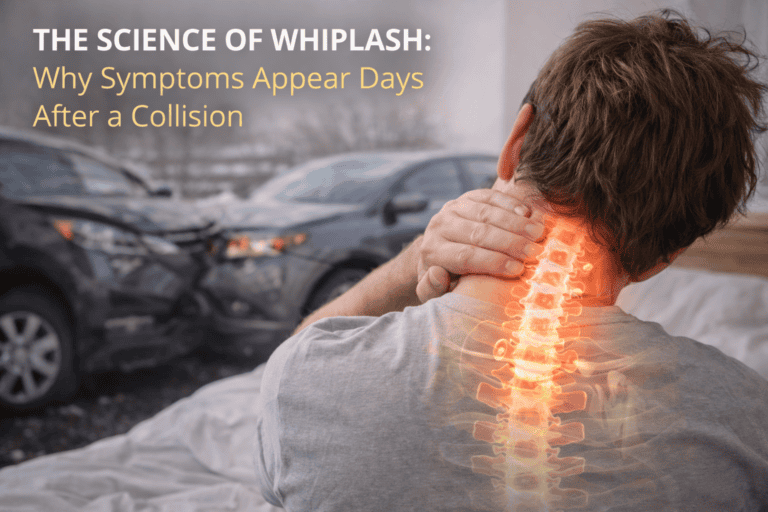
Soft tissue injuries frequently do not present at full severity right away. Adrenaline suppresses pain at the scene. Inflammation builds over the following 24 to 72 hours. Many people genuinely feel worse on day three than they did on day one, which we explained in more detail in the science of whiplash.
That creates a trap. If you wait two weeks to be examined because you were hoping it would resolve on its own, the insurer gets to argue that something else caused your symptoms during those two weeks. A weekend hike. Lifting a box. Sleeping wrong. The longer the gap between the collision and the first documented exam, the more room there is for that argument.
Getting examined promptly does not manufacture an injury. It documents one that already exists, at the point where the connection to the crash is hardest to dispute.
What a Multi-Disciplinary Intake Looks Like
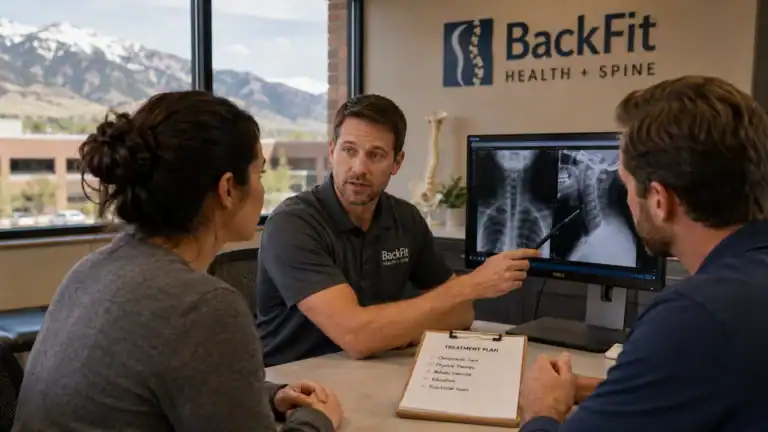
Not every provider approaches a post-collision exam the same way. Urgent care is built to rule out emergencies, which is exactly what it should do. A clinic that regularly treats motor vehicle injuries is built for something different, and the intake reflects that.
Accelerate Health, one of our Power Partners, sees crash patients at their Denver and Lakewood clinics with a team that includes chiropractors, physical therapists, sports medicine providers, and massage therapists working under one roof. Their auto injury intake is designed around the reality that a low speed impact can still produce weeks of neck pain, headaches, and shoulder trouble, and that some of it will not be evident on the first day.
That matters for two reasons. First, a provider who examines crash patients routinely knows which findings to look for and how to record them in a way that survives scrutiny. Second, when chiropractic, physical therapy, and rehabilitative care sit inside one practice, the record stays coherent instead of fragmenting across four unconnected offices with four unconnected charts.
We link to Accelerate Health because Colorado accident victims genuinely need somewhere to go in the first week, and because our clients have come back from their care in better shape than they started. Flanagan Law has no financial arrangement with them and receives nothing when you make an appointment.
What to Expect at the Visit
Bringing a few things makes the first exam more useful:
- The date, time, and location of the collision, and the direction of impact
- Whether you were belted, whether airbags deployed, and where you were seated
- Whether you hit your head or lost consciousness even briefly
- A written list of every symptom, including ones that seem minor or unrelated
- The specific activities you can no longer do, described concretely
- Any prior injuries to the same area, because concealing these damages your credibility far more than disclosing them
Answer honestly and completely. Do not exaggerate and do not minimize. Patients who downplay symptoms out of stoicism create records that undervalue real injuries, and patients who overstate them create records that fall apart under examination.
How the Baseline Gets Used Later
Six months on, the question is rarely whether you were in a collision. It is how much the collision actually cost you.
The baseline exam answers that by giving everyone a starting point. Progress notes from later visits get compared against it. Improvement is measured from it. A treating provider’s opinion about whether your condition is permanent rests on it. If the case is contested, an independent examiner hired by the insurance company will read it closely, looking for gaps and inconsistencies.
A well documented baseline also protects you when your recovery is not linear. Almost nobody heals in a straight line. Good and bad weeks are normal. What raises questions is a record that begins vaguely and stays vague, because there is nothing solid to anchor the rest of the story to.
Treatment decisions after the baseline carry their own weight, which we address in how post-accident medical treatment decisions make or break your claim.
Frequently Asked Questions
How soon after a Colorado car accident should I be examined?
As soon as possible, ideally within 72 hours of the collision. This window matters because soft tissue inflammation peaks in the first few days and because a short gap between the crash and the exam leaves little room for an insurer to argue that something else caused your symptoms. If you have already waited longer than that, get examined now rather than waiting further.
What is the difference between subjective complaints and objective findings?
Subjective complaints are symptoms you report, such as pain or headaches, while objective findings are things a provider independently measures or observes, such as restricted range of motion, positive orthopedic tests, or palpable muscle spasm. Insurers weigh objective findings more heavily because they do not depend on the patient’s word. A strong medical record contains both.
Does going to urgent care count as my baseline exam?
An urgent care visit helps establish the date of injury but usually does not produce a detailed baseline. Emergency and urgent care providers are trained to rule out fractures, bleeds, and other immediate dangers, not to measure range of motion in degrees or document functional limitations. Most people benefit from a follow-up exam with a provider who regularly treats motor vehicle injuries.
Will seeing a chiropractor after a crash hurt my claim?
No. Chiropractic care is an accepted form of treatment for motor vehicle injuries in Colorado, and adjusters routinely process claims that include it. What weakens a claim is inconsistent attendance, unexplained gaps in care, or records that lack objective measurement. We cover this in more depth in our article on chiropractic care after a Colorado car accident.
Should I tell the provider about an old injury to the same body part?
Yes, always. Prior injuries almost always surface eventually through medical records, and an omission that comes to light later undermines everything else you have said. Colorado law allows recovery when a collision aggravates a preexisting condition, so disclosing the history usually costs you far less than concealing it would.
What if I feel fine right after the accident?
Feeling fine immediately after a collision is common and is not reliable evidence that you were uninjured. Adrenaline masks pain at the scene, and many soft tissue injuries take one to three days to become apparent. A brief evaluation while you feel fine costs very little and creates a record that becomes valuable if symptoms appear later.
Do I need a lawyer before my first medical visit?
No, and you should never delay medical care in order to speak with an attorney first. Get evaluated, then call. An attorney can help coordinate treatment, handle the insurer, and protect the record from that point forward, but the exam itself should not wait on a phone call.
Talk to Flanagan Law
Flanagan Law is a boutique Colorado firm focused exclusively on vehicle accident cases across the Denver metro and Front Range. If you were hurt in a collision and you are unsure what to do first, call 720-928-9178. Someone answers 24 hours a day.
This article is general information about how medical documentation functions in Colorado injury claims. It is not medical advice and it is not legal advice for your particular situation.