School Bus Stop-Arm Violations in Colorado: The Law, the Exception, and Who Is Liable
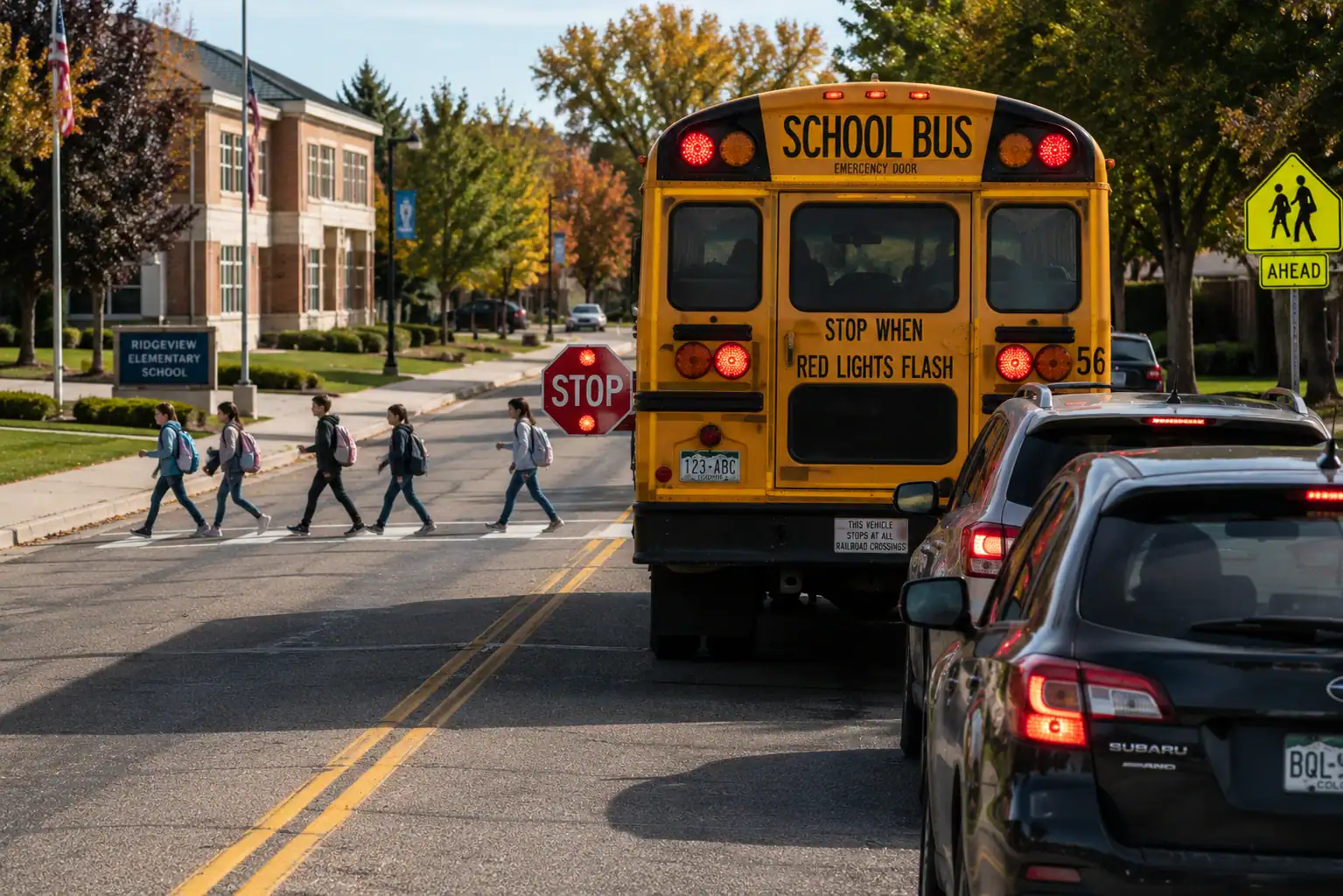
The most dangerous part of a school bus route is not the ride. It is the thirty seconds a child spends outside the bus, crossing a road while traffic in both directions is supposed to be stopped.
Colorado has a specific statute governing that moment, and drivers violate it constantly, often without realizing they have.
What Colorado Law Requires
A school bus signals in two stages, and the stages mean different things.
Flashing amber lights mean the bus is preparing to stop. Drivers approaching from either direction should slow and prepare to stop. This is the warning phase, and it is the phase drivers most often ignore by accelerating to get past before the reds come on.
Flashing red lights and an extended stop arm mean stop. Drivers approaching from both directions must stop at a distance from the bus and remain stopped until the arm retracts, the red lights stop flashing, and the bus begins moving again or signals drivers to proceed.
Passing a stopped school bus with its red lights active and stop arm extended is a serious traffic offense in Colorado, carrying substantially higher penalties than an ordinary moving violation, along with license points.
The Divided Highway Exception, Which Drivers Get Wrong
This is the part that generates the most confusion and the most bad guesses at the wheel.
On a divided highway, drivers traveling in the opposite direction from the bus are generally not required to stop, because a physical barrier or median separates the roadways and children are not expected to cross them.
The critical detail is what counts as divided. A physical separation, a raised median, a barrier, or a genuine separation of the roadways is what triggers the exception. A center turn lane does not divide a highway. A painted stripe does not divide a highway. Two solid yellow lines do not divide a highway.
Multi-lane arterials with center turn lanes are extremely common across the Denver metro, and they are exactly where drivers wrongly assume they may proceed. When in doubt, stop. The cost of stopping unnecessarily is a few seconds.
Where Children Actually Get Hit
The area immediately surrounding a stopped school bus is the highest risk zone, and the reasons are physical rather than legal.
A child crossing in front of a bus is below the driver’s sightline for part of the crossing. A child who drops something and returns for it disappears entirely. Children who miss the bus run alongside it. And a child stepping out from in front of a stopped bus is invisible to passing traffic until the moment they clear the front bumper, which is precisely why the stop requirement exists.
Two distinct collision types follow from this, and they lead to very different claims.
A passing motorist strikes the child. The motorist violated a safety statute enacted specifically to protect children in that exact situation. In a Colorado civil claim, violation of a statute designed to protect a particular class of people from a particular type of harm is strong evidence of negligence, and it is difficult to argue around.
The bus itself strikes the child. This is a different case entirely, because the defendant is usually a school district or a contracted transportation company.
When the Bus Is the Problem
If a public school district bus injures a child, Colorado’s Governmental Immunity Act governs the claim. Immunity is waived for the operation of a motor vehicle by a public entity, so these claims can proceed, but they carry a short written notice requirement running from the date of injury.
Missing that notice deadline can end an otherwise strong claim permanently, regardless of the severity of the child’s injuries. It runs while the family is still in the hospital, and it does not wait for anyone to feel ready. The mechanics are covered in hit by a government vehicle in Colorado.
Where a district contracts transportation to a private company, the analysis differs and the notice requirement may not apply the same way. Determining which entity actually operated the bus is therefore an early and urgent question, not a detail to sort out later.
Evidence That Exists and Then Does Not
School bus cases have unusually good evidence available, and unusually short windows to get it.
- Most school buses carry multiple interior and exterior cameras, and many have stop arm cameras aimed at passing traffic
- Buses commonly carry GPS and telematics recording speed, position, and door and stop arm activation with timestamps
- Route logs establish the scheduled stop location and time
- Other children on the bus are witnesses, and they are findable through the school in the first days and much harder to identify later
- The bus driver files an incident report
These systems overwrite. Districts and contractors follow retention schedules measured in days or weeks, not months. A written preservation request to the district and to any transportation contractor should go out immediately, and it should specifically name video, telematics, GPS, route records, and driver reports.
What a Family Should Do
- Call 911 and get the child evaluated even if they appear unhurt
- Photograph the scene before anything moves, including bus position, stop arm, roadway markings, and whether a median exists
- Record the bus number, district, and any contractor name on the vehicle
- Get names and contact information for adults at the stop, since parents waiting at bus stops are frequently the best witnesses
- Send a written preservation request to the district immediately
- Do not give a recorded statement to any insurer before you understand the injuries
- Watch for head injury symptoms over the following days
A child’s own conduct is not judged by the adult standard in Colorado, and a parent’s inattention generally is not charged against the child’s claim. Both points are covered in our article on Colorado school zone law, and the settlement mechanics specific to minors are covered in the Colorado parent’s legal guide.
For Drivers
- Amber lights mean stop is coming, not hurry
- A center turn lane is not a divided highway
- Stay stopped until the arm retracts and the bus moves
- Expect a second child, because there is almost always a second child
- Assume a stop arm camera is recording, because increasingly it is
Frequently Asked Questions
When do I have to stop for a school bus in Colorado?
You must stop when a school bus displays flashing red lights and an extended stop arm, whether you are approaching from behind or from the opposite direction. Remain stopped until the stop arm retracts, the red lights stop flashing, and the bus resumes travel. Flashing amber lights are a warning that the bus is preparing to stop.
Do I have to stop for a school bus on a divided highway?
Drivers traveling in the opposite direction on a genuinely divided highway are generally not required to stop, because a physical median or barrier separates the roadways. A center turn lane, painted lines, or a two-way left turn lane does not make a road divided. If there is no physical separation, stop.
What is the penalty for passing a stopped school bus in Colorado?
Passing a school bus displaying flashing red lights and an extended stop arm is treated as a serious traffic offense in Colorado, carrying a substantially higher fine than ordinary moving violations along with license points. Penalties increase for repeat offenses, and a violation can also serve as evidence of negligence in a civil injury claim.
Who is liable if a school bus hits my child?
It depends on who operated the bus. A public school district is subject to Colorado’s Governmental Immunity Act, which waives immunity for the operation of a motor vehicle but imposes a short written notice deadline running from the date of injury. If a private contractor operated the bus, the analysis differs. Identifying the operating entity is an urgent first step.
Is there video of a school bus accident?
Usually, and often several angles. Most buses carry interior and exterior cameras, many have stop arm cameras aimed at passing traffic, and telematics systems record speed, position, and stop arm activation. All of it is subject to retention schedules measured in days or weeks, so a written preservation request needs to go out immediately.
What if my child was hit while running to catch the bus?
The claim is still viable. Colorado measures a child’s conduct against what a reasonably careful child of similar age and experience would do, not against the adult standard, and very young children are generally treated as incapable of negligence. A driver near a school bus stop is expected to anticipate exactly this behavior.
Talk to Flanagan Law
Flanagan Law is a boutique Colorado firm handling vehicle accident cases across the Denver metro and Front Range. If your child was injured at a school bus stop, call 720-928-9178. Someone answers 24 hours a day.
This article is general information about Colorado law and is not legal advice for your particular situation.