I-70 Mountain Corridor Crash Statistics: Where the Most Dangerous Miles Are and Why
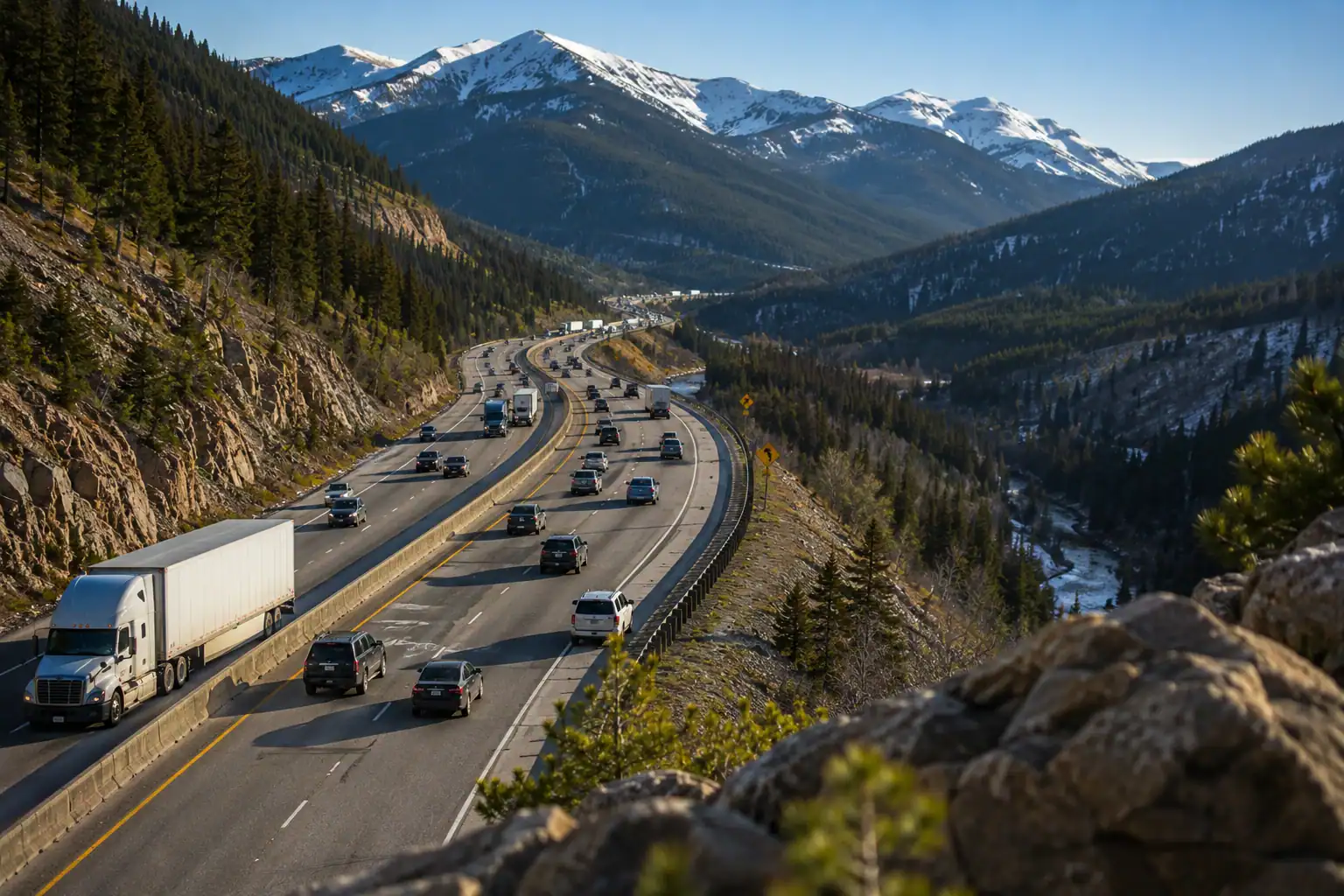
The I-70 mountain corridor is the road most Colorado families drive when something matters. The ski weekend. The summer hike. The family wedding in Glenwood Springs. The drive to the airport at four in the morning because the flight is at six and the alternative was no flight at all. The road carries us through some of the most beautiful country in North America, and it also carries a disproportionate share of the serious crashes that happen in Colorado each year.
This article looks at where on the corridor those crashes happen most, why those specific stretches are more dangerous than others, and what to do legally if you have been involved in a crash on I-70 between Denver and the Utah border. We have handled mountain corridor crashes for years and the patterns are consistent enough to be worth knowing before you make your next trip up.
If you have been hurt in an I-70 mountain crash, call us at 720-928-9178. The conversation is free, there is no obligation, and there is no fee unless we win your case.
The Corridor in Numbers
I-70 from Denver to the Utah border is approximately 285 miles long. Roughly the first one hundred miles, from C-470 to Glenwood Springs, is the stretch most Colorado residents and visitors actually use, and it is the stretch where the bulk of the serious crashes occur. CDOT data consistently shows the corridor produces a higher rate of severe and fatal crashes per mile than comparable Colorado interstate stretches, and the patterns are predictable enough that the dangerous miles can be identified by name.
The corridor carries traffic that mixes high-speed through-traffic, slow-moving commercial trucks on grades, recreational vehicles operated by drivers unfamiliar with mountain driving, and weekend ski and tourist traffic that produces predictable volume spikes. The result is a road where the variance in driver experience and vehicle capability is enormous, and that variance is what produces crashes.
The Most Dangerous Miles, by Section
The Eisenhower Tunnel approaches. The eastern approach to the tunnel from Silverthorne and the western approach descending toward Frisco produce a consistent pattern of crashes related to commercial trucks losing brakes on the descent, vehicles changing lanes into trucks unable to slow quickly, and chain-up zone backups that create rear-end conditions.
The Vail Pass corridor. The stretch between Frisco and Vail, including the long climb to Vail Pass and the descent into Vail, produces crashes related to weather, speed differential between fast and slow traffic, and the curvature of the road. Snow and ice in winter, sun glare in summer.
The Glenwood Canyon. The narrow canyon stretch between Glenwood Springs and Dotsero is one of the most beautiful and most legally complex sections of the corridor. The road is narrower than standard interstate, the shoulders are minimal, and incidents that would be manageable elsewhere become catastrophic in the canyon. Rockfall and weather closures are common.
The Floyd Hill descent. The stretch between Idaho Springs and the eastern end of the corridor near Genesee includes the Floyd Hill descent, where commercial trucks routinely lose brake function on the long downhill grade. The runaway truck ramps that punctuate the descent are not decorative.
The Wolcott to Eagle stretch. The relatively flat section in the Eagle River Valley sees high-speed crashes related to driver fatigue, particularly during overnight travel by drivers returning to the Front Range after a weekend in the mountains.
Why Mountain Crashes Produce Different Cases
Mountain corridor crashes differ from typical Colorado highway crashes in several legally meaningful ways.
The injuries tend to be more severe. The combination of speed, terrain, and frequent commercial vehicle involvement produces crashes where the injury profile skews catastrophic. Traumatic brain injury, spinal cord injury, and wrongful death are all more common in mountain crashes than in comparable Front Range crashes.
The insurance picture is often deeper. Commercial trucks operating on I-70 typically carry liability coverage of one million dollars or higher under federal motor carrier regulations. Discovery of the full coverage picture is essential. Our coverage of why commercial vehicle accident claims work differently walks through the framework.
Out-of-state driver involvement is frequent. The corridor draws drivers from across the country, particularly during ski season and summer. Out-of-state drivers do not change the legal merits of a Colorado claim, but they complicate service of process and locating the driver after the fact.
The jurisdictional question can be complicated. Mountain crashes occur across multiple Colorado counties. The case is generally filed in the county where the accident occurred, but in some cases the jurisdiction analysis warrants careful thought.
Multi-vehicle crashes are common. Mountain corridor crashes frequently involve more than two vehicles, particularly during high-traffic periods when a single crash cascades into a pileup. The liability and coverage analysis in multi-vehicle cases requires more work than a typical two-vehicle case.
What Happens to the Evidence in a Mountain Crash
Evidence preservation in mountain crashes is particularly time-sensitive.
Vehicles involved in mountain crashes are often impounded at facilities in mountain towns where evidence preservation is not always a priority. We send preservation letters within hours of taking on a serious mountain case to ensure event data recorder (“black box”) data, vehicle damage, and any other physical evidence is preserved.
Commercial truck driver logs and hours-of-service records are governed by federal regulations and have specific retention requirements. Discovery of these records on commercial vehicles requires prompt action.
Weather data at the time of the crash is available from federal sources but specific to the location. We obtain weather records for the exact mile marker and time of the crash routinely.
Witness statements deteriorate quickly when the witnesses are out-of-state visitors. Getting contact information at the scene matters more than usual.
The Insurance Layers in a Mountain Crash
A serious mountain crash typically involves multiple insurance layers.
The at-fault driver’s liability coverage. For commercial vehicles, this is often one million dollars or higher. For private vehicles, the coverage varies widely and is often inadequate for catastrophic injuries.
Commercial coverage and employer liability. If the at-fault driver was operating in the course of employment, the employer’s coverage applies and employer liability may extend the recovery.
UM/UIM coverage on your own policy. Often becomes the largest source of recovery in serious cases where the at-fault driver’s coverage is exhausted. We address the full coverage analysis in our complete guide to Colorado auto insurance.
Umbrella policies on both sides. Drivers with substantial assets often carry umbrellas. Discovery of all available coverage is essential.
What to Do Immediately After a Mountain Crash
Get to safety if you can. The corridor’s narrow shoulders mean a stopped vehicle in the travel lane is at high risk of being struck.
Call 911. Colorado State Patrol covers the corridor.
Seek medical attention at a trauma center if the injuries warrant it. The mountain towns have limited hospital capacity. Serious cases typically transfer to Denver-area trauma centers, sometimes by air. Get the highest level of care that is available.
Document the scene thoroughly. Mountain crashes often involve evidence that is unique to the corridor, including weather conditions, road condition, mile marker, the position of guard rails, the presence or absence of warning signs.
Notify your own insurance carrier.
Do not give recorded statements to the at-fault driver’s insurance carrier.
Engage counsel quickly. Evidence preservation on mountain crashes is time-sensitive.
Frequently Asked Questions
How long do I have to file an I-70 mountain crash claim?
Three years from the date of the accident under CRS 13-80-101 for personal injury claims arising from a motor vehicle. If a government entity is involved, the 182-day notice deadline under CRS 24-10-109 applies.
What if the at-fault driver was a tourist from out of state?
Out-of-state drivers do not change the legal merits of a Colorado claim. Colorado courts have jurisdiction over accidents on Colorado roads. The practical complications are usually about service of process.
What if I was hit by a commercial truck on I-70?
Commercial vehicle cases involve federal motor carrier regulations, higher liability coverage, and employer liability. The investigation requires prompt action to preserve driver logs, EDR data, and other federal-regulated evidence.
What if the crash occurred in Glenwood Canyon?
Glenwood Canyon crashes are subject to the same Colorado law as other I-70 crashes. The canyon’s specific conditions, including the narrow shoulders, frequent closures, and weather exposure, often factor into the liability and damages analysis.
Are mountain crashes more often fatal than Front Range crashes?
CDOT data consistently shows that the I-70 mountain corridor produces a higher rate of severe and fatal crashes per mile than comparable Colorado interstate stretches. The combination of speed, terrain, weather, and traffic mix contributes.
What about CDOT liability for road conditions?
CDOT can have liability under the Governmental Immunity Act in narrow circumstances. The 182-day notice deadline applies. We address the framework in our coverage of suing government entities under CRS 24-10.
Sources
Colorado Revised Statutes 13-80-101: Three-Year Limitation for Motor Vehicle Tort Actions, leg.colorado.gov
Colorado Revised Statutes 13-21-111: Comparative Negligence, leg.colorado.gov
Colorado Revised Statutes 24-10-101 et seq.: Colorado Governmental Immunity Act, leg.colorado.gov
Colorado Department of Transportation, I-70 Mountain Corridor Resources, codot.gov
Federal Motor Carrier Safety Administration, Commercial Vehicle Regulations, fmcsa.dot.gov
National Highway Traffic Safety Administration, Crash Data, nhtsa.gov
If you have been hurt on the I-70 mountain corridor, please call us. The conversation is free and there is no obligation. Mountain crashes require fast, experienced action on evidence preservation, and the clients who recover the most are typically the ones who called early. Reach Samantha Flanagan and the Flanagan Law team at 720-928-9178. We are a Colorado boutique firm. We answer our own phones. And we do not get paid unless we win your case.