Greenwood Village Car Accident Near I-25 and Arapahoe: High-Stakes Claims in the DTC Corridor
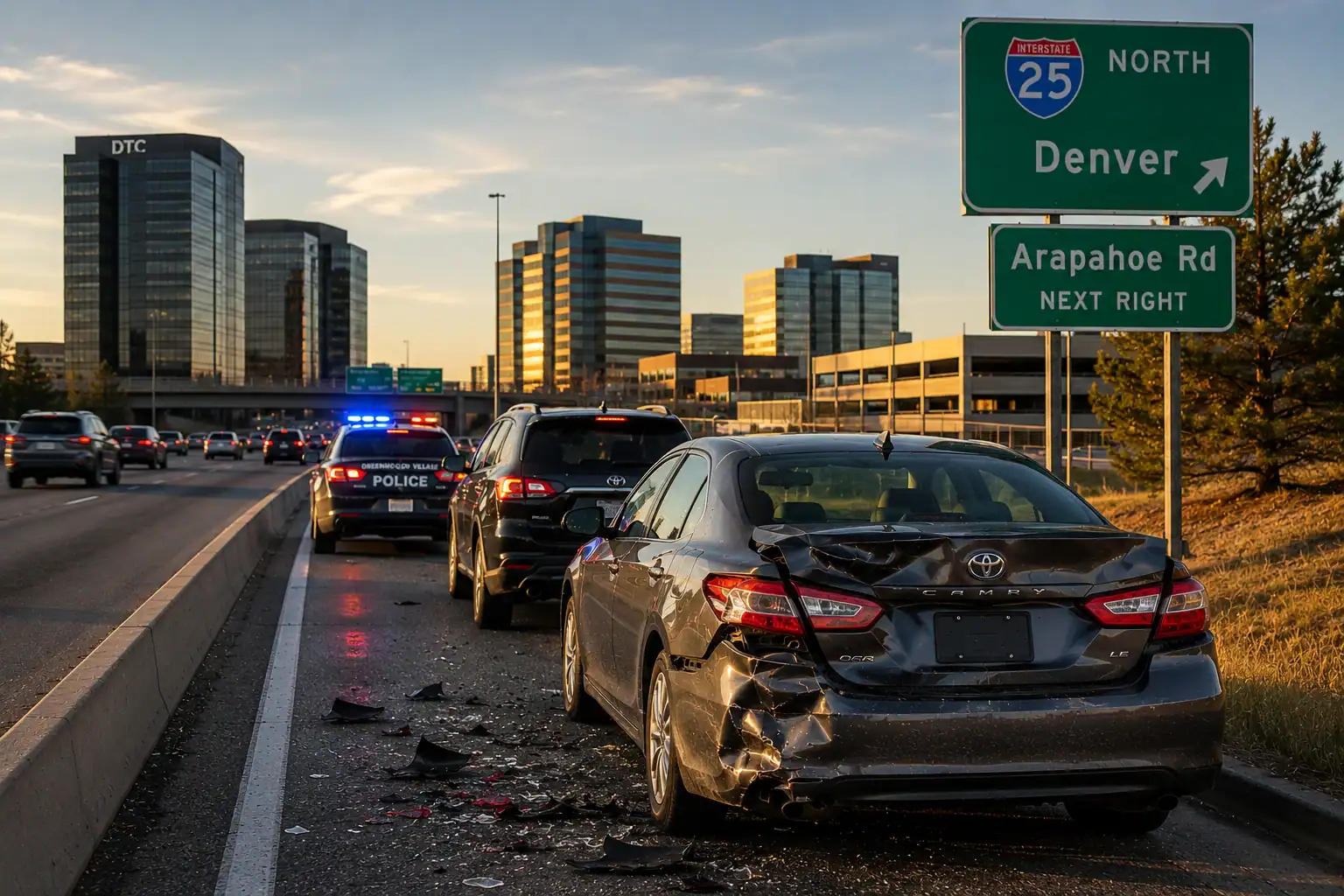
The Denver Tech Center corridor along I-25 between Belleview and Lincoln Avenue is one of the highest-income employment centers in Colorado. The corridor’s businesses include major corporate headquarters, professional services firms, and the broader cluster of technology, finance, and professional industries that gave the area its name. The drivers who commute through the DTC corridor every day are, on average, higher-earning than the metro average, and the crashes that happen in the corridor produce claims that often involve substantial lost income and complex damages analysis.
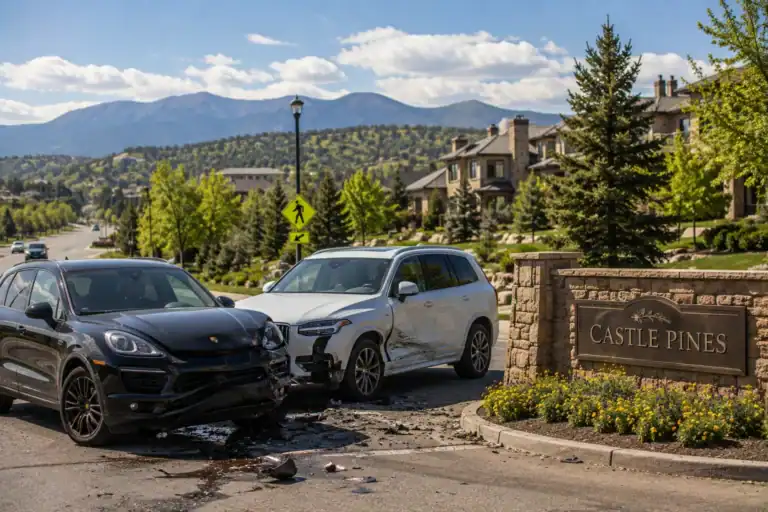
This article is for the Greenwood Village resident or DTC commuter who has been in a crash near I-25 and Arapahoe Road. We have written about other high-income suburban claim dynamics in our recent coverage of Lone Tree and Castle Pines, and the framework that applies there applies here. The DTC-specific corridor and its commuter patterns add some specifics.
If you have been hurt in a Greenwood Village or DTC corridor crash, call us at 720-928-9178. The conversation is free, there is no obligation, and there is no fee unless we win your case.
Where DTC Corridor Crashes Happen Most
The I-25 and Arapahoe Road interchange is one of the busiest in Colorado. The interchange handles substantial commuter volume in both directions during peak hours, and the merging and exiting dynamics produce consistent crashes.
The DTC Boulevard corridor running parallel to I-25 sees consistent commuter and business traffic, with intersection crashes at the major signalized intersections.
The Belleview Avenue interchange to the north and the Orchard Road interchange to the south produce similar crash patterns at smaller scale.
The internal road network of the DTC, including the access points to and from the office park, generates the standard mix of intersection and parking lot crashes.
Why DTC Crashes Often Involve High-Income Claimants
The DTC corridor is one of the highest-income employment areas in Colorado. The drivers who commute through the corridor every day are disproportionately professionals, executives, and business owners whose compensation includes substantial non-base elements.
The lost wages and lost earning capacity components of a serious DTC crash claim are typically large. The compensation includes base salary plus bonus plus deferred compensation plus equity vesting plus partner draws plus other forms of compensation that require forensic accountant and economist support to present credibly.
We addressed the broader high-income suburban claim dynamics in our recent piece on Castle Pines high-income claims and our earlier piece on Lone Tree near Park Meadows. The DTC corridor warrants the same careful approach.
The Insurance Picture
The insurance picture in a DTC crash often involves multiple layers.
The at-fault driver’s primary coverage is the starting point. If they were operating a commercial or company vehicle, commercial coverage of one million dollars or more may apply.
The at-fault driver’s umbrella coverage, if any, must be discovered. DTC corridor drivers often carry umbrellas, and discovery of that coverage can change the case substantially.
Your own UM/UIM coverage applies when the at-fault driver’s coverage is exhausted. Stacking analysis across household policies and any umbrella that includes UM/UIM can produce substantial additional coverage.
Your own MedPay applies regardless of fault.
The full coverage picture is addressed in our complete guide to Colorado auto insurance.
What to Do After a DTC Corridor Crash
Standard advice applies. Call 911. Get police to the scene. Greenwood Village Police, Cherry Hills Village Police, or Colorado State Patrol respond depending on the location.
Document the scene.
Seek medical attention.
Notify your own carrier.
Do not give recorded statements to the at-fault driver’s carrier.
Engage counsel early. The cases warrant experienced representation.
Frequently Asked Questions
How long do I have to file a DTC crash claim?
Three years from the date of the accident under CRS 13-80-101.
What if I was hit by a corporate vehicle?
Commercial coverage applies, often providing one million dollars or more in liability protection. Employer liability may also apply if the driver was acting within the scope of employment.
How are bonuses and stock compensation treated in lost wage calculations?
Properly documented, they are all part of the lost income calculation. Forensic accountants and economists are typically needed to present them credibly.
Should I accept the first offer?
Almost never.
What if my injuries affect my ability to work in a high-skill profession?
Lost earning capacity covers the difference between what you could have earned and what you can now earn. The numbers in cases involving significant earning capacity loss can be very large.
Sources
Colorado Revised Statutes 13-21-111: Comparative Negligence, leg.colorado.gov
Colorado Revised Statutes 13-80-101: Three-Year Limitation for Motor Vehicle Tort Actions, leg.colorado.gov
Colorado Revised Statutes 10-4-609: Uninsured Motorist Coverage, leg.colorado.gov
Colorado Department of Transportation, I-25 Corridor and Crash Data, codot.gov
Arapahoe County, Colorado, Public Safety Resources, arapahoegov.com
If you have been hurt in a Greenwood Village or DTC corridor crash, please call us. The conversation is free and there is no obligation. Reach Samantha Flanagan and the Flanagan Law team at 720-928-9178. We are a Colorado boutique firm. We answer our own phones. And we do not get paid unless we win your case.