How Black Box Data Is Used in Colorado Car Accident Claims: What EDR Evidence Can Prove
Your car has a black box. After a Colorado accident, that data can determine who caused the crash. Here is how EDR evidence works and how to preserve it before its gone.
Most drivers know that commercial trucks carry electronic logging devices and black boxes that record driving data. Far fewer know that their personal vehicle almost certainly has one too. Event Data Recorders have been standard equipment in American passenger vehicles for decades, and since 2014 federal regulations have required EDRs in virtually all new passenger vehicles sold in the United States. The data these devices capture in the seconds before and during a crash is among the most objective and powerful evidence available in a Colorado accident claim, and most people have no idea it exists until an attorney tells them.
This article explains what EDR data records, how it is obtained and used in Colorado accident claims, what it can prove, and the critical preservation steps that must happen quickly after a crash to ensure this evidence is not lost.
What Event Data Recorders Capture
An Event Data Recorder in a passenger vehicle functions similarly to the flight data recorder on an aircraft, recording a continuous loop of vehicle operational data and locking the most recent data when a triggering event, typically a crash or near-crash, occurs. The specific data captured varies by vehicle make, model, and year, but most modern EDRs record some combination of the following in the five to ten seconds preceding a crash event.
Vehicle speed at impact and in the seconds before. This is often the single most valuable data point in a liability dispute. A driver who claims they were traveling at 35 miles per hour when the EDR shows 62 miles per hour has a significant credibility problem. Speed data from the EDR is not subject to the reconstruction uncertainty that attaches to speed estimates based on skid marks and damage patterns.
Brake application timing and force. Whether the driver applied brakes before impact, when they applied them, and how hard they pressed are all recorded. A driver who claims they braked but whose EDR shows no brake application in the three seconds before impact has provided the accident reconstructionist with powerful evidence.
Throttle position. Whether the driver was accelerating, coasting, or had lifted off the throttle at impact. Combined with speed data, throttle position helps reconstruct whether the driver made any attempt to avoid the crash.
Steering angle and rate of change. Sudden steering inputs in the seconds before impact can indicate an evasive maneuver, an overcorrection, or simply the driver’s heading at impact.
Seatbelt status for front seat occupants. Whether belts were buckled at the time of the crash is recorded on most systems, which is directly relevant to injury causation and comparative fault arguments in unbuckled occupant cases.
Airbag deployment timing and which airbags deployed. This data helps reconstruct the direction and severity of the impact.
How EDR Data Is Obtained in a Colorado Accident Case
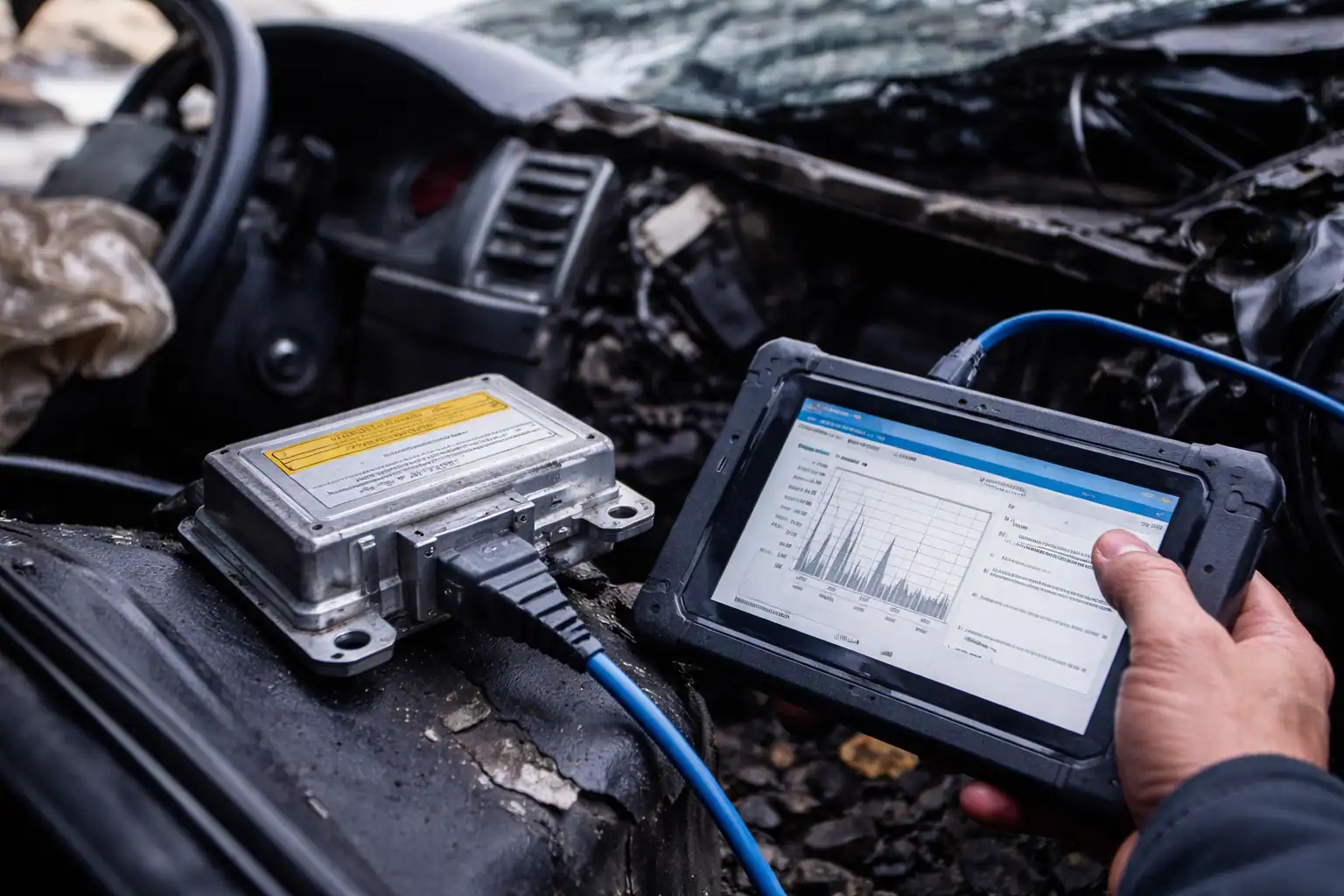
EDR data does not download itself. Accessing the data requires a qualified accident reconstructionist using specialized equipment, typically a Bosch Crash Data Retrieval tool or equivalent, to connect to the vehicle’s diagnostic port and extract the stored data. This process must be performed before the data is overwritten, the vehicle is repaired, or the module is replaced.
In the civil litigation context, your attorney can request the at-fault driver’s EDR data through discovery. This request should be made early in the litigation process, accompanied by a vehicle preservation demand that prohibits the at-fault driver or their insurer from repairing or disposing of the vehicle until the EDR data has been extracted. Destroying or failing to preserve EDR data after receiving a preservation demand constitutes spoliation, which can result in adverse inference instructions to the jury.
For your own vehicle’s EDR data, the decision about whether to extract it depends on whether it supports or complicates your account of the crash. Your attorney will make this assessment as part of the initial case evaluation.
Colorado courts have consistently accepted properly authenticated EDR data as admissible evidence. Authentication requires establishing the chain of custody for the data, the qualifications of the person who extracted it, and the reliability of the extraction equipment and process.
What EDR Data Can Prove in a Colorado Accident Claim
Speed disputes are the most common application. When an at-fault driver claims they were traveling at a lawful speed and the EDR shows otherwise, the speed data eliminates the dispute in favor of the objective record. This is particularly valuable in cases where the physical evidence of the crash, such as the extent of vehicle damage, is ambiguous about the impact speed.
Brake application disputes arise in rear-end collision cases where the following driver claims they applied brakes but the crash occurred anyway, arguing the lead vehicle stopped too suddenly. EDR data showing the following driver applied no brakes in the three seconds before impact contradicts this narrative directly.
Distraction reconstruction is an emerging application. While EDR data does not directly record phone use, the combination of no brake application, no steering input, and no throttle reduction in the seconds before a crash that should have been avoidable is circumstantially consistent with a driver who was not watching the road. Combined with cell phone records showing active device use at the time of impact, this pattern supports a distracted driving narrative powerfully.
Seatbelt data addresses the comparative fault argument that an unbelted occupant’s injuries were their own responsibility. If the EDR shows the occupant was not belted, this is relevant to the damages analysis under Colorado’s comparative negligence rules at CRS 13-21-111. If the EDR shows the occupant was belted and the defense claims otherwise, the EDR data resolves the dispute.
Call us at 720-928-9178 if you were hurt in a Colorado accident and want to know whether EDR data exists and how to preserve it. The consultation is free and there is no fee unless we win.
The Preservation Window: Why You Must Act Immediately
EDR data is not permanently stored. Most systems record on a loop, and depending on the vehicle, the locked crash data may be overwritten by subsequent driving activity, a subsequent crash, or simply the passage of time and battery cycles. The specific preservation window varies by vehicle, but waiting weeks or months to address EDR evidence is a genuine risk to its availability.
Your attorney should send a vehicle preservation letter to the at-fault driver and their insurer within days of the accident, prohibiting any repair, disposal, or modification of the vehicle and specifically requiring preservation of all electronic data including EDR data. For your own vehicle, instruct your insurer not to dispose of or repair the vehicle until EDR data has been extracted if your account of the crash would be supported by the data.
In commercial vehicle cases, the preservation obligation is more urgent because federal regulations require carriers to preserve post-accident data under specific timelines. An attorney can send a preservation letter to the carrier within 24 to 48 hours of the crash to ensure compliance.
Frequently Asked Questions
Does my personal vehicle have a black box EDR?
Almost certainly yes if your vehicle was manufactured after 2014, when federal regulations required EDRs in virtually all new passenger vehicles. Many vehicles manufactured before 2014 also have EDRs. The specific location and data captured vary by make and model.
How long is EDR data preserved after a crash?
This varies by vehicle. Some systems preserve crash data indefinitely until overwritten by a subsequent triggering event. Others may overwrite data after a number of ignition cycles or a period of inactivity. The safest approach is to treat EDR preservation as urgent and act within days of the crash.
Can the insurance company access my vehicle’s EDR without my permission?
Not without your consent or a court order in the civil context. If you have given your insurer possession of your vehicle for inspection or repair, review your policy’s cooperation clause carefully. Your attorney can advise on the appropriate approach to your own vehicle’s EDR data.
What if the at-fault driver repairs their vehicle before the EDR data is extracted?
Repairing the vehicle after receiving a preservation demand constitutes spoliation. Colorado courts can impose sanctions including adverse inference instructions, which tell the jury it may assume the destroyed evidence would have been unfavorable to the party that destroyed it. This can be a powerful outcome in cases where EDR data was likely decisive.
Is EDR data admissible in Colorado courts?
Yes, when properly authenticated. Authentication requires establishing the chain of custody, the qualifications of the person who extracted the data, and the reliability of the extraction process and equipment. Properly authenticated EDR data is treated as objective technical evidence and is generally given significant weight.
Can EDR data hurt my case?
Potentially, if your own vehicle’s EDR recorded data inconsistent with your account of the crash. This is why your attorney should evaluate your vehicle’s EDR data early and privately before the opposing party requests it. Understanding what your own EDR shows allows your attorney to develop the strongest possible case strategy.
Does EDR data apply to commercial trucks differently than passenger vehicles?
Commercial trucks are subject to federal Electronic Logging Device requirements under FMCSA regulations that go beyond the passenger vehicle EDR framework. Commercial truck EDR data, combined with ELD records of driver hours and GPS location history, provides a more comprehensive picture of driver behavior before a crash than passenger vehicle EDR data alone.
Sources
Federal EDR Mandate, 49 CFR Part 563 Federal Motor Carrier Safety Administration, Electronic Logging Device Requirements: https://www.fmcsa.dot.gov Colorado Comparative Negligence Statute, CRS 13-21-111 Personal Injury Statute of Limitations, CRS 13-80-101 National Highway Traffic Safety Administration, EDR Research and Standards: https://www.nhtsa.gov National Transportation Safety Board, Vehicle Recorder Resources: https://www.ntsb.gov Colorado Judicial Branch, Evidence Admissibility Standards: https://www.courts.state.co.us
If you were hurt in a Colorado accident and want to know whether black box data can strengthen your claim, call Samantha Flanagan at 720-928-9178. The consultation is free, confidential, and there is no fee unless we win. Your recovery comes first.