
Imaging After a Colorado Car Accident: What X-Ray, MRI, and CT Actually Show and Why Timing Matters
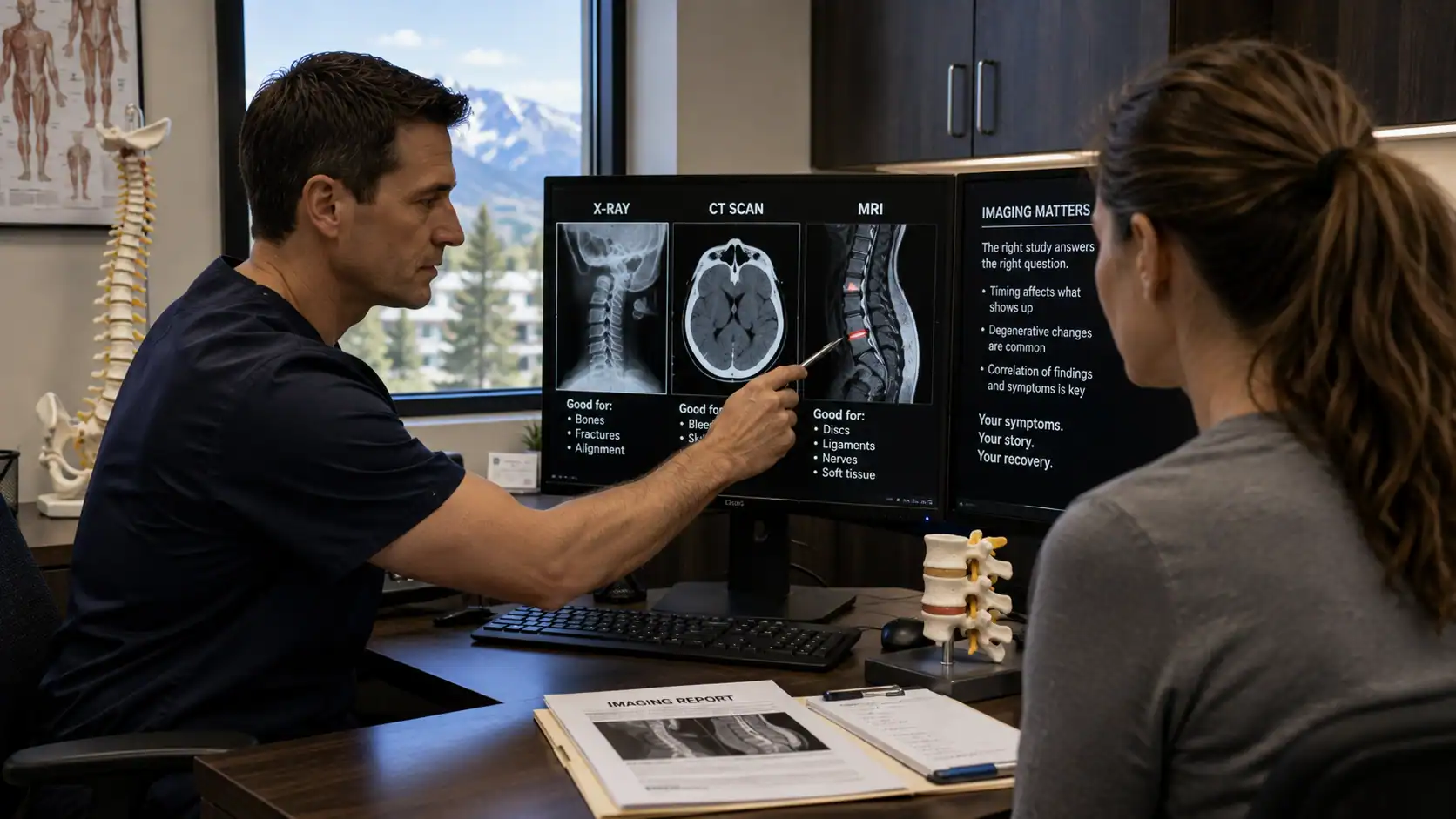
Imaging occupies a strange position in an injury claim. Adjusters treat it as the most objective evidence available, patients often assume a normal result means nothing is wrong, and the two beliefs together produce a lot of undervalued claims.
Each imaging type answers a narrow question. Understanding which question, and when it gets asked, matters more than most people expect.
X-Ray
X-ray images dense structures. Bone, primarily. It is fast, widely available, inexpensive, and it is the correct first study after most collisions.
What it answers: is anything broken, is anything dislocated, is there gross instability, is there significant preexisting degenerative change.
What it cannot answer: almost everything involving soft tissue. Muscle, ligament, tendon, disc, and nerve are effectively invisible on plain film. A completely normal X-ray is fully compatible with a serious soft tissue injury, and it is exactly what a whiplash-type injury looks like on X-ray.
That distinction gets lost constantly. A patient told their X-ray was clean concludes they are fine and skips follow-up. Weeks later, symptoms that never resolved have no documented pathway back to the collision.
One useful thing X-ray does capture is alignment. Loss of the normal cervical curve is a finding a provider can document, and it is the kind of objective observation that supports a soft tissue diagnosis the film cannot show directly.
CT
Computed tomography is cross-sectional imaging, substantially better than X-ray at detecting complex fractures and, critically, at detecting bleeding in the head.
It is the emergency setting study. If there was a head strike, loss of consciousness, altered mental status, or significant force, a CT rules out the injuries that kill people in the first hours.
The limitation matters enormously and is widely misunderstood. A normal head CT rules out bleeding. It does not rule out a brain injury. Most mild traumatic brain injuries produce no CT finding at all, because the injury is functional rather than structural at the resolution CT provides. Families are told the CT was normal and reasonably conclude the head is fine, and then spend months confused about symptoms that everyone has already ruled out on paper.
Our article on late-onset TBI symptoms covers what to watch for after a normal scan.
MRI
Magnetic resonance imaging is the study that shows soft tissue. Discs, ligaments, spinal cord, nerve roots, muscle, and edema.
It is the study that matters most in a serious spine claim, and it is the study most likely to be delayed. Cost, prior authorization, and the standard sequence of conservative care first all push it later. Some of that delay is clinically appropriate, since most soft tissue injuries improve without imaging and MRI findings rarely change early management.
The claim consequences of delay are still real, and they run in two directions.
Findings that fade. Acute soft tissue changes, edema and inflammation, are visible early and resolve over weeks. An MRI at four months may show a structural finding without the acute signal that would have tied it clearly to a specific date.
The intervening cause argument. The longer between collision and imaging, the more available the argument that something in the interval caused what the MRI shows.
Reasonable practice is conservative care first with a defined checkpoint. If symptoms have not meaningfully improved on schedule, or if there are nerve symptoms such as numbness, weakness, or radiating pain, imaging should escalate rather than drift.
The Degenerative Findings Problem
This is the single most consequential thing to understand about spine MRI in an injury claim.
Disc bulges, disc degeneration, and arthritic change are extremely common in adults who have no symptoms whatsoever. Their prevalence rises steadily with age, and by middle age a substantial share of people walking around pain-free would show findings on a spine MRI.
Insurers use this. The report says degenerative disc disease, the adjuster concludes the finding predates the collision, and the offer drops accordingly.
The response is not to dispute that degeneration existed. It is to establish that the collision changed something. Colorado permits recovery when a collision aggravates a preexisting condition, and the aggravation argument is built from specific materials:
- Documented absence of symptoms before the collision, including a clean treatment history for that region
- Prior imaging of the same region, if any exists, for direct comparison
- Acute findings on the new study that are distinguishable from chronic change
- Symptoms that correlate anatomically with the finding rather than being generally located nearby
- A treating provider willing to state the causal relationship explicitly
That last item does more work than any image. Radiology reports describe what is visible. They do not assign causation, and a report saying degenerative changes is not a statement that the collision caused nothing. A treating physician has to connect those dots in writing.
The clinical and legal difference between finding types is covered in herniated discs versus bulging discs.
Practical Points
- A normal X-ray does not mean you are uninjured, and a normal head CT does not rule out a brain injury
- Get copies of the actual images, not only the reports, since later reviewers may want the source files
- Locate any prior imaging of the same region, because a clean comparison study is one of the most valuable pieces of evidence available
- Report nerve symptoms immediately, since numbness, weakness, and radiating pain change the imaging calculus
- If imaging is denied by an insurer, that denial should be documented rather than quietly accepted
- Ask whether the collision date appears in the clinical history sent with the imaging order
That last point is small and frequently missed. Imaging is interpreted against the clinical history provided. An order that says neck pain produces a different read than one that says neck pain following motor vehicle collision on a specific date.
Frequently Asked Questions
Do I need an MRI after a car accident?
Not always. Most soft tissue injuries improve with conservative care and imaging rarely changes early treatment. MRI becomes appropriate when symptoms fail to improve on the expected schedule, when nerve symptoms such as numbness, weakness, or radiating pain appear, or when a surgical question arises. Ask your provider for a specific checkpoint rather than leaving it open-ended.
My X-ray was normal, so am I fine?
Not necessarily. X-ray images bone and is very good at ruling out fractures and dislocations, but muscle, ligament, disc, and nerve are essentially invisible on plain film. A normal X-ray is entirely consistent with a significant soft tissue injury, including whiplash. Continue following symptoms rather than treating a clean X-ray as a discharge.
Does a normal CT scan rule out a brain injury?
No. A head CT is designed to detect bleeding and skull fractures, which are the injuries that require immediate intervention. Most mild traumatic brain injuries produce no CT abnormality at all. Persistent headaches, light sensitivity, memory or concentration problems, mood changes, or sleep disruption after a normal scan should be evaluated further.
Why does my MRI report say degenerative disc disease?
Degenerative findings are extremely common in adults without symptoms and become more prevalent with age. Their presence on a report does not mean the collision caused no injury. Colorado allows recovery when a collision aggravates a preexisting condition, and the argument rests on documented absence of prior symptoms, comparison imaging if available, and a treating provider’s causation opinion.
How soon after a crash should I get imaging?
X-ray or CT in the emergency setting is driven by clinical indications such as head strike, loss of consciousness, or suspected fracture. MRI is usually appropriate after a defined period of conservative care, but delay carries a cost, because acute soft tissue changes fade over weeks and long gaps invite the argument that something else caused the findings. Set a checkpoint with your provider rather than letting it drift.
Should I get copies of my imaging?
Yes, and request the actual image files rather than only the written report. Later reviewers, including specialists and any physician retained by the insurance company, may want to examine the images directly. Facilities typically provide them on request, and obtaining them during treatment is easier than years later.
Talk to Flanagan Law
Flanagan Law is a boutique Colorado firm handling vehicle accident cases across the Denver metro and Front Range. If an insurer is using degenerative findings on your imaging to discount your injuries, call 720-928-9178. Someone answers 24 hours a day.
This article is general information about Colorado injury claims. It is not medical advice and it is not legal advice for your particular situation.