Work Notes and Return-to-Work Restrictions After a Crash
After a car accident, most people worry about two things at once: getting better and getting back to work. The paperwork that connects those two concerns is the work note. A note from your treating provider that says you can’t work, or can work only with limits, is one of the most important documents in a lost wage claim. Without it, an insurance adjuster may treat every missed shift as your choice. For patients of Accelerate Health in Denver and Lakewood, one of Flanagan Law’s Power Partners, understanding how work notes and restrictions are documented can protect both a recovery and a claim.
What is a work note after a car accident?
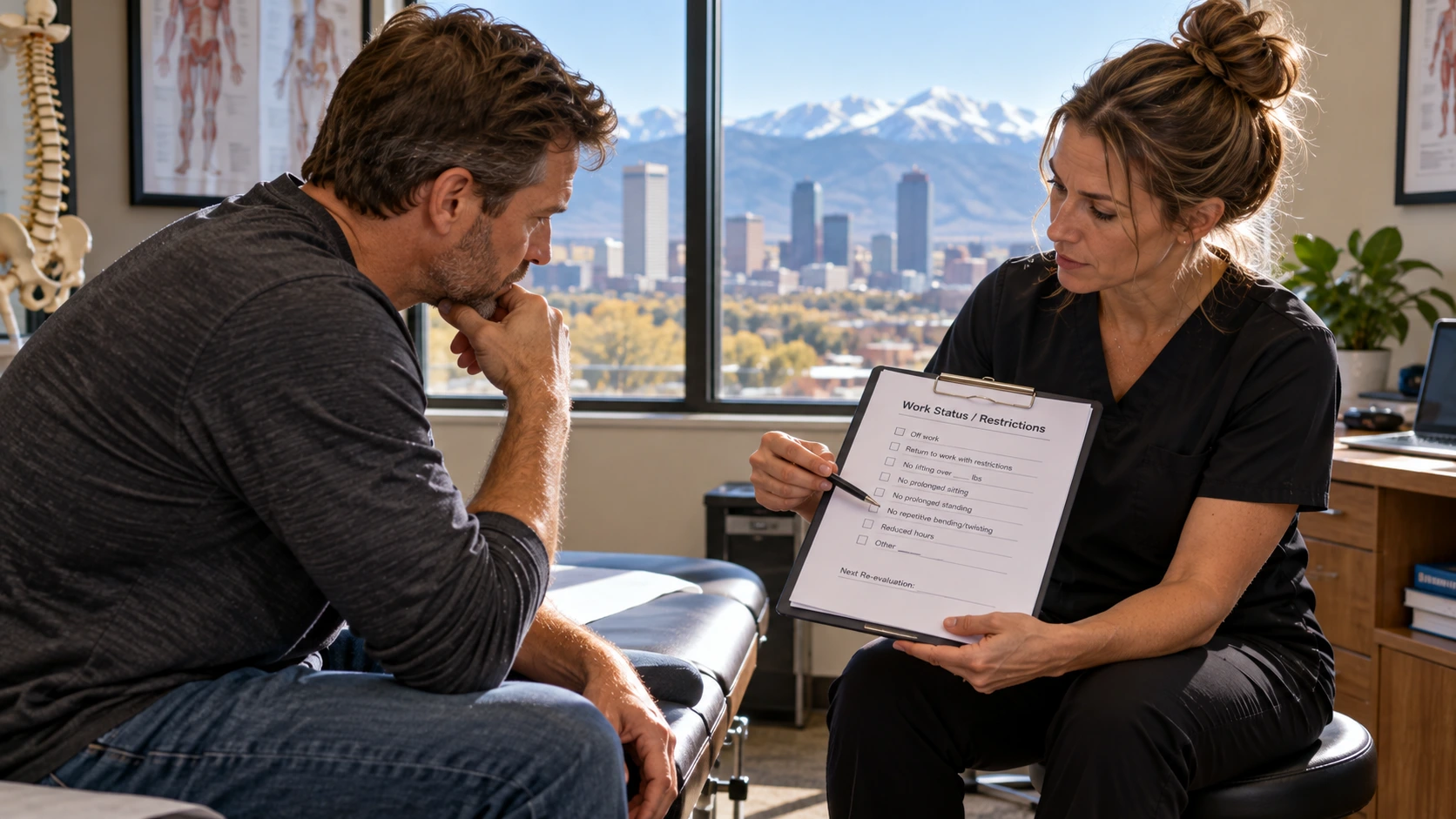
A work note is a written statement from your treating provider explaining whether you can work and, if so, under what limits. It may excuse you from work entirely for a period of time, or it may release you to work with restrictions such as no lifting over 15 pounds, no prolonged sitting, or reduced hours. Employers use work notes to decide what you can do. Insurers use them to decide what lost income they’ll pay.
Why do work notes matter so much to a lost wage claim?
Work notes matter because lost wages are only recoverable when time off is tied to the injury, and the work note is what ties them together. In a Colorado injury claim, you can recover income you lost because of the crash. An adjuster reviewing a gap in your paychecks will ask whether a provider said you couldn’t work during that time. If the answer is no, the adjuster will argue you chose to stay home. A clear note, issued at the time, answers that question before it is asked.
What should a strong work note include?
A strong work note includes the date of the visit, the diagnosis, whether you are off work or restricted, the specific restrictions, and the date of your next re-evaluation. Specific restrictions carry more weight than general ones. “Light duty” leaves room for argument. “No lifting over 10 pounds, no overhead reaching, and a break every 45 minutes” tells your employer exactly what you can do and tells an adjuster exactly why your job was affected.
Why do restrictions need to match your actual job?
Restrictions need to match your job because the question in a claim is whether the injury kept you from doing the work you actually do. A restriction against lifting matters to a warehouse worker and may matter little to someone who works at a desk. Telling your provider what your job involves, including lifting, driving, standing, or repetitive motion, helps the provider write restrictions that fit. That match is what makes lost wages credible to an insurer.
What happens if your employer can’t accommodate your restrictions?
If your employer can’t offer work within your restrictions, the income you lose is generally part of your claim. Ask your employer to put the decision in writing, whether by email or a letter saying that light duty isn’t available. That record, along with your work note and pay records, shows the loss came from the injury rather than from your choice. If your employer does offer modified work you can do, taking it usually strengthens your credibility.
How should restrictions change as you recover?
Restrictions should change at each re-evaluation as your provider measures your progress. A note that keeps you off work for months without updates invites an insurer to question it. A series of notes showing full restrictions at first, then partial, then a full release tells a believable recovery story. If you return to work and symptoms flare, go back to your provider promptly so any new restriction is documented. Our article on why fragmented medical records weaken a Colorado injury claim explains why consistent records matter.
What other records support a lost wage claim?
Alongside work notes, a lost wage claim needs pay stubs from before and after the crash, tax returns for self-employed workers, a letter from your employer confirming your rate of pay and time missed, and records of any paid time off you used. Using sick leave or vacation doesn’t erase the loss, because that leave had value. If your injury affects your ability to earn in the future, the claim may also include lost earning capacity, as our guide on calculating lost earning capacity explains.
Why does Accelerate Health’s approach matter to injured patients?
Patients injured in crashes across Denver and Lakewood benefit from a provider who documents not just what hurts but how it affects daily life and work. When each visit records function, restrictions, and progress, the record answers an adjuster’s questions about time missed from work. That documentation helps patients get the time they need to heal and helps their attorney show why every missed paycheck was caused by the crash.
Frequently Asked Questions
Do I need a doctor’s note to recover lost wages after a car accident?
A work note isn’t strictly required by law, but without one, insurers often refuse to pay for time missed. A note from your treating provider saying you couldn’t work, or could work only with restrictions, is the strongest evidence connecting time off to the crash.
Can a chiropractor write a work note in Colorado?
Yes. A chiropractor treating you for crash injuries can document work restrictions within the scope of their practice. What matters most is that the note is issued at the time of treatment, explains the restrictions clearly, and is updated as you recover.
What if I used sick leave or vacation after my accident?
Paid time off you used because of the injury is generally recoverable, because you lost leave you would otherwise have kept. Keep records showing which days you used and why, along with the work notes covering those days.
What if my employer won’t let me work with restrictions?
Ask your employer to confirm in writing that work within your restrictions isn’t available. That letter, together with your work notes and pay records, supports a claim for the income you lost while you couldn’t return to your regular job.
Can I recover lost wages if I’m self-employed?
Yes, but the proof looks different. Tax returns, invoices, contracts, and records of canceled jobs help show what you earned before the crash and what you lost after. Work notes are just as important, because they show why you couldn’t take the work.
When should I contact a lawyer about lost wages?
Contact a lawyer early, especially if you’ve missed significant time or your employer is pushing you back before you’re ready. Flanagan Law can help organize work notes and pay records so your loss is fully documented. Call 720-928-9178 for a free consultation.
Learn more about Accelerate Health’s auto injury care at acceleratehealthdenver.com.
If a Colorado car accident has kept you from working, call Flanagan Law at 720-928-9178 for a free consultation.