
Injections and Regenerative Treatment After a Colorado Crash: Why Insurers Fight Them and What to Do
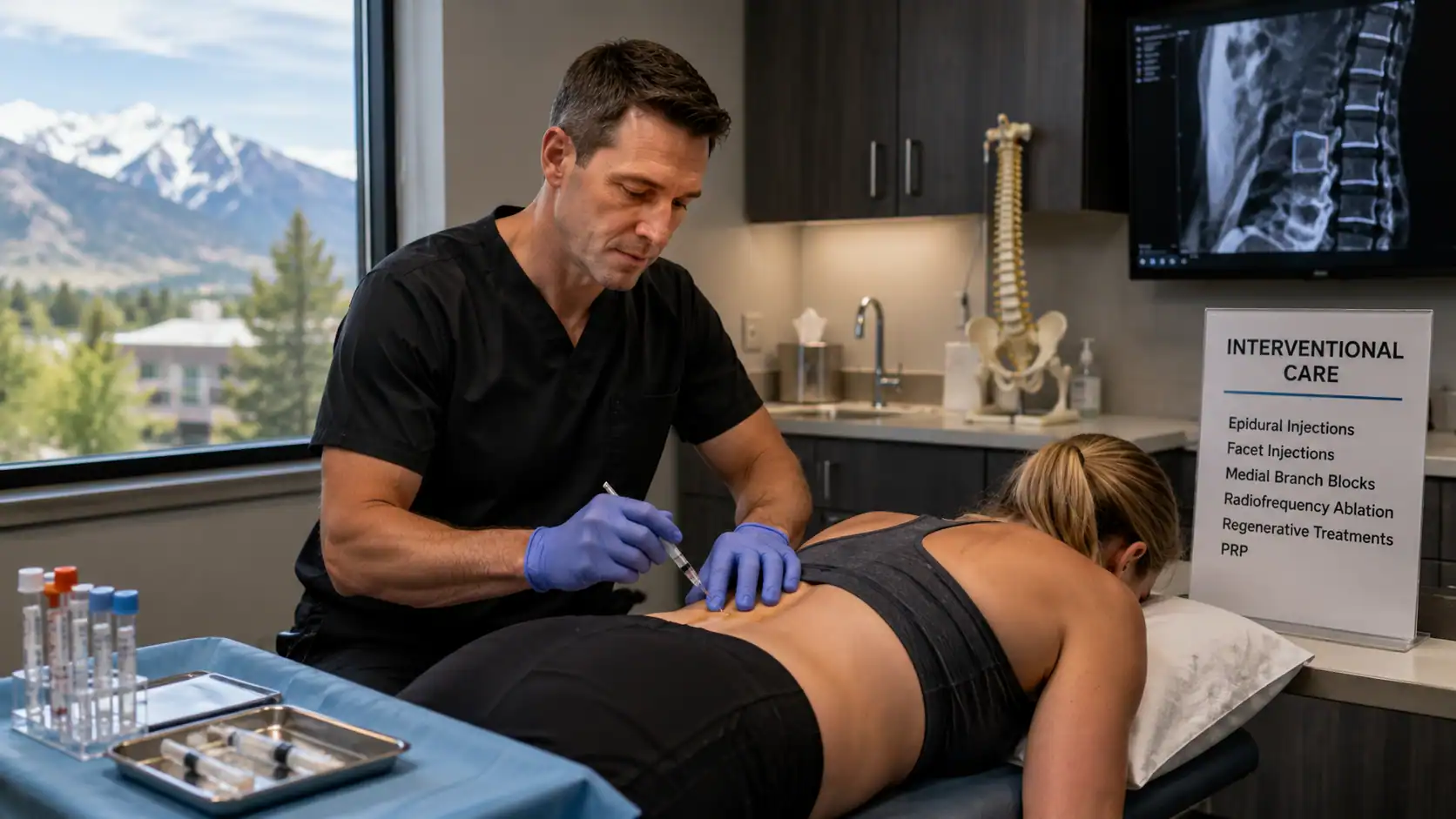
Conservative care has a ceiling. When manual therapy and exercise have run their course and pain persists, the next step is usually something delivered by needle rather than by hand.
This is the stage where insurance resistance sharpens noticeably, and where patients face a decision that is medical, financial, and legal at the same time.
The Two Categories, Which Get Treated Very Differently
Injection-based care after a collision falls into two buckets, and the insurance treatment of each is nearly opposite.
Established interventional procedures. Epidural steroid injections, facet joint injections, medial branch blocks, radiofrequency ablation, and trigger point injections. These have long histories, established billing codes, and clear places in accepted treatment protocols. Insurers generally pay for them, subject to authorization requirements and documentation of failed conservative care.
Regenerative procedures. Platelet-rich plasma and related biologic treatments. These use the patient’s own blood components, concentrated and reinjected, to stimulate healing in soft tissue. Adoption has grown substantially, particularly in sports medicine and in clinics treating motor vehicle injuries.
Insurers frequently classify the second category as investigational or experimental and decline to cover it. That classification is a coverage decision, not a clinical verdict, and the distinction matters more than most patients realize.
Why the Diagnostic Value Matters as Much as the Treatment
Something gets missed in the argument about whether these procedures work.
Several of them are diagnostic as well as therapeutic. A medial branch block that produces temporary, substantial relief tells everyone that the pain is coming from a specific joint. A facet injection that produces nothing tells everyone to look elsewhere.
That has real weight in a claim, because it converts a subjective complaint into something with an anatomic address. “Chronic neck pain” is a phrase an adjuster discounts. “Pain reproducibly relieved by blocking a specific level, confirmed on repeat testing” is a finding that is difficult to characterize as exaggerated.
Patients frequently do not understand this when they decline an injection because they would rather not have a needle in their spine. The procedure may be the thing that establishes the injury is real.
Why Denials Happen
Beyond the experimental label, several patterns reliably produce denial letters.
- Insufficient documented conservative care before escalation
- No clear anatomic diagnosis connecting the procedure to a specific structure
- Repeat procedures without documented benefit from the previous one
- Gaps in treatment before the procedure was recommended
- An examination report from a physician retained by the insurer concluding you reached maximum improvement earlier
- Billing at rates the insurer characterizes as unreasonable, particularly for cash-pay regenerative procedures
The repeat procedure issue causes recurring trouble. Interventional care is often planned as a series. If the first injection produced meaningful relief, that needs to be documented specifically, with duration and degree, before the second is requested. “Patient reports some improvement” will not carry a second authorization.
The Financial Structure Is Its Own Problem
When an insurer declines to cover a procedure, the cost does not disappear. It moves.
Three arrangements are common, and each carries consequences.
Health insurance pays. Cleanest clinically, but it usually creates a reimbursement obligation against your eventual settlement. How that obligation works depends heavily on the type of plan, and the mechanics are covered in medical liens after a Colorado accident.
Treatment on a lien or letter of protection. The provider treats and waits for the settlement. This makes necessary care accessible, and it also means an amount comes off the top of any recovery. Understand the number before agreeing to it, and understand whether it is negotiable at the end.
Out of pocket. Common with regenerative procedures. Keep every receipt, since these expenses are recoverable in a claim if the treatment is shown to be reasonable and related to the collision.
In every version, the recoverability question turns on the same two words. Reasonable and necessary. A procedure recommended by a treating provider, following documented failure of conservative care, with a clear diagnosis and recorded outcome, meets that standard far more easily than one that appears in the record without visible reasoning.
What Strengthens the Record
- A documented course of conservative care, with dates and measured outcomes, before escalation
- A specific anatomic diagnosis rather than a general pain description
- A written statement from the treating provider explaining why the procedure is indicated for this patient
- Recorded outcome after each procedure, including degree and duration of relief
- Continuity, since a long gap before a procedure invites the argument that something else intervened
- For regenerative procedures, documentation of why it was chosen over covered alternatives
That last item is the one clinics most often omit and the one that most often decides the coverage fight. If a provider selected a regenerative approach because the patient could not tolerate steroids, or because prior injections failed, that reasoning belongs in the chart at the time, not in a letter written after the denial.
The Decision Nobody Should Make on Insurance Grounds
Patients sometimes decline a recommended procedure because coverage is uncertain, then find their claim characterized as involving someone who refused reasonable treatment. Colorado’s duty to mitigate expects injured people to take reasonable steps toward recovery.
The reverse error also exists. Patients pursue expensive procedures with poor documentation and find themselves holding the bill.
The correct approach is to make the medical decision on medical grounds, in consultation with the treating provider, and to handle the financial structure separately and deliberately. If a procedure is genuinely indicated, there is almost always a way to arrange it. If the question is whether surgery is next, that path is covered in when surgery becomes the only option.
Frequently Asked Questions
Will insurance cover PRP after a car accident in Colorado?
Often not. Many insurers classify platelet-rich plasma and similar regenerative procedures as investigational and decline coverage, which is a coverage determination rather than a clinical judgment about whether the treatment helps. Costs paid out of pocket or on a provider lien can still be recoverable in an injury claim if the treatment is shown to be reasonable and related to the collision.
What is the difference between a therapeutic and a diagnostic injection?
A therapeutic injection is intended to reduce pain, while a diagnostic injection is intended to identify the source of pain by temporarily blocking a specific structure. Many procedures do both. Diagnostic value matters in a claim because it converts a subjective complaint into a finding tied to a specific anatomic location.
Why did my insurer deny an epidural steroid injection?
Common reasons include insufficient documented conservative care beforehand, the absence of a specific anatomic diagnosis, a gap in treatment before the recommendation, or a report from a physician retained by the insurer concluding you had already reached maximum improvement. Repeat injections are also denied when benefit from the previous one was not documented with specificity.
Can I refuse an injection my doctor recommends?
Yes, medical decisions are yours. Be aware that Colorado expects injured people to take reasonable steps toward recovery, and a documented refusal of recommended treatment can be used to argue that your continuing symptoms are partly self-inflicted. Discuss concerns with your provider and have the reasoning noted in the chart rather than simply declining.
What is a letter of protection?
It is an arrangement in which a provider agrees to treat and defer payment until an injury claim resolves, with the bill paid from the settlement. It makes necessary care accessible when coverage is unavailable, and it means that amount comes off the recovery. Understand the figure and whether it can be negotiated at the end before agreeing.
Are out-of-pocket treatment costs recoverable in a Colorado injury claim?
They can be, when the treatment is shown to be reasonable in cost and necessary for injuries caused by the collision. Keep every receipt, invoice, and payment record, and make sure the clinical reasoning for choosing that treatment appears in your medical records at the time it was recommended rather than only afterward.
Talk to Flanagan Law
Flanagan Law is a boutique Colorado firm handling vehicle accident cases across the Denver metro and Front Range. If an insurer has denied a procedure your doctor recommended, call 720-928-9178. Someone answers 24 hours a day.
This article is general information about Colorado injury claims. It is not medical advice and it is not legal advice for your particular situation.