Pothole Damage and Car Accidents in Colorado: When the Road Itself Is to Blame
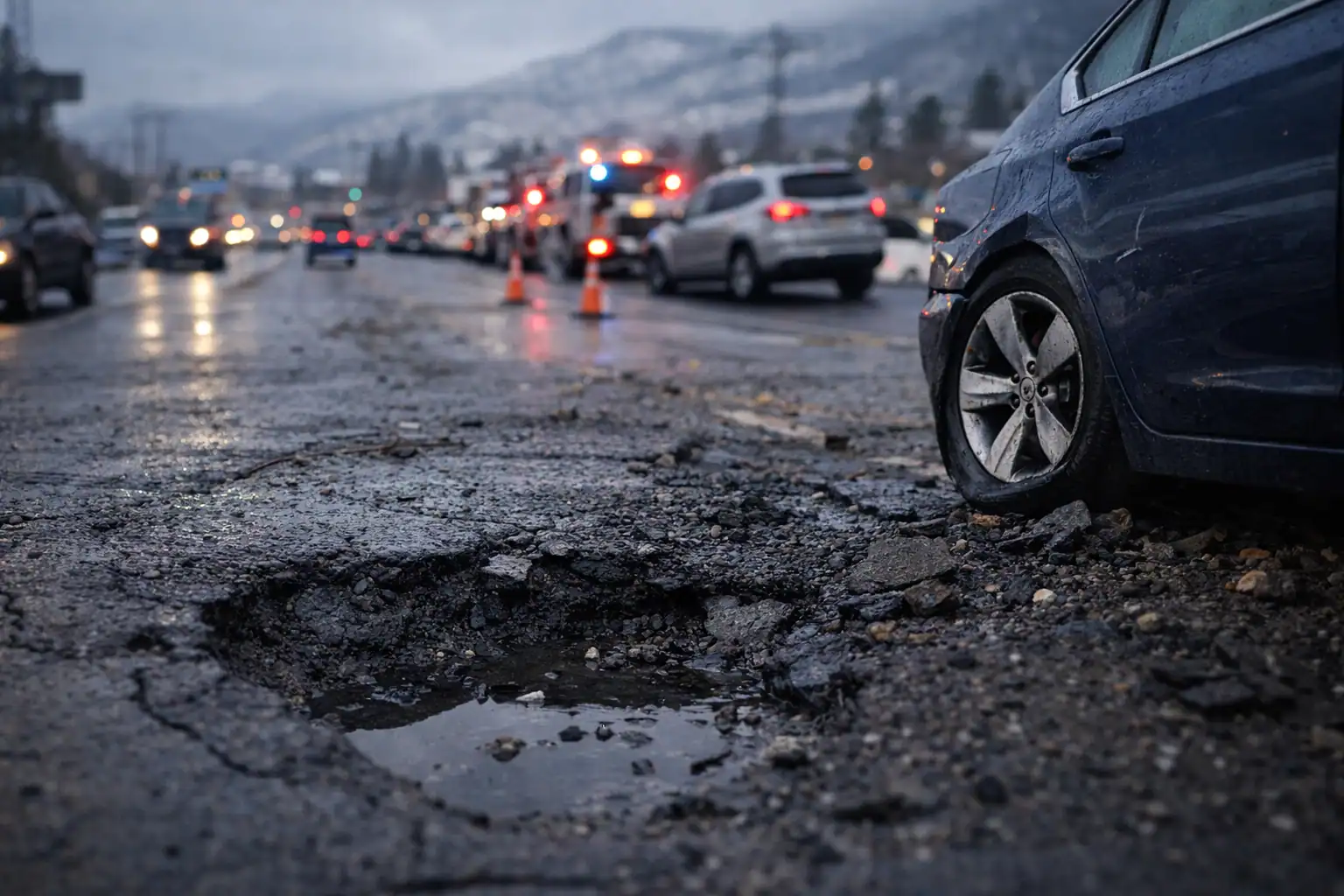
Colorado roads take a beating every winter, and by March the damage shows up on nearly every major street and highway in the Denver metro. Potholes open along I-25, I-270, and the surface streets connecting Aurora, Commerce City, and Thornton almost overnight once temperatures start swinging. Most drivers write off a blown tire or a bent rim as bad luck. In our practice, we see something different: cases where a dangerous road condition was the direct cause of a serious accident, and where the driver who swerved to avoid a pothole, blew a tire at highway speed, or lost control on a cratered surface had every right to pursue a legal claim.
You may not realize that road conditions can be part of your accident case. This article explains when they are, who can be held responsible, and what Colorado law requires you to do to protect that claim.
Why Pothole Accidents Are More Serious Than They Look
A pothole isnt just an inconvenience. At highway speeds, striking one can blow a tire, break a wheel bearing, misalign a vehicle, or cause a driver to jerk the wheel and swerve into another lane. The resulting accident looks like a single-car crash or a lane-change collision. The pothole’s role is invisible unless someone investigates.
In Colorado, the spring thaw is the single most destructive force on road surfaces. Water seeps into pavement cracks during the freeze-thaw cycles that define our late winter and early spring, and when the ground contracts and expands, the surface fractures. March and April are peak pothole season across the Front Range. CDOT and municipal public works departments know this. The question is whether they respond quickly enough once a hazard is reported.
If they dont, and someone is injured, that failure can give rise to a legal claim.
Who Is Legally Responsible for a Pothole Accident in Colorado?
Responsibility depends on who owns and maintains the road. In Colorado, roads are maintained by one of three entities: CDOT for state highways, county public works departments, or city and municipal road departments. The ownership determines which legal rules apply.
For accidents involving state highways, CDOT is the responsible party. For accidents on city streets in Denver, Aurora, Lakewood, or any incorporated municipality, that city’s road department may be liable. For unincorporated county roads, the county carries responsibility.
Suing a government entity in Colorado is not like suing a private driver. The Colorado Governmental Immunity Act, codified at CRS 24-10-101 et seq., grants government entities broad immunity from civil lawsuits. There are specific exceptions carved out for dangerous road conditions, but those exceptions come with strict procedural requirements.
The Notice Requirement Under the Colorado Governmental Immunity Act
Under CRS 24-10-109, before you can sue a government entity for a road defect in Colorado, you must file a formal written notice of claim within 182 days of the date of the injury. This is not optional. If you miss this deadline, your claim is barred permanently, regardless of how serious your injuries are.
The notice must include specific information: your name and address, a description of the accident, the location of the road defect, a description of your injuries, and the amount of compensation you are seeking to the extent it is known.
This is one of the most consequential deadlines in Colorado personal injury law and one of the most commonly missed. People focus on recovery, on dealing with insurance companies, on their vehicles, and 182 days passes faster than most people expect. By the time they consider a legal claim, the window has closed.
If your accident involved a road defect, a pothole, a crumbling shoulder, a missing guardrail, or an unmarked construction hazard, the clock on your government notice began running the day you were hurt.
If you were injured in a road-related accident in Colorado, call us at 720-928-9178. There is no obligation, no pressure, and no fee unless we win your case. This is a call worth making before that deadline arrives.
When a Pothole Accident Involves Another Driver
Many pothole accidents involve more than just the road. A driver ahead of you swerves to avoid a pothole, crosses into your lane, and hits your vehicle. A driver behind you doesnt have time to react when you hit a pothole and slow unexpectedly. In these situations, both the other driver’s negligence and the road condition may be relevant to your claim.
Colorado follows a modified comparative negligence standard under CRS 13-21-111. Fault can be distributed across multiple parties, and you can still recover damages as long as you are less than 50 percent responsible for the accident. An experienced attorney can evaluate whether the road condition, another driver, or both contributed to your crash and structure your claim accordingly.
What Evidence to Collect After a Pothole Accident in Colorado
If you suspect a road defect contributed to your accident, the evidence you gather in the first hours matters significantly.
Photograph the pothole or road defect immediately, before road crews repair it. Capture its dimensions, depth, and location relative to lane markings. If you can do so safely, include a reference object for scale. Note the GPS coordinates or nearest cross streets and write down the date and time.
Request the police report and make sure the officer notes the road condition in it. If witnesses stopped, get their contact information.
Check whether the defect had been previously reported to CDOT or the relevant municipality. Under Colorado’s public records laws, you may be able to obtain maintenance logs showing whether the agency knew about the hazard and failed to act. Prior knowledge is the foundation of a government liability claim.
Frequently Asked Questions
Can I sue CDOT for a pothole that caused my accident?
Potentially yes, but only if CDOT had prior notice of the defect and failed to address it within a reasonable time, and only if you file the required government notice of claim within 182 days of your injury under CRS 24-10-109. Property damage alone may not support a viable claim; serious injuries significantly strengthen it.
What if I swerved to avoid a pothole and hit another car?
This scenario involves at least two potential sources of liability: the road defect and possibly your own driving response. Colorado’s comparative negligence rules allow fault to be apportioned across multiple parties. An attorney can help you analyze whether the road condition was the primary cause and whether a government claim is warranted alongside the standard insurance claim.
How long do I have to file a claim for a road defect accident in Colorado?
You have 182 days from the date of injury to file a written notice of claim against the responsible government entity under CRS 24-10-109. The standard personal injury statute of limitations under CRS 13-80-101 is three years for negligence claims, but the government notice deadline comes first and is far shorter. Missing it eliminates the government as a liable party entirely.
Does my regular auto insurance cover pothole damage?
Collision coverage typically covers pothole damage to your vehicle, subject to your deductible. Comprehensive coverage does not. If your injuries or vehicle damage are significant, a government liability claim may be the more important path. An attorney can help you evaluate both options at the same time.
What if the pothole was in a construction zone?
Construction zone road defects add a layer of potential liability beyond the government entity. The contractor responsible for maintaining the work zone may share or carry primary responsibility. CRS 42-4-620 governs traffic control requirements in construction zones. If a contractor’s failure contributed to your accident, that claim runs against a private party rather than a government entity, which means different procedural rules and potentially a more direct path to recovery.
What does the government have to know before it can be held responsible for a road defect?
The government entity generally must have had actual or constructive notice of the defect, meaning they either knew about it or should have known based on how long it had existed and how visible it was. Prior complaints, internal maintenance records, and the age and severity of the defect all factor into this analysis. A road that has been deteriorating for months in a high-traffic corridor is much harder for a municipality to disclaim knowledge of than one that appeared overnight.
Can I still recover if I was partly at fault for the accident?
Yes. Under Colorado’s modified comparative negligence standard (CRS 13-21-111), you can recover damages as long as you are less than 50 percent responsible. Your recovery is reduced by your percentage of fault. If you were 20 percent responsible and your damages are $100,000, you can recover $80,000. An attorney can help you build the strongest possible case for minimizing your assigned share of fault.
Sources
Colorado Governmental Immunity Act, CRS 24-10-101 et seq. Government Notice of Claim Requirement, CRS 24-10-109 Colorado Comparative Negligence Statute, CRS 13-21-111 Personal Injury Statute of Limitations, CRS 13-80-101 Construction Zone Traffic Control Requirements, CRS 42-4-620 Colorado Department of Transportation, Road Maintenance and Conditions: https://www.codot.gov National Highway Traffic Safety Administration, Crash Causation Data: https://www.nhtsa.gov
If a dangerous road played a role in your accident, you deserve an honest conversation about your options. Call Samantha Flanagan at 720-928-9178. The consultation is free, confidential, and comes with no obligation. Your recovery comes first.