How Colorado’s Road Construction Season Creates New Accident Hazards Every Spring
Colorado’s construction season opens every spring with new hazards on I-25, I-70, and Front Range roads. Here is what the law says about liability when worksites cause crashes.
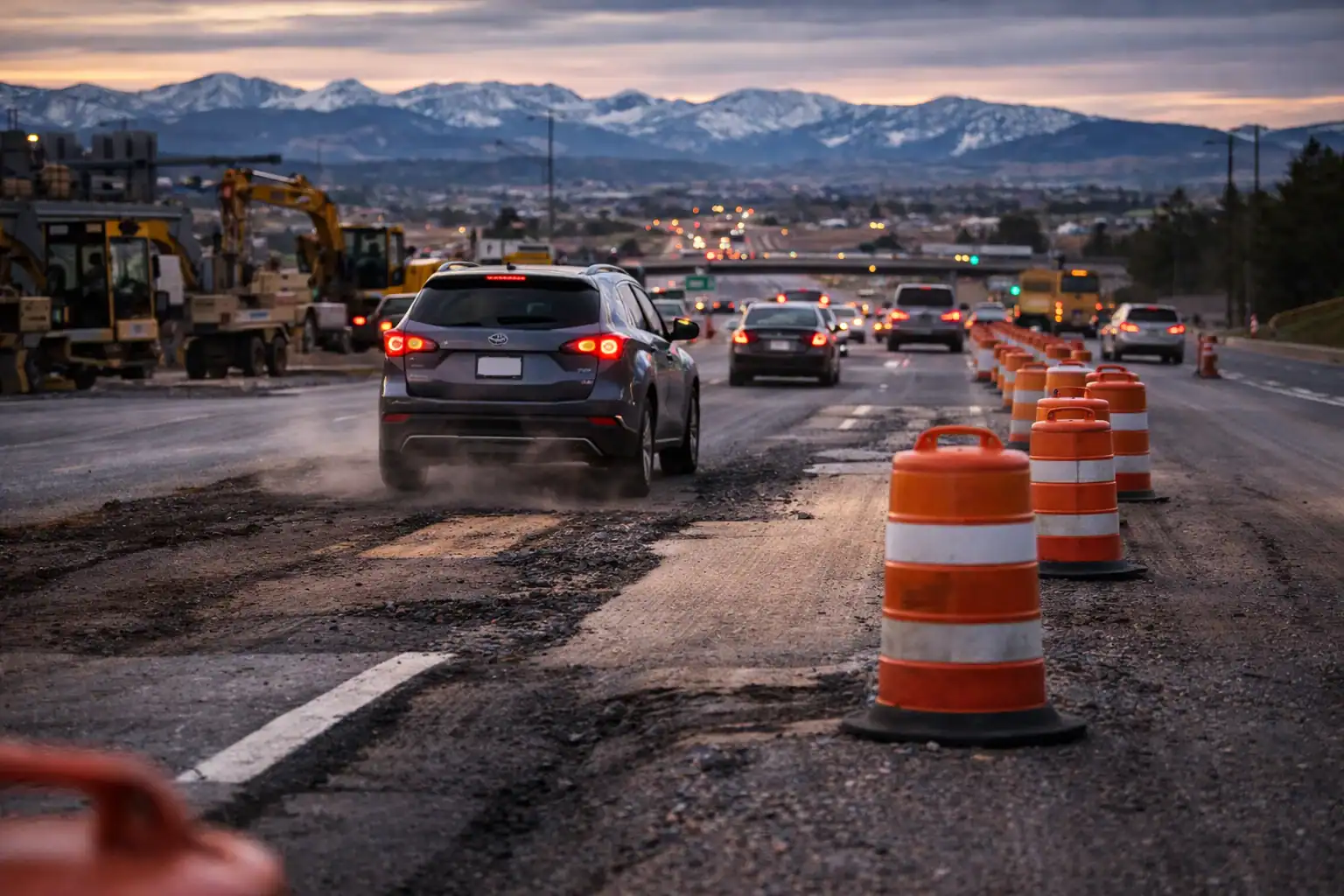
Colorado’s road construction season follows a reliable calendar. As temperatures stabilize above freezing in April and May, CDOT and municipal public works departments activate projects that were planned through the winter. By June, the Front Range is a patchwork of orange barrels, shifted lane configurations, reduced speed zones, and temporary pavement surfaces stretching from Fort Collins to Pueblo along I-25 and from the Kansas border to the Eisenhower Tunnel along I-70.
This is not background noise for Colorado drivers. It is a seasonal transformation of the roads millions of people use every day, and it creates accident conditions that are legally distinct from standard two-car crashes. This article examines the specific hazards that Colorado’s construction season introduces, how liability is determined when those hazards cause crashes, and what the data shows about where and when construction zone accidents are most likely to occur.
The Scale of Colorado’s Annual Construction Program
CDOT manages one of the most complex annual construction programs of any state transportation department in the Mountain West. Projects in a typical construction season span pavement rehabilitation, interchange reconstruction, bridge work, drainage improvements, and capacity expansion across the 23,000-lane-mile state highway network. Add to that the concurrent construction programs of the 64 Colorado counties and hundreds of municipalities, and the scale of active work zone exposure facing Front Range drivers becomes clear.
CDOT’s own safety data shows that work zone crashes are a persistent problem on the Colorado highway system. The I-25 corridor through the Denver metro, which has seen near-continuous construction activity for more than a decade, accounts for a significant share of the state’s annual work zone crash total. The I-70 mountain corridor is the other major concentration point, where construction activity coincides with high tourist traffic volumes and drivers who are unfamiliar with mountain driving conditions.
NHTSA national data shows that approximately 800 people are killed in work zone crashes annually across the United States, with tens of thousands more injured. Rear-end collisions are the dominant work zone crash type nationally, accounting for more than 30 percent of all work zone fatalities. In Colorado, the pattern is consistent with national trends, with rear-end crashes in congested work zone approach areas representing the most common serious injury scenario.
How Spring Construction Zones Differ From Established Work Zones
The opening weeks of Colorado’s construction season present specific hazards that differ from those in a mature, long-running work zone. Newly activated work zones introduce changed road conditions that drivers have not yet encountered and have received no prior warning about. Lane shifts that were not present the day before appear without the accumulated signage repetition that drivers in an established work zone have experienced over weeks or months.
Temporary pavement surfaces at the transitions between finished and unfinished road are at their most hazardous in the spring, when contractors are first laying temporary asphalt and the edge differentials between existing and new pavement are most pronounced. Motorcyclists are particularly vulnerable to these transitions, which can catch a front wheel and cause loss of control at speed.
Mud and debris from construction activity on I-70 and the mountain highway corridors is a distinct spring hazard. Heavy equipment tracking material onto travel lanes creates slick surfaces that drivers dont anticipate. CRS 42-4-1407 prohibits vehicles from depositing mud, rocks, or debris onto public roads, and a contractor whose equipment creates a hazardous surface condition on an active travel lane may bear direct liability for resulting crashes.
The Regulatory Framework Governing Colorado Work Zones
Colorado work zones on state highways must comply with CDOT’s work zone safety standards, which incorporate and expand upon the federal Manual on Uniform Traffic Control Devices. These standards specify minimum advance warning distances, required sign sequences, appropriate taper lengths for lane closures, lighting requirements for nighttime work, and flagger training and positioning requirements.
The gap between these standards and what drivers actually encounter in the field is where liability is established. A work zone that compresses its advance warning distance because a contractor wanted to maximize the active work area, a lane closure that lacks the required taper length because setup was rushed, or a nighttime work zone with inadequate lighting because the contractor cut corners on equipment all represent violations of standards that exist specifically to prevent crashes.
Under CRS 42-4-620, traffic control in highway construction and maintenance zones is a specific legal category with defined requirements. Violations of this statute that cause injury can support a negligence per se finding against the responsible contractor or agency.
CDOT’s construction contracts require general contractors to maintain safe work zones as a condition of the contract. Failure to do so creates both contractual and tort liability. The contractor’s general liability insurer is a separate source of compensation from the at-fault driver’s auto insurance, and in serious work zone crash cases both sources are often implicated simultaneously.
Where Colorado’s Spring Construction Season Creates the Highest Risk
The I-25 corridor from the Colorado Springs area through Denver to Fort Collins is the single highest-risk environment for work zone crashes in the state during the spring construction season. The volume of daily traffic, the frequency of active projects, and the compressed geometry of urban freeway construction create a combination of hazard factors that exceeds almost any other road environment in Colorado.
The I-70 corridor from the Eisenhower Tunnel to Glenwood Canyon presents different but equally serious risks. Construction activity on mountain sections of I-70 coincides with spring ski season traffic, creating work zone encounters where drivers who are already managing unfamiliar mountain highway conditions encounter sudden lane shifts and reduced speed zones.
C-470 and E-470 in the south and southeast suburbs see significant spring construction activity as the corridor continues to expand, with active work zones appearing on roads that carry commuter traffic at speeds that leave little margin for the reaction times that work zone approach areas require.
Municipal construction programs in Aurora, Thornton, Westminster, and Lakewood regularly produce surface street work zones on high-volume arterials where the combination of lower speeds and higher pedestrian and cyclist exposure creates a different but equally serious risk environment.
Call us at 720-928-9178 if you were hurt in a Colorado construction zone this spring. Construction zone cases require fast evidence preservation. The consultation is free and there is no fee unless we win.
Nighttime Construction and the Special Hazard It Creates
CDOT and its contractors increasingly use nighttime construction windows to minimize daytime traffic disruption on high-volume corridors. This practice reduces congestion during peak hours but concentrates construction zone accident risk in the overnight hours when driver fatigue, reduced visibility, and lower overall traffic volume create a different risk profile.
NHTSA data consistently shows that nighttime work zone crashes have a higher fatality rate per incident than daytime work zone crashes. Reduced lighting in the transition between the illuminated work area and the surrounding road, along with the visual complexity of construction zone signage and lighting equipment, contributes to driver disorientation that increases crash risk.
Contractors using nighttime construction windows are required to meet specific lighting standards under CDOT’s work zone guidelines. Failure to meet these standards in a nighttime crash scenario is a significant liability factor.
Frequently Asked Questions
When does Colorado’s construction season typically begin and end?
The primary construction season on Front Range highways runs from approximately April through October, corresponding to the period when temperatures support paving and concrete work. Mountain highway construction windows are shorter, typically June through September, constrained by weather at elevation. Work zones can appear earlier or persist later depending on project schedules and weather conditions.
Who is responsible for safety in a CDOT construction zone?
The general contractor is primarily responsible for maintaining safe work zone conditions under the terms of its CDOT contract. CDOT retains oversight responsibility and can be subject to government liability claims in limited circumstances. Subcontractors responsible for specific work zone components such as signage or striping may carry independent liability for their scope.
What law governs traffic control in Colorado construction zones?
CRS 42-4-620 governs traffic control in highway construction and maintenance zones. Federal requirements under the Manual on Uniform Traffic Control Devices also apply to state highway work zones. CDOT’s work zone safety standards incorporate both frameworks and provide the specific technical requirements that contractors must meet.
Can a contractor be held liable for construction debris on a travel lane?
Yes. CRS 42-4-1407 prohibits depositing mud, rocks, or debris on public roads. A contractor whose equipment tracks hazardous material onto an active travel lane and causes a crash has potentially violated this statute in a way that supports both a statutory violation claim and a general negligence claim.
What if I was injured in a construction zone by another driver, not by the worksite itself?
The at-fault driver is liable under standard negligence principles regardless of the work zone context. Construction zones dont eliminate driver liability; they add potential additional defendants. If the work zone’s configuration contributed to the crash by giving the at-fault driver inadequate warning or visibility, both the driver and the contractor may bear responsibility.
How does nighttime construction affect my accident claim?
Nighttime construction zone crashes may involve additional liability factors including inadequate lighting, visual complexity from construction equipment, and driver fatigue. If the contractor failed to meet CDOT’s nighttime lighting requirements, that failure is a separate basis for liability beyond the at-fault driver’s negligence.
Is there a statute of limitations for a Colorado construction zone accident claim?
Three years from the date of injury under CRS 13-80-101 for claims against private contractors and drivers. If a government entity is involved, the 182-day notice under CRS 24-10-109 applies first. Construction zone evidence changes rapidly as projects progress, which makes early action critical regardless of the formal deadline.
Sources
Colorado Work Zone Traffic Control Statute, CRS 42-4-620 Construction Zone Speed and Fine Provisions, CRS 42-4-619 Debris on Roadway Prohibition, CRS 42-4-1407 Colorado Governmental Immunity Act, CRS 24-10-101 et seq. Government Notice of Claim Requirement, CRS 24-10-109 Personal Injury Statute of Limitations, CRS 13-80-101 Federal Manual on Uniform Traffic Control Devices: https://mutcd.fhwa.dot.gov Colorado Department of Transportation, Work Zone Safety Program: https://www.codot.gov National Highway Traffic Safety Administration, Work Zone Crash Statistics: https://www.nhtsa.gov
If a Colorado construction zone crash hurt you this spring, call Samantha Flanagan at 720-928-9178. The consultation is free, confidential, and comes with no obligation. We dont charge a fee unless we win your case.