Herniated Discs vs. Bulging Discs: Why the Distinction Matters for Your Claim

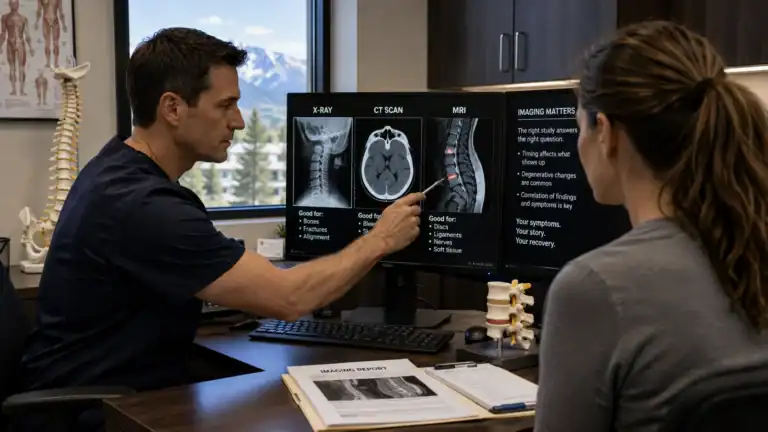
The MRI results come back and your doctor says you have a disc injury in your spine. You hear the words herniated or bulging and they sound interchangeable. Your doctor may even use them loosely in conversation as if they mean the same thing. They do not. And in the context of a personal injury claim in Colorado, the difference between these two diagnoses can shift the value of your case by tens of thousands of dollars.
Insurance adjusters know this. They are trained to exploit the distinction. Understanding what these injuries actually are and how they differ gives you the knowledge to push back when an insurance company tries to minimize what happened to your spine.
What a Disc Actually Does
Your spine is a column of bones called vertebrae stacked on top of each other. Between each pair of vertebrae sits a disc, a flat, round structure about the size of a small coaster. These discs have two components. The outer layer is a tough, fibrous ring called the annulus fibrosus. The inner core is a soft, gel-like substance called the nucleus pulposus.
Discs serve as shock absorbers. Every time you walk, bend, twist, or sit in a car that hits a pothole, your discs are absorbing and distributing force so your vertebrae dont grind against each other. When a disc is healthy, you never think about it. When a disc is damaged, it can dominate every waking moment of your life.
The Bulging Disc
A bulging disc occurs when the disc expands beyond its normal boundary and protrudes outward, but the outer layer remains intact. Think of it like a hamburger patty that is slightly too large for the bun. The disc material extends past where it should be, but nothing has ruptured or leaked.
Bulging discs are common. Many people have them without any symptoms at all. They can develop gradually from aging, repetitive stress, poor posture, or the cumulative wear of daily life. They can also result from trauma, including the sudden forces experienced in a car accident.
When a bulging disc does cause symptoms, those symptoms typically include localized pain, stiffness, and sometimes radiating discomfort if the bulge presses against a nearby nerve. The severity ranges from mildly annoying to genuinely debilitating depending on the size of the bulge, its location in the spine, and whether neural structures are being compressed.
The Herniated Disc
A herniated disc is a more severe injury. In a herniation, the tough outer layer of the disc tears or ruptures, allowing the soft inner material to push through and escape. This is not a gradual expansion. It is a structural failure.
The leaked disc material can press directly on spinal nerves, causing pain that radiates down the arms or legs depending on the location of the herniation. Cervical herniations in the neck often produce shooting pain, numbness, and weakness in the shoulders, arms, and hands. Lumbar herniations in the lower back frequently cause sciatica, the sharp, burning pain that travels from the lower back down through the buttock and leg.
Herniated discs are more likely to require aggressive treatment including epidural steroid injections, nerve blocks, physical therapy over extended periods, and in many cases surgery. Discectomy, laminectomy, and spinal fusion are all surgical procedures used to address herniations that do not respond to conservative care. Recovery from spinal surgery can take months, and some patients never return to their pre-injury baseline.
Why Insurance Companies Care About the Difference
Here is where the medical distinction becomes a legal and financial battleground.
Insurance adjusters are trained to characterize disc injuries in the way that minimizes claim value. Their playbook is predictable. If your MRI shows a bulging disc, the adjuster will argue that bulges are common, that yours probably existed before the accident, and that the crash merely made you aware of a pre-existing condition rather than causing a new injury.
If your MRI shows a herniated disc, the adjuster will attempt to downplay it as a minor herniation, argue that it will resolve with conservative treatment, or claim that the herniation was degenerative rather than traumatic.
The financial stakes of this distinction are significant. A bulging disc claim with conservative treatment might settle in the range of $15,000 to $50,000 depending on the specifics. A herniated disc requiring surgery can produce settlements and verdicts well into six figures. Insurance companies understand these numbers intimately, which is why they fight so hard over the diagnostic language.
The Pre-Existing Condition Trap
This is the single most common defense strategy in disc injury claims, and it catches unprepared plaintiffs off guard every time.
Most adults over 30 have some degree of disc degeneration visible on MRI. This is normal aging. The insurance company will obtain your prior medical records looking for any mention of back pain, neck stiffness, chiropractic visits, or previous imaging that showed disc changes. If they find anything, they will argue that your current disc injury is simply the natural progression of a pre-existing condition, not the result of the accident.
Colorado law addresses this through the eggshell plaintiff doctrine and the concept of aggravation of pre-existing conditions. Under Colorado law, a defendant takes the plaintiff as they find them. If you had a mildly degenerated disc that caused no symptoms before the accident, and the crash turned that silent condition into a painful herniation requiring surgery, the at-fault driver is responsible for the full extent of your current injury.
The key legal question is not whether the disc showed prior changes. The question is whether the accident caused a new injury or substantially aggravated a condition that was previously asymptomatic or minimally symptomatic. This is where your medical records before and after the accident become critical evidence. A documented history of no back complaints prior to the crash, followed by immediate and persistent symptoms after, builds a strong causation argument regardless of what the MRI shows about age-related changes.
What Your Doctor’s Words Mean for Your Case
The specific language your treating physician uses in medical records matters more than most patients realize. There is a difference between a doctor writing “disc bulge at L4-L5, likely degenerative” and writing “disc herniation at L4-L5 consistent with acute traumatic injury.”
Both descriptions might reflect similar clinical findings, but the language shapes how an insurance adjuster, a defense attorney, and ultimately a jury will interpret your injury. You are not asking your doctor to exaggerate or misrepresent anything. You are asking them to be specific and accurate about causation when documenting your condition.
If your doctor believes the accident caused or substantially worsened your disc injury, that opinion should be clearly stated in your medical records. Vague language like “patient reports back pain following motor vehicle accident” is far less valuable than “MRI findings are consistent with acute disc herniation resulting from the forces described in the motor vehicle collision of January 15, 2026.”
Talk to your doctor. Make sure they understand that you were in an accident, that your symptoms began after the accident, and that accurate documentation of causation matters for both your medical care and your legal rights.
Treatment Trajectories and Claim Value
The treatment path your disc injury follows directly affects the value of your claim. Insurance companies evaluate claims based heavily on the type and duration of medical treatment.
Conservative treatment for a bulging disc typically includes physical therapy, anti-inflammatory medications, activity modification, and possibly chiropractic care. This treatment may last weeks to months and the associated costs are relatively modest. Claims involving only conservative treatment for bulging discs tend to settle at lower values.
When conservative treatment fails and the injury progresses to epidural injections, nerve blocks, or surgical intervention, the claim value increases substantially. Surgical treatment for a herniated disc can cost $50,000 to $150,000 or more before rehabilitation. Lost wages during surgical recovery add to the economic damages. And the pain and suffering associated with spinal surgery, the fear, the recovery, the uncertainty about outcomes, all contribute to non-economic damages that Colorado law allows you to recover.
Do not let an insurance company pressure you into settling before your treatment is complete. If your doctor recommends further treatment or believes surgery may become necessary, settling early locks you into a number that cannot be revisited even if your condition worsens.
When Surgery Becomes Part of the Conversation
Not every herniated disc requires surgery. Many respond to conservative care over time. But when a herniation causes progressive neurological deficits, meaning increasing numbness, weakness, or loss of function in the extremities, surgical intervention becomes a medical necessity rather than an elective choice.
The decision to pursue surgery should be made between you and your surgeon based purely on medical need. However, you should understand that the insurance company will scrutinize this decision intensely. They will hire their own medical experts to review your imaging and records. Those experts will frequently opine that surgery is unnecessary, that conservative treatment should continue, or that the herniation is not related to the accident.
Having a clear, well-documented medical record that shows a logical progression from injury to conservative treatment to failed conservative treatment to surgical recommendation builds the strongest possible foundation for your claim. Gaps in treatment, inconsistent symptom reporting, or a sudden jump from no treatment to surgery give the insurance company ammunition to challenge both the severity of your injury and the necessity of the proposed treatment.
If you are dealing with a disc injury after a Colorado car accident, the difference between a bulging disc and a herniated disc can mean the difference between a settlement that covers your bills and one that changes your life. Call Flanagan Law at 720-928-9178 for a free consultation. We understand spine injuries, we understand insurance tactics, and we will fight for what your injury is actually worth.
Frequently Asked Questions
Can a car accident cause a herniated disc or does it only aggravate existing problems?
Car accidents absolutely can cause new disc herniations in previously healthy spines. The forces involved in a collision, particularly the rapid acceleration and deceleration of the cervical and lumbar spine, can tear the annular fibers of a disc and produce an acute herniation. While insurance companies will always look for pre-existing conditions to blame, the medical literature clearly supports that traumatic disc herniations occur in motor vehicle accidents.
How long after the accident can disc injury symptoms appear?
Symptoms can appear immediately or develop over days to weeks following the accident. It is not uncommon for disc injury symptoms to worsen gradually as inflammation builds around the damaged disc and surrounding nerves. Delayed onset of symptoms does not mean the injury is unrelated to the accident, but it does make prompt medical evaluation important for both your health and your legal case.
What if my doctor calls it a bulging disc but I think it is worse than that?
Consider seeking a second opinion from a spine specialist such as an orthopedic surgeon or neurosurgeon. General practitioners and emergency room physicians may use imprecise terminology when describing disc injuries. A specialist who reviews your MRI in detail can provide a more accurate diagnosis and a clearer opinion about causation, prognosis, and treatment options.
Does a herniated disc qualify as a permanent injury in Colorado?
It can. Many herniated discs result in some degree of permanent impairment even after treatment, including surgery. If your treating physician assigns a permanent impairment rating after you reach maximum medical improvement, that rating becomes a significant factor in calculating the long-term value of your claim, including future medical care, reduced earning capacity, and ongoing pain and suffering.