The Danger Zone: An Analysis of Colorado’s Most Dangerous Highways for Commercial Truck Accidents

They are the lifeblood of our economy, transporting goods across the state and country every single day. But sharing the road with an 80,000-pound commercial truck carries inherent risks, especially on Colorado’s uniquely challenging highways. From the congested urban corridors of the Front Range to the treacherous mountain passes of the Continental Divide, certain highways have become undeniable hotspots for serious and fatal truck accidents.
To understand where the greatest dangers lie, Flanagan Law analyzed the most recent crash data from the Colorado Department of Transportation (CDOT) and the Federal Motor Carrier Safety Administration (FMCSA). In 2024 alone, there were 4,715 accidents in Colorado involving medium and heavy trucks, leading to 88 fatalities and over 1,150 injuries. This data reveals a clear pattern: a handful of highways bear a disproportionate share of the risk.
This is not just a collection of statistics; it is a map of the danger zones every Colorado driver should be aware of.
The High-Risk Corridors: Where Truck Accidents Happen Most
While accidents can occur anywhere, Colorado’s data points to two primary types of danger zones: high-traffic urban interstates and steep, winding mountain passes.
1. Interstate 25: The Urban Danger Zone
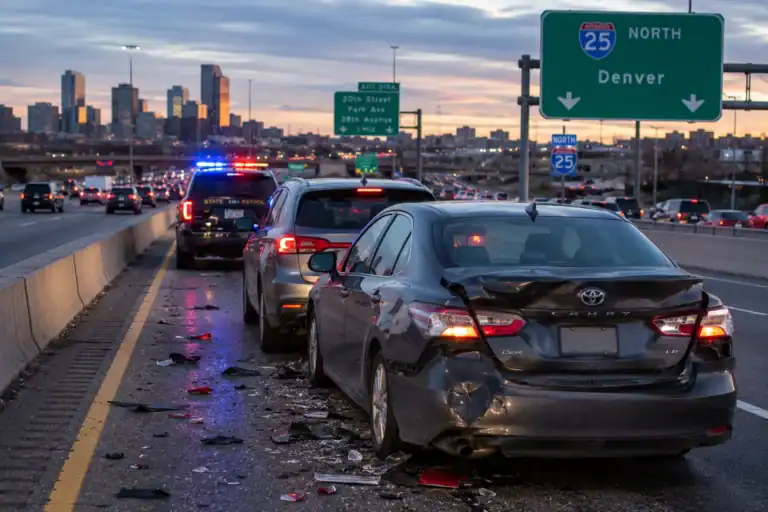
As the primary north-south artery through Colorado’s most populated cities, I-25 is the undisputed epicenter of commercial truck accidents. The counties it runs through—El Paso, Denver, Adams, and Arapahoe—consistently rank as the top four in the state for truck-related crashes.
- Why it’s dangerous: The constant mix of high-speed commercial traffic with stop-and-go commuter traffic creates a recipe for disaster. Sudden braking, frequent lane changes, and congested interchanges lead to a high volume of front-to-rear and sideswipe collisions—the two most common types of truck accidents.
- Hotspots: The sections of I-25 through the Denver Tech Center, the “mousetrap” interchange with I-70, and the stretch between Colorado Springs and Monument (“The Gap”) are perennial high-accident zones.
2. Interstate 70: The Mountain Gauntlet
The I-70 mountain corridor, stretching from Denver to Glenwood Springs, is one of the most challenging stretches of interstate in the entire country for commercial truck drivers. It combines heavy traffic with extreme weather and punishing geography.
- Why it’s dangerous: Steep grades, sharp curves, and severe, rapidly changing weather are the primary factors. Brake failure on long descents, such as the run into Idaho Springs or down from Vail Pass, is a common cause of catastrophic runaway truck accidents. Winter snow and ice exacerbate these dangers exponentially.
- Hotspots: The Eisenhower Tunnel approaches, Vail Pass, and the descent from Floyd Hill are all areas that demand extreme caution from truckers and passenger vehicles alike.
3. U.S. Highway 550: The “Million Dollar Highway”
While it sees less traffic than the interstates, this iconic highway between Silverton and Ouray is arguably the most treacherous. Its combination of hairpin turns, steep drop-offs, and a complete lack of guardrails in many sections makes it exceptionally dangerous for large trucks.
- Why it’s dangerous: The road’s design is unforgiving. There is zero room for error. A slight miscalculation by a truck driver can be fatal. The risk of avalanches in winter often closes the road entirely.
Common Causes of These Catastrophic Accidents
According to CDOT data, driver error is the leading cause of truck accidents. The most common contributing factors include:
- Driving Too Fast for Conditions: This is the #1 cause of winter accidents and a major factor on steep mountain descents.
- Driver Fatigue: Truck drivers are often pushed to drive long hours. The FMCSA reports that “fell asleep or fatigued” was a factor in nearly 100 serious truck accidents in Colorado in 2024.
- Distracted Driving: Whether from a cell phone, a GPS, or an internal distraction, inattention for even a few seconds can be deadly in a large truck.
- Improper Backing: This is a surprisingly common cause of accidents, especially in urban areas and at loading docks.
When you are injured in a truck accident, you are not just up against a driver; you are up against a major trucking company and their insurance carriers. These cases are far more complex than a standard car accident. [Link “truck accident” to your /truck-accidents/ page]
Frequently Asked Questions
Who is responsible in a truck accident? The driver or the trucking company?
Liability can be shared. The driver is responsible for their direct actions, but the trucking company (motor carrier) can also be held liable for things like negligent hiring (hiring a driver with a poor record), improper maintenance of the truck, or encouraging drivers to violate hours-of-service safety rules.
What is “black box” data and why is it important?
Most modern commercial trucks are equipped with an Event Data Recorder (EDR), or “black box.” This device records critical data like the truck’s speed, brake application, and engine RPM in the seconds leading up to a crash. Securing this data immediately after an accident is one of the most important steps an attorney can take, as it provides objective, powerful evidence.
Are there different insurance requirements for commercial trucks?
Yes. Commercial trucks are required by federal law to carry much higher insurance policy limits than passenger vehicles, often ranging from $750,000 to over $1 million, depending on the type of cargo they are hauling.
What are the “hours-of-service” rules?
The Federal Motor Carrier Safety Administration (FMCSA) has strict rules limiting how many hours a truck driver can be on duty and behind the wheel without taking a mandatory rest break. Driver fatigue is a known killer, and proving a driver violated these rules can be powerful evidence of negligence in a personal injury claim.
I was hit by a truck on I-70 in a snowstorm. Isn’t that just a weather-related “accident”?
No. Commercial truck drivers are held to a higher standard and are expected to have the training and skill to operate their vehicles safely in adverse conditions. If conditions are too dangerous, they have a responsibility to pull over. Driving too fast for snowy or icy conditions is a form of negligence, not simply a weather-related event.
If you or a loved one has been the victim of a serious truck accident on one of Colorado’s dangerous highways, you need a legal team with the resources and experience to take on a powerful trucking company. Contact Flanagan Law for a free and confidential consultation. We act quickly to preserve critical evidence like black box data and driver logs to build the strongest case possible for your recovery.