Drunk Driving vs. Distracted Driving: Understanding the Legal Differences in Colorado
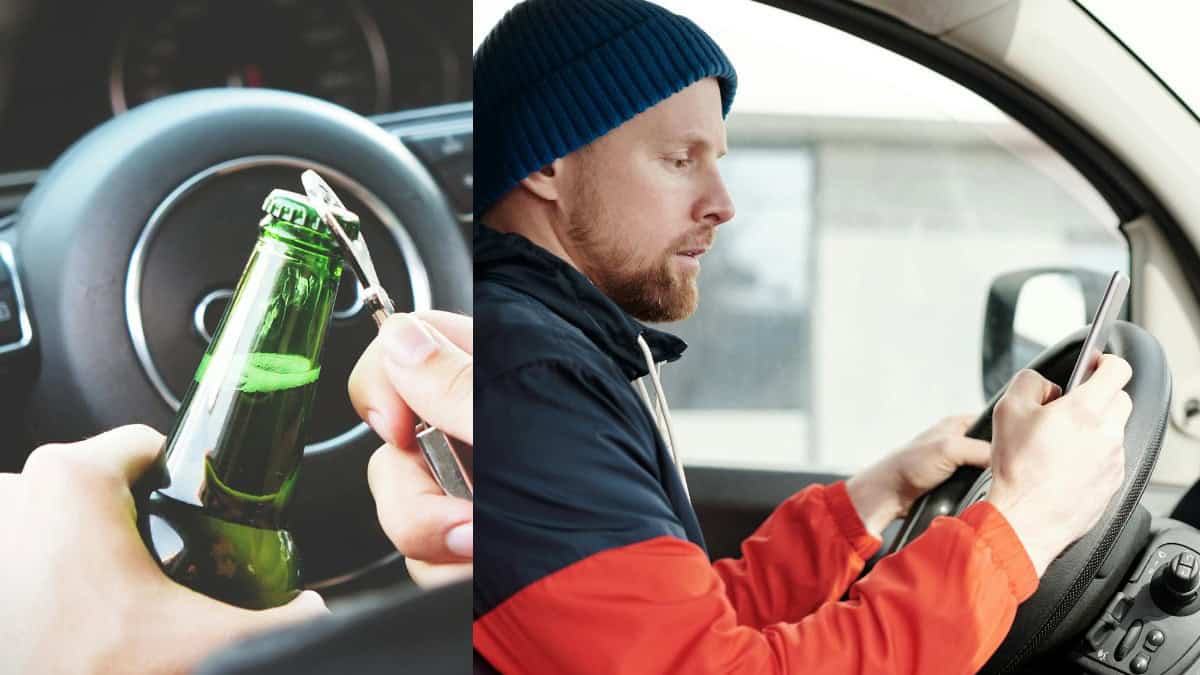
While both can shatter lives in an instant, drunk driving and distracted driving are viewed very differently under Colorado law. One is a deliberate act of impairment with severe, immediate criminal penalties. The other is an act of negligence, with penalties that can vary dramatically depending on the circumstances. As a victim, understanding these differences is critical to knowing your rights.
At Flanagan Law, we have seen the devastation caused by both types of driver negligence. This guide will unravel the key legal distinctions between a drunk driving accident and a distracted driving accident, clarifying how each is prosecuted criminally and how victims can pursue justice through a civil claim.
Drunk Driving: A Crime of Impairment
In Colorado, driving under the influence is not just a traffic violation; it is a serious crime with a clearly defined chemical threshold. The law is designed to punish the act of driving while impaired, regardless of whether an accident occurs.
- The Legal Standard: Colorado law has two main charges:
- Driving Under the Influence (DUI): Your Blood Alcohol Content (BAC) is 0.08% or higher. For a DUI charge, the prosecution does not need to prove you were driving poorly, only that your BAC was over the legal limit.
- Driving While Ability Impaired (DWAI): Your BAC is between 0.05% and 0.079%. For a DWAI, the prosecution must show that your ability to operate a vehicle was impaired to “the slightest degree” by alcohol, drugs, or a combination of both.
- Criminal Penalties: The consequences are severe and escalate with each offense. A first-time DUI can result in up to one year in jail, fines up to $1,000, and a 9-month license revocation. Penalties increase significantly for repeat offenses, and a fourth offense is a Class 4 Felony.
- Impact on a Civil Claim: When a drunk driver causes an accident, their intoxication is considered “negligence per se.” This means their act of breaking the DUI law is, in itself, proof of negligence. This can make it easier to establish liability in a personal injury lawsuit. Furthermore, because their conduct is so reckless, a jury may award punitive damages in addition to compensation for medical bills and pain and suffering. Punitive damages are designed to punish the offender and deter similar behavior in the future.
Distracted Driving: A Crime of Inattention
Unlike the clear-cut BAC limits for drunk driving, distracted driving is defined by an action rather than a chemical state. Proving it can be more complex.
- The Legal Standard: Colorado’s primary distracted driving law (CRS 42-4-239) specifically targets texting and other forms of “manual data entry.” An officer must witness the driver using the phone and observe them driving in a “careless or imprudent manner” to issue a citation. As of 2025, a new hands-free law is in effect, prohibiting drivers from holding a mobile device at all while driving, making it easier for law enforcement to cite this dangerous behavior.
- Criminal Penalties: The penalties are far less severe than for a DUI. A first-time texting while driving ticket is a Class 2 traffic misdemeanor, carrying a $300 fine and four points on your license. Only if the act causes serious bodily injury or death do the penalties escalate to a Class 1 traffic misdemeanor with potential jail time.
- Impact on a Civil Claim: In a personal injury case, a citation for distracted driving is powerful evidence of negligence. Your attorney can subpoena the at-fault driver’s cell phone records to show call logs, text message timestamps, and data usage around the time of the crash. This evidence can definitively prove the driver was not paying attention to the road and is therefore liable for your injuries. While punitive damages are less common than in drunk driving cases, they may still be pursued if the driver’s actions were exceptionally reckless.
The Bottom Line: Two Paths to Proving Negligence
The key difference for an accident victim lies in how negligence is established. For a drunk driving accident, the driver’s BAC and criminal charge create a direct path to proving fault. For a distracted driving accident, fault is proven by piecing together evidence like witness statements, camera footage, and cell phone records to demonstrate a clear breach of the duty to drive safely. [Link the appropriate phrases to your /drunk-driving-accidents/ and /distracted-driving-accidents/ pages]
Regardless of the cause, the outcome is the same: an innocent person is left injured and facing a difficult recovery.
Frequently Asked Questions
Is it harder to win a personal injury case against a distracted driver than a drunk driver?
It can be more challenging because the evidence is not as straightforward as a BAC test result. However, a skilled attorney can build a very strong case using cell phone records, witness testimony, and accident reconstruction. The key is to act quickly to preserve that evidence before it can be lost or deleted.
Can a driver be charged with both DUI and distracted driving?
Yes. If a driver is found to be over the legal BAC limit and was also texting at the time of the crash, they could potentially be cited for both offenses. This would create an extremely strong foundation for a civil lawsuit seeking maximum compensation, including punitive damages.
What if the driver who hit me was on a hands-free call?
While hands-free calls are legal for adult drivers in Colorado, they can still be a significant cognitive distraction. In a civil case, you can still argue that the driver was not paying adequate attention to the road, even if their phone use was technically legal. This is known as cognitive distraction, and it can be just as dangerous as manual or visual distraction.
Does a distracted driving ticket automatically mean the driver is 100% at fault for the accident?
While it is very powerful evidence, it doesn’t automatically assign 100% fault. The other driver’s insurance company may still try to argue that you were partially at fault using the principle of “comparative fault.” However, the distracted driving citation makes it much more difficult for them to successfully shift the blame.
What should I do at the scene if I suspect the other driver was on their phone?
Your safety is the first priority. Call 911. When the police arrive, tell them exactly what you observed. For example: “I saw the driver looking down at a phone in their lap right before they hit me.” This observation will be noted in the official police report and is a critical piece of evidence. Also, try to get contact information from any witnesses who may have seen the same thing.